
MUMBAI, India | August 24, 2026 —
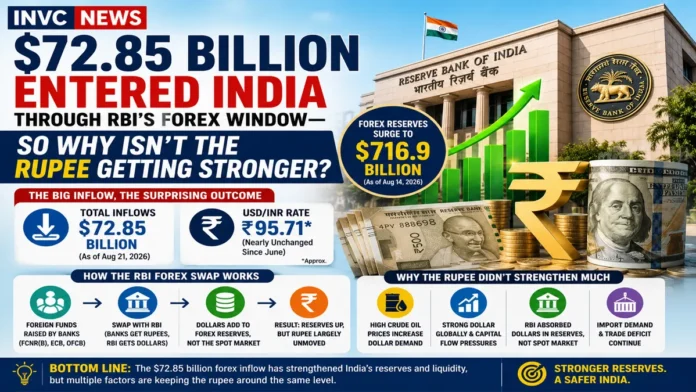
The Reserve Bank of India’s special forex swap facility has attracted a staggering $72.85 billion in foreign-currency inflows, strengthening the central bank’s reserve buffer and giving Indian banks access to substantial rupee liquidity.
Yet something surprising has happened.
The Indian rupee has barely strengthened.
When the special facility was introduced in June, the rupee was trading around ₹95.7 against the U.S. dollar. More than two months later—and after tens of billions of dollars were mobilized through the RBI window—the currency remained near the same level.
So where did all those dollars go?
The answer lies in the mechanics of the RBI’s swap program.
Most of the foreign currency raised under the scheme has effectively moved onto the Reserve Bank’s balance sheet and strengthened foreign-exchange reserves rather than flooding directly into India’s spot currency market.
That distinction helps explain why $72.85 billion can enter the financial system without automatically producing a dramatic appreciation of the rupee.
RBI Forex Swap Facility Attracts $72.85 Billion
The scale of the response has been extraordinary.
According to the latest figures reported by authorized dealer banks, foreign-currency inflows mobilized under the special USD-INR swap facility reached approximately $72.85 billion as of August 21.
The money came through three major channels:
FCNR(B) deposits: $65.397 billion
Overseas Foreign Currency Borrowings: $4.860 billion
External Commercial Borrowings: $2.591 billion
FCNR(B) deposits therefore accounted for almost 90% of the total inflows.
That is particularly important for non-resident Indians because FCNR(B) deposits allow eligible overseas Indians to maintain term deposits in foreign currencies rather than converting their savings permanently into rupees.
What Exactly Did RBI Do?
The mechanism sounds complicated, but the basic idea is straightforward.
Indian banks raise foreign currency—primarily dollars—from eligible overseas sources.
They then swap those dollars with the Reserve Bank of India.
In exchange, RBI provides rupees to the banks.
The bank therefore gains rupee liquidity that can be used within India’s financial system, while RBI receives the foreign currency.
In simplified form:
Overseas dollars → Indian banks → RBI
and
RBI → rupee liquidity → Indian banks
The crucial point is what happens next.
The dollars do not necessarily enter the open spot market where companies, investors, importers and exporters normally buy and sell currencies.
Instead, much of that foreign currency is absorbed by RBI.
So Why Didn’t $72.85 Billion Make the Rupee Surge?
This is the heart of the story.
Currency prices are heavily influenced by supply and demand in the foreign-exchange market.
If tens of billions of additional dollars suddenly entered the spot market and were sold for rupees, the supply of dollars could rise sharply.
All else being equal, that could push the rupee higher against the dollar.
But that is not what happened.
Under the swap structure, the RBI effectively became the recipient of much of the foreign currency.
As a result, the dollars strengthened the central bank’s foreign-exchange position without creating an equivalent surge in dollar supply in the spot market.
That is why the headline inflow figure and the movement in the rupee appear disconnected.
Rupee Was Around ₹95.71 Before—and Around ₹95.71 After
The comparison is striking.
When the facility began in June, the rupee was around ₹95.71 per U.S. dollar.
On August 21, it closed at approximately the same level.
In other words, roughly $72.85 billion of mobilization did not translate into a corresponding currency rally.
This does not mean the RBI program failed.
It means the program’s impact must be measured differently.
Instead of judging it solely by whether the rupee appreciated, the facility can also be assessed by how much it strengthened reserves, foreign-currency liquidity and India’s ability to manage external shocks.
India’s Forex Reserves Have Surged
The clearest impact can be seen in India’s foreign-exchange reserves.
India’s forex reserves rose by almost $9.9 billion in the week ended August 14, reaching approximately $716.9 billion.
Over roughly seven weeks, the reserve stock increased by close to $50 billion.
Foreign-currency assets alone recorded a substantial rise during that period.
This is where the RBI swap story becomes strategically important.
A larger reserve buffer gives the central bank greater capacity to manage periods of currency volatility, capital outflows or sudden increases in demand for dollars.
What Are Forex Reserves and Why Do They Matter?
Foreign-exchange reserves are financial assets held by a country’s central bank.
India’s reserves include:
- Foreign currency assets
- Gold
- Special Drawing Rights
- India’s reserve position with the International Monetary Fund
Large reserves provide an economy with protection against external shocks.
They can help a country pay for imports, meet external financial obligations and reassure global investors.
They also give the RBI greater capacity to intervene when currency markets become disorderly.
That matters because India remains heavily dependent on imported energy.
INVC recently explained how expensive crude oil and global risks could put further pressure on the Indian rupee.
A stronger reserve position provides RBI with a larger buffer if those pressures intensify.
Why Oil Prices Still Matter More to the Rupee
India imports most of the crude oil it consumes.
Those purchases are largely settled in dollars.
When international crude becomes expensive, Indian refiners require more dollars to pay overseas suppliers.
That increases demand for the U.S. currency.
If dollar demand rises faster than supply, the rupee can weaken.
This is why even very large financial inflows may not guarantee rupee appreciation when oil prices, geopolitical tensions and importer demand are simultaneously pushing in the opposite direction.
INVC’s analysis of higher Brent crude and the potential impact on petrol and diesel prices in India also explains why crude prices and the rupee are closely connected.
For India, oil and currency risk frequently reinforce each other.
Higher oil → more dollar demand → pressure on rupee → even more expensive oil imports in rupee terms.
Foreign Investors Also Influence the Rupee
Oil is only one factor.
Foreign portfolio investment can move the currency in either direction.
When overseas investors put large amounts of money into Indian stocks and bonds, they generally need rupees.
That can support the currency.
When they withdraw money, the process can reverse.
Global interest rates, U.S. Treasury yields, geopolitical risk and investor appetite for emerging markets can therefore affect the rupee even when India’s domestic economy remains relatively strong.
India’s broader ability to attract long-term foreign capital is consequently important.
Recent changes to the investment framework have already generated new proposals. INVC reported that India received $511.5 million in FDI proposals after easing selected investment rules.
Long-term FDI and short-term portfolio flows, however, affect the economy differently.
RBI Is Not Necessarily Trying to Make the Rupee Much Stronger
Another misconception is that every RBI currency measure is designed to push the rupee upward.
That is not how India’s exchange-rate framework works.
The rupee is largely market determined.
The Reserve Bank generally intervenes to contain excessive volatility and disorderly market conditions, rather than publicly defending one fixed exchange rate.
A rapidly strengthening currency can create its own problems.
Indian exporters receive foreign currency for goods and services sold overseas.
If the rupee appreciates sharply, those foreign earnings translate into fewer rupees.
That can hurt the competitiveness of some exporters.
Therefore, policymakers generally care about stability and orderly adjustment—not simply making the rupee as strong as possible.
Why This Time Is Different From RBI’s 2013 Experiment
The comparison with 2013 is fascinating.
India faced a major currency crisis that year as the rupee came under intense pressure following global concerns about U.S. monetary tightening.
The RBI introduced special swap windows for FCNR(B) deposits and overseas bank borrowings.
Those measures mobilized roughly $34 billion.
The rupee subsequently strengthened significantly.
The current episode is different.
Despite mobilizing more than twice that amount, the currency has not recorded anything comparable.
Why?
One important reason is that the market transmission mechanism is different.
If incoming dollars are largely absorbed by the central bank rather than circulating through the spot market, the immediate exchange-rate impact can be much smaller.
Is the $72.85 Billion Really India’s Money?
This requires another important distinction.
Not all foreign-exchange inflows should be treated like permanent income.
FCNR(B) deposits are liabilities of banks to overseas depositors.
External commercial borrowings must eventually be repaid.
Similarly, overseas borrowings come with repayment obligations.
Therefore, the $72.85 billion should not be interpreted as free money permanently transferred to India.
It represents foreign-currency resources mobilized through specific financial channels.
That distinction is essential when evaluating the program.
Why Are NRIs Putting So Much Money Into FCNR(B) Deposits?
The special facility created strong incentives for banks to mobilize foreign-currency deposits.
FCNR(B) accounts can be attractive to NRIs because deposits are maintained in designated foreign currencies.
That protects the depositor from having to take direct rupee exchange-rate risk on the principal.
Banks have also been offering competitive interest rates on these deposits.
The RBI’s concessional swap arrangement made it cheaper and more attractive for banks to convert those foreign-currency resources into rupee liquidity.
The result has been a remarkable surge in mobilization.
FCNR(B) Window Is Closing Early
The response became so strong that the RBI moved to close the FCNR(B)-linked special window earlier than originally planned.
The facility had initially been expected to remain available until the end of September.
The FCNR(B) component is now scheduled to close on August 31, 2026.
Facilities linked to eligible ECB and overseas foreign-currency borrowing flows are expected to continue until December 31.
The early closure itself sends an important signal.
The central bank appears to believe that sufficient foreign-currency resources have already been mobilized through this particular channel.
RBI Governor Sees Around $80 Billion in Total Inflows
RBI Governor Sanjay Malhotra has indicated that the measures could ultimately attract around $80 billion.
With $72.85 billion already reported by August 21, the program is approaching that level.
This makes the experiment significant even by the standards of India’s enormous financial system.
But again, the key outcome is not necessarily a stronger spot rupee.
It is the combination of:
Higher foreign-exchange reserves
Improved external liquidity
Additional rupee liquidity for banks
Greater protection against external shocks
More room for RBI to manage volatility
Does a Bigger Forex Reserve Mean RBI Can Stop the Rupee From Falling?
Not indefinitely.
Large reserves provide significant firepower, but they cannot permanently defeat economic fundamentals.
If crude oil remains extremely expensive, the dollar strengthens globally, foreign investors withdraw capital and India’s trade deficit expands, the rupee can still weaken.
RBI can use reserves to smooth excessive movements and prevent disorderly conditions.
But continuously defending an unsustainable exchange rate would eventually consume reserves.
This is why reserve adequacy is best viewed as insurance rather than a guarantee of a particular currency level.
India’s Previous RBI Gold Story Adds Another Layer
Reserve composition has also attracted attention this year.
INVC previously examined a report claiming that RBI may have sold about $12 billion worth of gold while strengthening its foreign-currency position.
That analysis was not officially confirmed by the RBI, but it highlighted an important principle: central banks manage the composition of reserves as well as their total size.
Liquid foreign-currency assets can be particularly useful when a central bank needs to respond quickly to currency-market stress.
What Does This Mean for Ordinary Indians?
Forex swaps may sound remote from household finances.
They are not.
A weak rupee can make imported goods more expensive.
That includes:
Crude oil and fuels
Electronics
Imported machinery
Foreign education
International travel
Some medicines and chemicals
Overseas subscriptions and services
A stronger rupee can reduce some of those costs, while a weaker currency can increase them.
However, currency movements can also benefit exporters, IT companies receiving dollar revenue and households receiving overseas remittances.
The economic impact therefore varies depending on who is paying or receiving foreign currency.
What Does It Mean for NRIs?
For NRIs, the story is particularly relevant because FCNR(B) deposits account for the overwhelming majority of the special-window inflows.
These accounts allow eligible overseas Indians to keep deposits in foreign currencies.
However, deposit rates, maturity conditions, taxation eligibility and premature-withdrawal rules can differ.
Anyone considering an FCNR(B) deposit should therefore compare individual bank terms rather than making a decision solely because the RBI’s special swap program has attracted large inflows.
The central-bank facility primarily changes the economics for participating banks.
It does not automatically make every FCNR(B) product the best investment for every NRI.
What Happens When These Swaps Mature?
This is one of the most important long-term questions.
A swap has two legs.
The initial transaction gives RBI dollars and banks rupees.
At maturity, the transaction is reversed according to the agreed terms.
That means the central bank must manage future foreign-currency obligations associated with the swaps.
The current reserve boost should therefore be understood alongside the corresponding forward commitments.
This is another reason why analysts should not simply add $72.85 billion to India’s reserves and treat the entire amount as permanently available new wealth.
Could RBI Release These Dollars Into the Market Later?
Yes.
This is where the reserve buildup becomes strategically valuable.
If the rupee later faces severe pressure, RBI can intervene in the foreign-exchange market by selling dollars.
That increases dollar supply and can help reduce disorderly depreciation.
In other words, the swap program may not have caused a major rupee rally today, but it could increase RBI’s ability to respond to currency stress tomorrow.
That may be one of the most important benefits of the entire exercise.
The $72.85 Billion Paradox Explained
The apparent mystery becomes much easier to understand once the flow of money is separated into two markets.
What happened: India mobilized $72.85 billion through RBI-supported foreign-currency channels.
Where much of it went: Into the Reserve Bank’s foreign-currency assets and reserve framework.
What did not happen: The entire $72.85 billion was not dumped into the spot dollar-rupee market.
Result: Forex reserves strengthened dramatically, but the rupee did not appreciate proportionately.
That does not make the program ineffective.
It means its primary impact has so far been visible in India’s financial defenses rather than the headline exchange rate.
For investors, businesses and households, the next question is therefore not simply whether the rupee strengthens tomorrow.
It is whether India’s larger forex buffer proves valuable if crude oil, geopolitical risk or global capital flows put the currency under renewed pressure.
That is where the real test of RBI’s $72.85 billion forex experiment may still lie ahead.











Comments are closed.