New Delhi, August 18, 2026
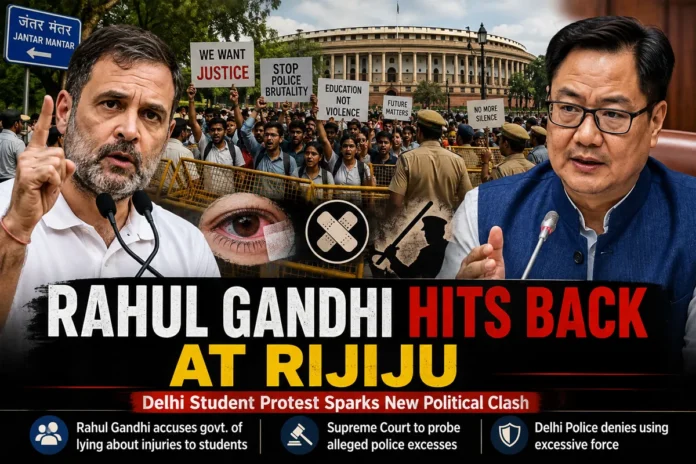
Rahul Gandhi on Tuesday launched a sharp attack on Union Parliamentary Affairs Minister Kiren Rijiju after the minister praised Delhi Police for its handling of last month’s student protest near Parliament and said no demonstrator had suffered a broken bone or remained hospitalized with a serious injury.
The Leader of the Opposition in the Lok Sabha accused the government of denying what he described as serious injuries suffered by young protesters during the July 20 demonstration that began at Jantar Mantar and later moved toward Parliament.
Gandhi said the government should not “lie to the country’s children,” arguing that students had seen what happened and would remember it.
The political confrontation comes as allegations surrounding the police response to the demonstration remain under judicial scrutiny. Delhi Police has denied using excessive force and has maintained that officers exercised restraint while responding to what it described as an unlawful march toward Parliament.
What Did Rahul Gandhi Say?
In a social media post, Gandhi referred to Rijiju’s argument that Delhi Police deserved praise for its handling of the demonstration.
He challenged that assessment, alleging that peaceful students had been subjected to excessive force close to Parliament.
Gandhi claimed that pellet guns and batons fitted with nails were used against demonstrators and alleged that one student suffered a serious eye injury while another young protester sustained an injury to her ear.
Those allegations remain disputed by Delhi Police, which has denied using pellet guns during the protest and has rejected claims that it used disproportionate force.
Gandhi said he had personally met injured students and argued that widely circulated videos of the July protest contradicted the government’s version of events.
‘Don’t Lie to the Country’s Children’
Gandhi ended his criticism with a direct message to the government.
He said young people should not be misled because they had “eyes” and “memory,” framing the dispute as an issue of accountability rather than simply a political disagreement.
His comments were a response to Rijiju’s remarks defending Delhi Police and arguing that the protest had been handled without deaths or serious long-term injuries.
What Did Kiren Rijiju Say?
Rijiju defended the security response during an interview aired Tuesday.
He said no protester had died, no one had suffered a broken bone and no demonstrator remained hospitalized with a serious injury.
The minister argued that the scale of the mobilization should be taken into account when assessing the police response and said Delhi Police should be praised for preventing fatalities and more serious violence.
His comments came amid continuing criticism from opposition leaders and student groups over the July 20 confrontation.
Delhi Police Says It Used ‘Minimum Required Force’
Delhi Police has presented a substantially different version of the incident from Gandhi and other opposition leaders.
In submissions before the Supreme Court, police said the march from Jantar Mantar toward Parliament had become unlawful and that officers used only the minimum force required to restore order.
Police also argued that the demonstration had been infiltrated by individuals it described as anti-social elements and people with criminal histories.
According to the police account, more than 240 police and security personnel were injured during the confrontation.
Earlier reporting on the clashes indicated that about 180 people, including both protesters and security personnel, were injured on July 20.
Pellet Gun Allegations Remain at Center of Dispute
One of the most contentious issues is whether pellet guns were used.
Gandhi has repeatedly alleged that pellets were fired at students and has highlighted the case of a young protester who suffered a severe eye injury.
Delhi Police has disputed that account.
The controversy has intensified because medical injuries associated with pellets have been reported, while questions remain over precisely how those injuries occurred and which personnel or equipment were responsible.
The Supreme Court previously directed authorities to ensure medical treatment for protesters who were reported to have suffered pellet-related injuries.
Supreme Court Moves Toward Independent Scrutiny
The dispute is now moving beyond political accusations.
On Tuesday, the Supreme Court said it would constitute a high-powered committee to examine allegations of police excesses during the Jantar Mantar student protest.
The development is significant because it could provide an independent examination of competing claims by protesters and police.
Among the questions likely to attract scrutiny are allegations surrounding the use of pellet weapons, baton injuries, plainclothes personnel and whether the level of force was proportionate to the security situation.
Delhi Police has said it is open to scrutiny of its conduct.
Rahul Gandhi Also Targets Amit Shah
Gandhi also criticized Union Home Minister Amit Shah over the controversy.
He alleged that Shah had avoided opposition questions during the parliamentary session and accused the government of failing to take responsibility for the treatment of protesters.
Gandhi further said Prime Minister Narendra Modi had not apologized to the students.
These were political allegations made by the Congress leader and should not be treated as established findings about responsibility for the police action.
The Delhi Police operates under the Union Home Ministry, making Shah a central target of opposition criticism over law-and-order issues in the national capital.
Gandhi Has Raised the Issue Before
This is not the first time Gandhi has challenged the government over the July 20 protest.
Days after the clashes, he wrote to Shah seeking accountability over what he described as a violent crackdown on students and questioned who had authorized the alleged use of pellet guns.
He has also met protesters who said they were injured during the demonstration and has repeatedly sought a wider debate on student grievances and the police response.
What Triggered the Jantar Mantar Student Protest?
The July protest grew out of youth anger over alleged irregularities in competitive examinations, paper leaks and broader concerns about the education and recruitment system.
Thousands of young demonstrators gathered in central Delhi before attempting to march toward Parliament.
The protest later descended into clashes between demonstrators and police, with injuries reported on both sides.
Authorities imposed security restrictions around central Delhi as the situation escalated.
Police Injuries Are Also Part of the Case
While opposition leaders have focused on injuries to students, Delhi Police has stressed that a large number of its personnel were also hurt.
Police told the Supreme Court that more than 240 personnel sustained injuries during the confrontation and argued that officers were dealing with a rapidly deteriorating law-and-order situation.
That claim forms a key part of the government’s defense of the police response.
Any final assessment of the incident will therefore need to examine both the injuries suffered by demonstrators and those reported by security personnel.
Political Battle Intensifies
The exchange between Gandhi and Rijiju has turned the controversy into a wider political battle over policing, student rights and government accountability.
Congress is portraying the incident as evidence of excessive force against young protesters.
The government, meanwhile, argues that police managed a potentially dangerous situation while preventing deaths and more serious violence.
With the Supreme Court now considering independent scrutiny of the events, the debate is increasingly likely to shift from political claims toward evidence, medical records, video footage and operational details.
Bottom Line
Rahul Gandhi has challenged Kiren Rijiju’s praise of Delhi Police, accusing the government of minimizing injuries suffered during the July 20 Jantar Mantar student protest.
Rijiju maintains that no protester died, suffered a broken bone or remained hospitalized with a serious injury, while Delhi Police says officers used only the force necessary to control an unlawful march.
Gandhi disputes that account and has cited alleged pellet injuries and other wounds as evidence of excessive force.
The competing claims have not been fully resolved.
With the Supreme Court moving toward a high-powered inquiry into allegations of police excesses, the focus will now be on establishing precisely what happened during one of Delhi’s most contentious student demonstrations of the year.