NEW DELHI, India | September 6, 2026 —
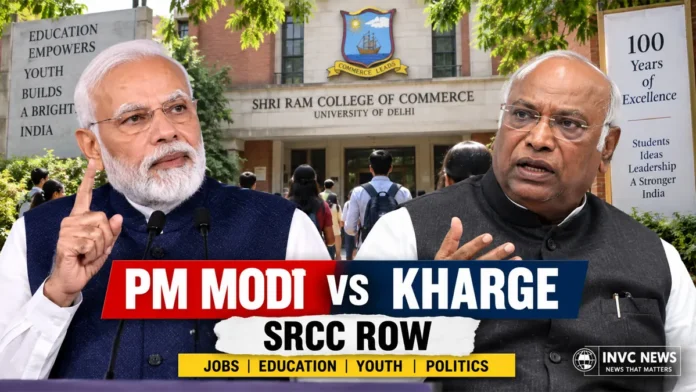
PM Modi SRCC Speech has triggered a fresh political confrontation after Congress president Mallikarjun Kharge accused Prime Minister Narendra Modi of turning an interaction with students into a political campaign while failing to adequately address concerns over jobs, education, recruitment delays and the future of young Indians.
Kharge mounted the attack on Sunday, a day after PM Modi addressed the centenary celebrations of Shri Ram College of Commerce at Delhi University.
The Congress president said the event offered an opportunity to engage young people on education, employment and their future. Instead, he argued, the Prime Minister focused heavily on political criticism and labels aimed at opponents.
The exchange has now pushed employment, education costs, recruitment delays and examination paper leaks back to the center of the political debate.
Kharge Questions PM Modi’s Youth Outreach
Kharge challenged the government’s outreach to young voters and argued that students also have a “report card” on the administration’s performance.
He highlighted unemployment, government vacancies that remain unfilled for long periods, recruitment delays, examination paper leaks, rising education costs, reduced scholarship opportunities and concerns over university autonomy.
The Congress chief also accused the government of using political labels against critics rather than answering difficult questions.
His intervention gave Congress a new opening to frame the political debate around issues that directly affect students, first-time job seekers and young voters.
The party has increasingly tried to link recruitment examinations, unemployment and education costs with its wider attack on the BJP-led government.
PM Modi Used SRCC Platform to Defend Government’s Record
PM Modi addressed SRCC students on Saturday as the institution marked its centenary.
During his speech, the Prime Minister presented India’s economic and development record and argued that the country had continued to grow despite global wars, trade disruptions and geopolitical uncertainty.
He referred to India’s economic growth and highlighted major government initiatives including UPI, semiconductor manufacturing, high-speed rail, the Statue of Unity and the new Parliament building.
PM Modi also targeted habitual critics of development projects, describing a section of opponents as people who question the need for virtually every major initiative.
The Prime Minister argued that India had repeatedly answered such criticism through implementation and results.
He also contrasted the country’s present position with conditions in 2013, when he had previously visited SRCC as Gujarat chief minister.
Congress Turns ‘Angry Uncle’ Remark Into Political Flashpoint
Congress seized on PM Modi’s remarks about critics becoming “angry uncles” whenever the government launches a project.
Kharge argued that political labels cannot substitute for answers on employment, education and governance.
Congress media and publicity department chairman Pawan Khera also joined the attack and questioned why the Prime Minister used a prestigious educational institution to criticize political opponents.
The opposition party is now trying to turn the phrase into a wider debate over the government’s engagement with students and young voters.
For Congress, the political calculation is clear: employment and education offer issues that cut across regions and social groups and can resonate strongly with younger voters.
Jobs and Recruitment Become Core Political Battle
Employment has remained one of the most politically sensitive issues in India.
Competitive examination candidates across several states have repeatedly raised concerns over delayed recruitment cycles, alleged paper leaks, canceled examinations and long waits for appointments.
Therefore, Kharge’s response goes beyond PM Modi’s choice of words at SRCC.
Congress is attempting to connect the speech with a broader argument that young Indians want measurable outcomes on jobs, examinations, scholarships and affordable education.
The BJP, on the other hand, has consistently highlighted economic growth, infrastructure investment, digitalization, manufacturing and entrepreneurship as evidence of expanding opportunities.
That contrast could increasingly shape the political conversation around India’s youth.
PM Modi Highlights India’s Growth and Development Push
During the SRCC address, PM Modi pointed to India’s economic performance and said the country had demonstrated resilience despite major external disruptions.
He also referred to the expansion of digital payments through UPI and India’s push into semiconductor manufacturing and other strategic sectors.
The Prime Minister argued that critics had questioned several major projects when the government first proposed them but that India ultimately demonstrated their value.
His remarks sought to present the government as ambitious and development-focused while portraying its opponents as resistant to change.
Congress, however, responded by asking whether headline economic indicators were translating into enough opportunities for students and young job seekers.
SRCC Speech Opens Wider BJP-Congress Contest
The political significance of the confrontation extends beyond a single college event.
Both the BJP and Congress increasingly view young voters as central to future electoral contests.
PM Modi is emphasizing India’s growth story, technology, infrastructure, entrepreneurship and national ambition.
Congress is countering with questions about unemployment, recruitment, examination integrity, education costs and institutional autonomy.
As a result, the SRCC controversy has quickly developed into a broader political argument over which side can better address the expectations of India’s young population.
The confrontation also shows how speeches delivered on university campuses can quickly move from education-focused events into national political debates.
For now, Kharge’s intervention ensures that PM Modi’s SRCC address will remain in the political spotlight—not only because of the Prime Minister’s criticism of opponents, but also because of the questions Congress has attached to jobs, education and the future of India’s youth.