By Team INVC | INVC NEWS
NEW DELHI, India | September 17, 2026 —
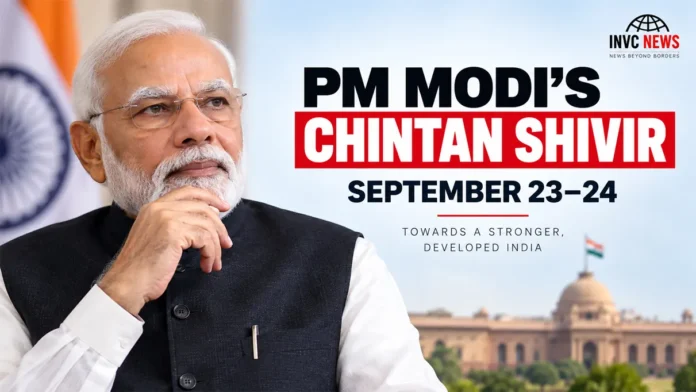
Prime Minister Narendra Modi is set to hold a two-day Chintan Shivir with Union Cabinet ministers on September 23 and 24 in New Delhi, bringing the government’s senior political leadership together for an extensive review of governance, ongoing work and priorities for the coming period.
The meeting is scheduled to take place at Seva Teerth, with Cabinet ministers expected to participate. Reports indicate that the exercise will focus on governance, ministry performance and better coordination across departments.
The timing makes the meeting particularly significant as the Modi government moves deeper into its third term and prepares its policy and implementation agenda for the period ahead.
However, there is currently no official announcement linking the Chintan Shivir to a Cabinet reshuffle or any specific personnel changes. The available information points primarily to a governance and strategy review.
What Will Happen at the September 23–24 Chintan Shivir?
The two-day meeting is expected to go well beyond a routine Cabinet discussion.
Current reporting indicates that ministers will review work already underway in their ministries and discuss priorities for the coming period.
Improving coordination between ministries is expected to form another major part of the discussions.
This is important because several large government programs involve multiple ministries and departments. Delays in one department can affect implementation elsewhere.
The Chintan Shivir gives ministers an opportunity to examine those overlaps and discuss how government decisions can move more efficiently from policy to implementation.
Ministerial Groups Asked to Brainstorm
Preparations have already begun.
Prime Minister Narendra Modi has reportedly directed the creation of more than half a dozen groups of ministers, with around eight members in each group, to brainstorm on different themes ahead of the meeting.
The subjects under consideration include governance practices, communication and self-improvement, according to reporting on the preparations. Different groups are expected to contribute ideas and presentations during the exercise.
That structure suggests the meeting will involve active presentations and discussion rather than simply a series of ministry status reports.
Government Reviewing What Ministries Have Delivered
Another important part of the preparation involves looking back at earlier directions.
Ministries have reportedly been asked to provide details of action taken on recommendations that emerged from the previous Chintan Shivir held in 2021.
That earlier exercise included directions on issues such as monitoring ministry activities, reviewing progress and improving feedback within departments.
This gives the September meeting a measurable review element: ministers can compare previous recommendations with actual implementation.
PM Modi Recently Met Ministers of State
The upcoming meeting follows a separate interaction between Prime Minister Narendra Modi and Ministers of State.
During that meeting, the Prime Minister sought feedback on the functioning of ministries and reviewed progress across departments, according to reports.
The September 23–24 Chintan Shivir will bring Cabinet ministers into a broader strategic discussion around governance priorities and inter-ministerial coordination.
The sequence suggests that the government is conducting reviews at different ministerial levels rather than treating the Chintan Shivir as an isolated event.
Reforms Likely to Remain an Important Theme
Reforms have already featured prominently in recent meetings of the Council of Ministers.
In May 2026, an official government statement said a Council of Ministers meeting discussed Ease of Living, Ease of Doing Business and ways to advance reforms toward the Viksit Bharat objective.
That provides useful context for the September exercise.
Although the complete agenda for the upcoming Chintan Shivir has not yet been officially released, government discussions in recent months have repeatedly focused on improving implementation and reducing friction for citizens and businesses.
Ministry Websites Also Under Review
Digital governance could also receive attention.
According to reporting on preparations for the Chintan Shivir, PM Modi recently asked ministers to work on making government ministry and department websites more user-friendly.
That may sound like a relatively small issue compared with major economic or infrastructure policies, but government websites are often the first interface citizens use for schemes, applications, information and public services.
Improving them fits into the wider Ease of Living and service-delivery agenda.
Coordination Has Become a Bigger Government Priority
Inter-ministerial coordination has also received attention during recent high-level meetings.
In a separate meeting with Union government secretaries, PM Modi emphasized seamless coordination among ministries and agencies, institutional preparedness and clear communication.
That meeting focused on national preparedness and security-related circumstances, but the government described its approach as a Whole of Government model.
The same principle — departments working together rather than in isolation — is likely to be relevant to the Chintan Shivir’s governance discussions.
Why the 2021 Chintan Shivir Matters
This is not the first such exercise under PM Modi.
A similar Chintan Shivir was held on October 21, 2021, during the government’s second term.
That meeting focused on governance and policymaking, with ministers making detailed presentations to colleagues.
The forthcoming session is expected to follow a broadly similar brainstorming format, although the priorities will reflect the government’s current agenda.
Reviewing progress since that meeting also gives the government an opportunity to identify which internal reforms worked and which require further attention.
Is a Cabinet Reshuffle Coming?
At present, there is no verified information establishing that the September 23–24 meeting is being held to prepare for a Cabinet reshuffle.
A Chintan Shivir can naturally generate political speculation because ministers’ performance and ministry functioning may be reviewed.
However, a performance review should not automatically be interpreted as evidence of impending changes in the Council of Ministers.
Until the Prime Minister’s Office or another authoritative source announces personnel changes, any reshuffle claim remains speculation.
What Could Emerge From the Meeting?
Based on the information currently available, five themes are likely to dominate attention:
Governance performance: Ministers may review whether major programs and decisions are meeting implementation targets.
Reforms: Discussions may look at steps that improve Ease of Living, Ease of Doing Business and administrative efficiency.
Ministry coordination: Departments could identify areas where overlapping responsibilities are slowing implementation.
Communication: Ministers may discuss how policies and government decisions are communicated to citizens.
Future priorities: The exercise is expected to help shape the government’s agenda for the coming period.
The final priorities may become clearer only after the two-day meeting concludes.
More Than a Routine Cabinet Meeting
The September 23–24 gathering is therefore better understood as a government strategy and governance-review exercise, rather than a conventional Cabinet meeting devoted to approving specific proposals.
For PM Modi and his senior ministers, the session provides an opportunity to assess implementation, identify administrative gaps and align ministries around future priorities.
The most important question will not simply be what ministers discuss inside Seva Teerth.
It will be which decisions, administrative changes and measurable targets emerge after the Chintan Shivir — and how quickly ministries implement them.