SEOUL, South Korea | September 7, 2026 —
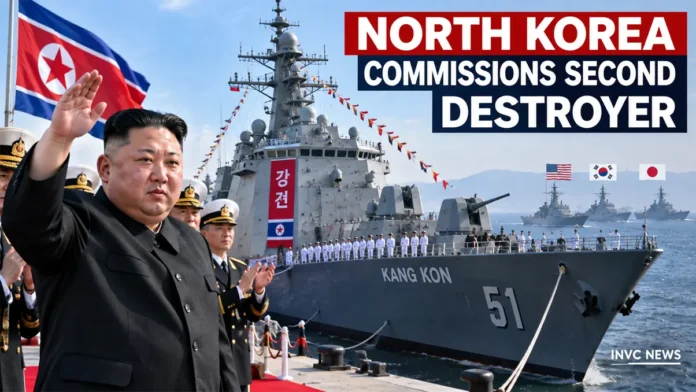
North Korea Destroyer Kang Kon has formally entered service as Pyongyang’s second 5,000-ton-class warship, with leader Kim Jong Un declaring that the vessel will become part of the country’s nuclear response system as the United States, South Korea and Japan launch a major trilateral military exercise.
Kim attended the commissioning ceremony in the eastern port city of Wonsan and used the event to signal a broader expansion of North Korea’s naval forces.
The commissioning comes as Washington, Seoul and Tokyo begin their five-day Freedom Edge exercise, adding another layer of military tension around the Korean Peninsula.
Kang Kon Becomes North Korea’s Second Major Destroyer
The Kang Kon is the second destroyer in North Korea’s new 5,000-ton class.
Pyongyang commissioned the first vessel, Choe Hyon, earlier this year as part of an accelerated effort to modernize a navy that has historically relied heavily on smaller and older ships.
The two destroyers now represent some of the most advanced surface warships North Korea has publicly displayed.
Kim Jong Un said the Kang Kon would strengthen the country’s ability to defend its maritime interests and expand what Pyongyang describes as its strategic deterrence capability.
North Korean state media presented the commissioning as a major step in the country’s naval modernization campaign.
Kim Jong Un Links Destroyer to Nuclear Response System
The most important part of Kim’s message centered on nuclear deterrence.
Kim said the new warship would operate as part of North Korea’s state nuclear response system and would support powerful retaliatory capabilities.
That statement signals that Pyongyang increasingly views its navy not simply as a coastal-defense force but as another platform for its broader nuclear strategy.
North Korea has spent years expanding the range of systems that could potentially support nuclear operations, including land-based ballistic missiles, cruise missiles and submarine-related technologies.
The Kang Kon now gives Pyongyang another highly visible platform around which it can build that strategy.
However, independent assessments of the ship’s full combat capabilities remain limited, and outside observers cannot verify every weapons claim made by North Korean authorities.
Freedom Edge Exercise Begins at Same Time
The commissioning also coincides with a major military exercise involving the United States, South Korea and Japan.
The three countries began their annual Freedom Edge exercise on September 7.
The five-day drill is scheduled to continue through September 11 in international waters southeast of South Korea’s Jeju Island.
The exercise brings together forces from all three countries for multi-domain training designed to improve coordination against nuclear, missile and other regional security threats.
The allies describe the drills as defensive.
North Korea routinely rejects that characterization and portrays major U.S.-led exercises around the peninsula as rehearsals for military confrontation.
US, South Korea and Japan Strengthen Military Coordination
Freedom Edge reflects increasingly close defence coordination among Washington, Seoul and Tokyo.
The three countries have expanded joint training as North Korea develops new ballistic missiles, cruise missiles, naval platforms and nuclear capabilities.
Their cooperation includes missile-warning activities, maritime exercises, air operations and other forms of integrated training.
For North Korea, that trilateral coordination has become a major security concern.
Pyongyang argues that closer military cooperation among the three countries strengthens an alliance structure directed against it.
Washington, Seoul and Tokyo counter that North Korea’s expanding missile and nuclear programmes make deeper military cooperation necessary.
North Korea Pushes Rapid Naval Modernization
The Kang Kon commissioning forms part of a much larger naval build-up.
Kim has previously called for North Korea to accelerate construction of large modern warships and strengthen naval bases, particularly along the country’s east coast.
He has also outlined plans for additional classes of naval vessels.
Earlier this year, Kim said North Korea should build two warships comparable in size to its 5,000-ton destroyers every year over the next five years.
If Pyongyang meets even part of that target, it would represent a significant transformation of the North Korean navy.
North Korea has also discussed developing larger destroyers and advanced underwater weapons.
These programmes suggest that Pyongyang wants to move beyond a force focused mainly on coastal defence toward one capable of carrying out more complex long-range operations.
Kang Kon Has Already Undergone Weapons Testing
The Kang Kon has appeared in North Korean military reporting before its formal commissioning.
Kim previously observed weapons tests involving the destroyer, including the launch of a strategic cruise missile and evaluations of anti-ship, anti-submarine and air-defence systems.
Those tests offered an early indication of the range of missions North Korea wants the vessel to perform.
A modern destroyer can potentially provide air defence, anti-ship warfare, submarine detection and long-range strike capabilities from a single platform.
The effectiveness of North Korea’s systems in actual combat conditions remains difficult to independently assess.
Still, the scale and pace of Pyongyang’s naval programme have attracted growing attention from neighbouring governments.
Kim Ju Ae Appears at Commissioning Ceremony
Kim Jong Un’s daughter, Kim Ju Ae, also appeared prominently at the Kang Kon ceremony.
Her presence continues a pattern in which she has accompanied Kim at high-profile military and strategic events.
North Korea has not formally announced her as Kim’s successor.
Nevertheless, her repeated appearances at events involving missiles, nuclear strategy and major military programmes continue to fuel international scrutiny of her possible future political role.
Her presence at the destroyer commissioning again placed her alongside one of North Korea’s most important new weapons programmes.
Tensions Rise Despite Possibility of Future Diplomacy
The military developments come at a complicated moment on the Korean Peninsula.
North Korea continues to expand its nuclear and missile capabilities while the United States and its regional allies strengthen military coordination.
At the same time, speculation persists over whether Washington and Pyongyang could eventually reopen high-level diplomatic talks.
Previous negotiations between the two countries failed to produce a lasting denuclearization agreement.
North Korea now insists that its nuclear status must form part of any future diplomatic calculation.
That position remains fundamentally at odds with longstanding international demands for the denuclearization of the Korean Peninsula.
Why the Kang Kon Destroyer Matters
The significance of the North Korea Destroyer programme extends beyond one additional warship.
Pyongyang is attempting to build a navy capable of supporting a much wider strategic mission.
By explicitly connecting the Kang Kon to its nuclear response structure, Kim Jong Un has signaled that maritime forces could play a larger role in North Korea’s deterrence strategy.
At the same time, the start of Freedom Edge shows that the United States, South Korea and Japan are also strengthening their ability to respond collectively to North Korean military developments.
The two moves create a familiar security dilemma.
As one side expands its military capabilities in the name of deterrence, the other responds with additional weapons, training and coordination.
For now, the commissioning of the Kang Kon marks another major step in North Korea’s military modernization—and another source of pressure in an already heavily armed region.