By Team INVC | INVC NEWS
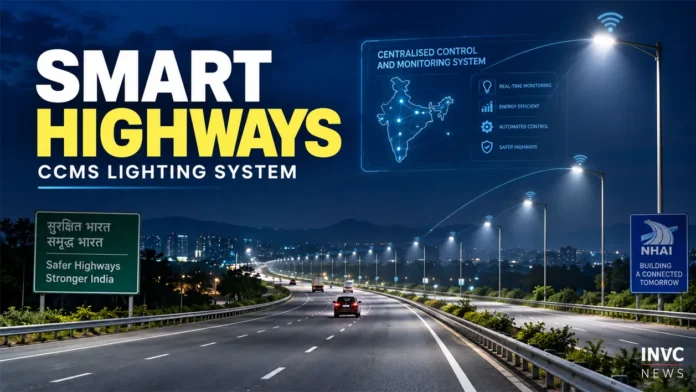
NEW DELHI, India | September 19, 2026 — NHAI is moving to modernize street lighting on National Highways through a centralized, web-based smart monitoring system that can automatically control lights, detect faults and track power consumption in real time.
The Centralized Control and Monitoring System, or CCMS, is designed for National Highway stretches managed by NHAI, the Ministry of Road Transport and Highways and NHIDCL where street-lighting infrastructure is provided.
The move is aimed at replacing fragmented manual monitoring with a technology-driven system that can identify lighting failures faster and improve the reliability of highway illumination.
What Is NHAI’s CCMS Smart Lighting System?
CCMS is a centralized digital platform that allows highway authorities to monitor street lights from a common dashboard.
The system can show whether individual lighting systems are working, track power consumption and electrical load, schedule automatic switching and identify faults remotely.
Officials at regional, project and implementation-unit levels can access the platform according to their assigned roles.
This means field teams may no longer need to depend entirely on physical inspections to discover whether lights have failed on a highway stretch.
Smart Lights Can Be Switched On and Off Automatically
One of the key features of the CCMS platform is automated ON and OFF scheduling.
Lighting systems can be programmed according to operating requirements instead of relying only on manual switching.
The platform can also provide centralized visibility across multiple projects.
That could improve operational efficiency while helping authorities identify abnormal power consumption or malfunctioning equipment more quickly.
Pilot Projects Completed in Varanasi and Hyderabad
Before wider implementation, the smart street-lighting platform was tested through pilot projects.
One pilot was completed under NHAI’s UP East regional office in Varanasi.
Another was carried out under the Ministry of Road Transport and Highways regional office in Hyderabad.
Authorities said the pilots demonstrated improvements in monitoring, control and operational efficiency.
These projects are now being used as reference models for wider rollout.
Will Every National Highway Get Continuous Street Lighting?
No.
This distinction is important.
The CCMS programme should not be interpreted as a plan to install street lights continuously along every kilometre of India’s National Highway network.
The system is intended to automate and centrally monitor street-lighting assets on highway stretches where lighting is required or already provided.
Lighting requirements vary depending on the nature of a highway section.
Interchanges, junctions, toll areas, built-up locations, structures and other identified stretches may have different illumination requirements from long open highway sections.
Therefore, the project is primarily about making highway lighting smarter, centrally monitored and more reliable.
How Smart Lighting Can Improve Road Safety
Reliable illumination is particularly important at locations where drivers need greater visibility at night.
A lighting failure at a junction, interchange or other critical stretch can make road conditions more difficult for motorists.
The CCMS system can help authorities identify such failures more quickly through remote fault detection.
Faster maintenance can, in turn, support safer night-time travel.
NHAI has also been expanding the use of other road-safety technologies, including AI-based monitoring, advanced traffic management systems and digital highway surveillance.
Smart lighting therefore forms part of a broader shift toward technology-driven National Highway operations.
NHAI Wants Real-Time Fault Detection
Under conventional systems, a failed street light may remain unnoticed until an inspection team or road user reports it.
CCMS changes that process by allowing faults and operating status to be monitored digitally.
Authorities can use the centralized dashboard to identify problems and initiate corrective action.
The system also provides performance analytics that can help highway managers understand recurring problems and maintenance requirements.
Power Consumption Will Also Be Monitored
The platform does more than monitor whether lights are working.
It can also track electricity consumption and load parameters.
That could help authorities identify unusual consumption patterns, inefficient equipment or other operational issues.
Energy monitoring is becoming increasingly important as infrastructure agencies look for ways to reduce operating costs while improving performance.
Centralized control may also help highway operators optimize lighting schedules without compromising required illumination.
NHAI Had Earlier Invited Smart Lighting Innovations
NHAI had earlier invited engineers, technology companies, startups and researchers to propose innovative solutions for smarter highway lighting.
The initiative focused on centralized automation, monitoring, intelligent street-light management and lifecycle costs.
Experts in electrical engineering, renewable energy, information technology and IoT-based energy monitoring were among those encouraged to participate.
The broader objective was to develop highway lighting systems that are safer, greener and more efficient.
Part of NHAI’s Bigger Technology Push
Smart lighting is not an isolated digital project.
NHAI has been steadily introducing new technologies for highway operations and road safety.
The authority is also moving toward predictive asset management, AI-powered dashcam monitoring and advanced emergency-response systems.
Its upgraded 1033 highway helpline is expected to use technologies including artificial intelligence and real-time location tracking to improve assistance during accidents, breakdowns and other emergencies.
Together, these initiatives show how India’s highway network is moving from conventional infrastructure management toward real-time digital monitoring.
What Changes for Highway Users?
Drivers may not immediately notice the CCMS platform itself because most of the technology operates in the background.
The visible difference should come from more reliable lighting and quicker identification of failures on illuminated highway sections.
For highway authorities, however, the change is much bigger.
Instead of managing thousands of lighting assets through disconnected systems, officials will be able to monitor their status through centralized digital dashboards.
The ultimate objective is simple: better visibility, faster maintenance, more efficient energy use and safer National Highway operations.