NEW DELHI, India | August 24, 2026 —
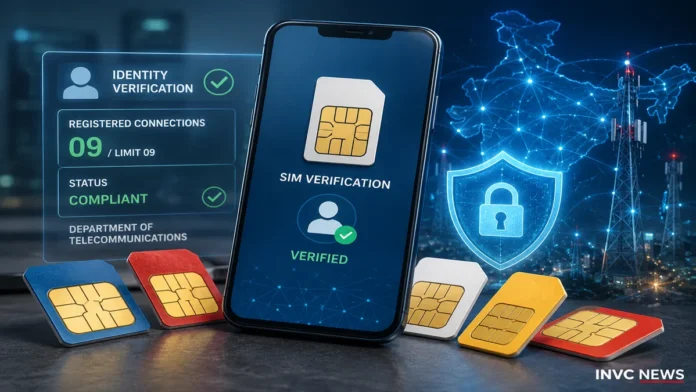
New SIM Card Rules From Today could directly affect mobile users who have several active numbers registered in their name, as the Department of Telecommunications has tightened enforcement of India’s existing limit on individual mobile connections from Monday, August 24.
Telecom operators including Reliance Jio, Bharti Airtel, Vodafone Idea and BSNL are now required to identify subscribers who have already reached the maximum number of permitted mobile connections before issuing another SIM.
For most of India, an individual is permitted to hold up to nine mobile connections across telecom operators and service areas.
A lower ceiling of six connections applies in Jammu and Kashmir, Assam and the North-East licensed service areas.
The important point for consumers is that the numerical limit itself is not entirely new. What changes from August 24 is the mechanism through which telecom companies are expected to identify customers who have reached that limit and stop additional connections from being issued.
Have 9 SIM Cards? A New Connection Can Be Denied
Suppose a subscriber already has nine mobile connections registered under the same identity.
From August 24, telecom operators are expected to identify that subscriber when another mobile connection is requested and inform the customer that the maximum permitted number of connections has already been reached.
The new SIM application can therefore be rejected.
The rule works across telecom networks rather than separately for each company.
That distinction is extremely important.
A person cannot hold nine Airtel connections, another nine Jio connections and nine Vi connections and treat them as separate limits.
Connections associated with the same individual are considered collectively for enforcement of the prescribed ceiling.
Will Your 10th SIM Automatically Stop Working Today?
Not necessarily.
Mobile users should not interpret the August 24 change as meaning that every existing connection above the prescribed limit will suddenly stop working at midnight.
The immediate focus is stricter identification and prevention of additional mobile connections.
However, the Department of Telecommunications has also directed telecom operators to take appropriate measures in cases where subscribers already hold connections beyond the prescribed limit.
There is another important situation consumers should understand.
During the initial phase, some checks may operate on a post-facto basis rather than instantly at the point of activation.
If a mobile connection is activated and subsequently found to have pushed a subscriber beyond the permitted limit, that newly activated connection can be immediately suspended until the issue is resolved.
That is why headlines suggesting that a “10th SIM may be blocked” require context: the rule does not mean every old 10th number across India is automatically being switched off on August 24.
DoT Will Use Digital Intelligence Platform
At the center of the enforcement mechanism is the Department of Telecommunications’ Digital Intelligence Platform, commonly known as DIP.
The platform is designed to allow telecom-related intelligence to be shared among authorized stakeholders and helps identify misuse of telecom resources.
For the latest SIM-limit enforcement, subscriber information uploaded by telecom service providers can be analyzed to identify mobile connections associated with the same individual across operators and service areas.
This is significant because a customer may have accumulated mobile numbers from multiple telecom companies over several years.
A Jio connection obtained in one place and Airtel or Vi connections obtained elsewhere can still contribute toward the overall prescribed limit.
DoT has also been using technology and data analytics to combat mobile connections obtained through fake or forged identity documents and connections associated with cybercrime and financial fraud.
Also Read: Cyber Fraud Escalates: Indians Lose ₹1,750 Crore in Four Months
Subscriber Photos Will Help Identify Users at the Limit
Another important part of the new system involves subscriber photographs.
Representative photographs of subscribers identified as having reached the prescribed mobile-connection ceiling are being made available through the Digital Intelligence Platform for telecom service providers.
Operators can use this information as part of their identification process when a subscriber attempts to obtain another connection.
The objective is to make it significantly more difficult for an individual to bypass the connection ceiling simply by moving between operators or service areas.
Real-Time SIM Verification Required by November 30
The enforcement mechanism beginning August 24 is not the final stage of the system.
Telecom service providers have been directed to integrate the required checks into their real-time enrolment and activation process by November 30, 2026.
Once fully integrated, the system is expected to identify whether an applicant has reached the prescribed mobile-connection limit while the new SIM request is being processed.
Until then, some telecom companies may use post-facto verification.
This transition is important because real-time verification should reduce the possibility of a connection being activated first and flagged only later.
How Many SIM Cards Can One Person Have in India?
For consumers, the basic rules can be understood simply:
| Region | Maximum Mobile Connections |
|---|---|
| Most parts of India | 9 |
| Jammu & Kashmir | 6 |
| Assam | 6 |
| North-East licensed service areas | 6 |
These limits relate to mobile connections issued to an individual and are counted across telecom service providers.
How to Check How Many SIM Cards Are Registered in Your Name
This is perhaps the most useful action mobile users can take today.
The government provides the Sanchar Saathi platform, where consumers can use the “Know Mobile Connections in Your Name” service to see mobile connections issued in their name.
Visit the official portal:
Sanchar Saathi: https://www.sancharsaathi.gov.in/
The service previously associated with TAFCOP allows users to identify numbers linked to their identity and flag connections they do not recognize or no longer require.
The process is particularly useful for people who have changed operators or phone numbers several times over the years.
You may have forgotten an old connection that remains associated with your identity.
More seriously, a number you have never used could potentially indicate misuse of your identity details.
What Should You Do If You Find an Unknown SIM in Your Name?
Do not ignore it.
If the Sanchar Saathi service displays a mobile connection that you do not recognize, use the available reporting or management option on the official platform.
An unauthorized mobile number associated with your identity can create serious problems if that connection is later misused for fraud or another illegal activity.
Sanchar Saathi is specifically designed to allow citizens to view and manage mobile connections issued in their name and report unnecessary or unauthorized connections.
The platform also provides services for reporting suspected fraudulent communication and blocking or tracing lost and stolen mobile handsets.
Also Read: India’s ₹62,500 Crore Mobile Manufacturing Push Targets ₹39 Lakh Crore Output and 60,000 Jobs
Why Is the Government Tightening SIM Verification?
SIM cards have become a key part of India’s digital identity and financial ecosystem.
A mobile number can be linked with banking services, UPI accounts, social media accounts, messaging platforms, e-commerce services and authentication systems.
Fraudulently obtained SIM cards can therefore become useful tools for cybercriminals.
The Department of Telecommunications has developed multiple systems to identify suspicious and fraud-linked mobile connections, including the Digital Intelligence Platform and AI-driven subscriber-verification tools.
The wider objective is to make it harder for criminals to obtain or maintain mobile connections through fake documents, identity misuse or other irregular methods.
Do Jio, Airtel and Vi Users Need to Do Anything Immediately?
For the overwhelming majority of subscribers who have only one, two or a few mobile numbers, there is little reason for concern.
Your existing legitimate SIM is not being affected simply because the new enforcement system starts on August 24.
Consumers with many mobile numbers, however, should check exactly how many connections are registered in their name.
This becomes particularly important before applying for another SIM.
If you have already reached the applicable limit, a new connection can be denied.
And if you discover numbers you no longer use, checking and resolving them through the official government system may prevent future complications.
Also Read: Don’t Wait for Diwali Sale? Smartphone Prices Are Rising in India—Here’s What Buyers Should Know
New SIM Card Rules From Today: What You Should Remember
The biggest change from August 24 is stricter enforcement, not the sudden cancellation of every extra SIM in the country.
Mobile users should remember five things:
- The normal ceiling is nine mobile connections per individual.
- The ceiling is six in Jammu & Kashmir, Assam and the North-East licensed service areas.
- Connections across different operators are considered together.
- A subscriber already at the maximum can be denied another mobile connection.
- Consumers can check numbers registered in their name through Sanchar Saathi.
With real-time verification scheduled to be integrated into SIM enrolment and activation systems by November 30, obtaining mobile connections beyond the prescribed limit is expected to become increasingly difficult.
For consumers, the simplest precaution is also the most effective: check the mobile numbers registered in your name now and report anything you do not recognize.