NEW YORK, United States | September 24, 2026 —
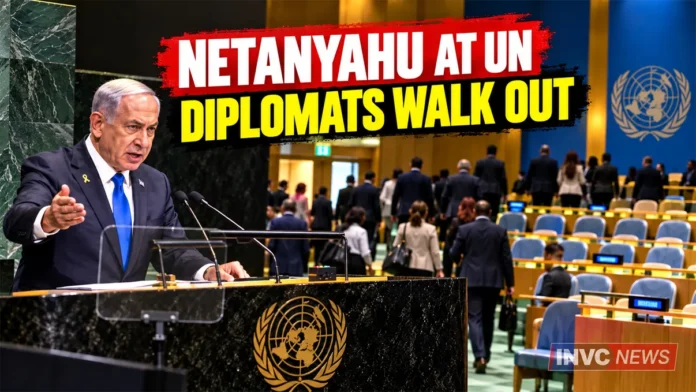
Dozens of diplomats walked out of the United Nations General Assembly on Thursday as Israeli Prime Minister Benjamin Netanyahu took the podium, turning his closely watched address into a stark display of the widening international divisions over Israel’s war in Gaza.
Scores of representatives headed for the exits as Netanyahu began speaking. A majority of visible seats were left empty after the walkout, while supporters in the gallery applauded and chanted in his favour.
Netanyahu responded defiantly, calling those who left “moral cowards” and insisting that Israel’s military actions were protecting not only his country but also other nations threatened by Iran and armed groups across the Middle East.
The confrontation captured the competing pressures surrounding Netanyahu: growing criticism abroad over Gaza, the occupied West Bank and Israel’s regional military campaigns, while he campaigns at home ahead of Israel’s October 27 general election.
Netanyahu Rejects Genocide Allegations
Netanyahu used much of his roughly 40-minute address to defend Israel’s conduct in Gaza and challenge governments and international figures that have accused his government of violating international law.
He rejected allegations of genocide against Palestinians, describing them as false, and argued that Israel had acted in self-defence after the Hamas-led attacks of October 7, 2023.
About 1,200 people were killed in those attacks and 251 were taken hostage.
Israel says its subsequent military campaign has targeted Hamas and other armed groups, not Palestinian civilians, and maintains that militants operating from densely populated areas have increased the risks to civilians.
Critics of Israel, however, point to the enormous Palestinian death toll, widespread destruction and displacement across Gaza.
According to the Gaza Health Ministry, at least 73,922 Palestinians have been killed since the war began. The ministry’s figures do not distinguish between combatants and civilians.
The competing accounts remain at the centre of one of the most divisive international debates of the past three years.
October 7 Remains Central to Netanyahu’s Case
Netanyahu repeatedly returned to the October 7 attacks as he sought to explain Israel’s military response.
He argued that much of the international criticism now directed at Israel had lost sight of the event that triggered the conflict.
For Israel, October 7 remains a defining national trauma and the foundation of its argument that Hamas cannot be allowed to retain the military capacity to launch another major attack.
For many governments critical of Israel, however, recognition of Israel’s right to security does not remove questions about civilian protection, proportionality and the long-term political future of Palestinians.
That divide was visible inside the General Assembly chamber.
Netanyahu spoke of security and survival.
Many of the diplomats who left were registering their opposition to the way Israel has prosecuted the war and to policies beyond Gaza.
Walkout Adds to Pressure Over Israel’s Global Standing
The protest at the UN does not mean Israel has lost its international alliances.
The United States remains Israel’s most important strategic partner, while Israel continues to maintain extensive diplomatic, security and commercial relationships across Europe, Asia, Africa and the Middle East.
But relations with several governments have come under increasing strain.
Britain, France and Canada announced measures earlier this month targeting Israeli settlements in the occupied West Bank, reflecting growing concern among governments that have historically maintained close ties with Israel.
The International Criminal Court has also issued an arrest warrant for Netanyahu alleging war crimes and crimes against humanity. Israel rejects the accusations and disputes the court’s jurisdiction.
Those developments have made Netanyahu’s international travel more complicated and have added another layer to the diplomatic pressure facing his government.
Netanyahu Pushes Back Over West Bank Criticism
The Israeli prime minister also challenged criticism of settler violence in the occupied West Bank.
He described those responsible for attacks as a relatively small group and said Israel would not tolerate vigilantism.
The issue has nevertheless become an increasingly serious diplomatic problem for Israel.
Palestinians seek the West Bank and East Jerusalem as parts of a future state, while most of the international community considers Israeli settlements in occupied territory illegal under international law.
Netanyahu has also said that no Palestinian state will be established while he remains Israel’s prime minister.
That position puts his government at odds with governments that continue to promote a two-state solution as the preferred route to ending the Israeli-Palestinian conflict.
Iran Dominates Netanyahu’s Wider Security Argument
Netanyahu sought to place Israel’s actions in Gaza within a much broader regional confrontation.
Iran featured heavily in his address.
He defended Israel’s military actions against Tehran and portrayed the conflict as part of a multi-front struggle involving Iran and armed groups aligned with it across the region.
At one point, Netanyahu displayed a pager while referring to Israel’s previous operations against Hezbollah in Lebanon. He also held up a Starlink receiver as part of his message to Iranians.
The use of visual props has long been a feature of Netanyahu’s appearances at the General Assembly, where he has frequently sought to turn complex regional security arguments into direct political messages.
This time, however, the walkout competed with the speech itself for international attention.
A Speech With a Domestic Audience Too
Netanyahu was not speaking only to diplomats in New York.
Israel is due to hold a general election on October 27, and his UN address was broadcast live during prime-time television at home.
His speech presented a familiar argument to Israeli voters: that Israel faces threats on several fronts and requires leadership willing to withstand international criticism.
The address therefore served two audiences at once.
At the United Nations, Netanyahu sought to defend Israel against mounting criticism.
At home, he presented himself as a leader refusing to yield under foreign pressure.
What the Walkout Actually Means
Diplomatic walkouts are primarily symbolic.
They do not automatically alter alliances, impose sanctions or change military policy.
Nor does Thursday’s protest establish that the international community has collectively turned against Israel.
But symbolism matters in diplomacy.
Governments communicate not only through formal votes and treaties but also through gestures that signal the depth of disagreement.
The sight of scores of diplomats leaving while Israel’s prime minister addressed the General Assembly offered a visible measure of how contentious Israel’s policies have become.
For Israel’s supporters, the walkout may reinforce a longstanding argument that the country faces unfair treatment at the United Nations.
For Israel’s critics, it represented growing frustration with the civilian cost of the Gaza war, settlement policies in the West Bank and Netanyahu’s rejection of Palestinian statehood.
Both interpretations will continue to shape the debate.
What is harder to dispute is that the diplomatic environment surrounding Israel has become significantly more difficult.
Netanyahu Leaves the UN With the Divide Still Intact
Netanyahu did not use his address to signal a change of direction.
He defended the Gaza campaign, rejected accusations against Israel, invoked October 7, defended action against Iran and challenged governments he said had unfairly condemned his country.
The diplomats who walked out delivered an equally clear message of opposition.
Neither side moved closer to the other.
That may ultimately be the most important conclusion from Netanyahu’s appearance in New York.
The empty seats did not prove that Israel stands alone.
But they demonstrated, in one highly visible moment, just how wide the political and diplomatic divide over Israel’s conduct has become.