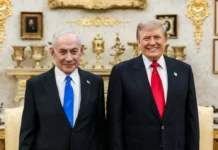
Jerusalem, October 30, 2026: Israeli Prime Minister Benjamin Netanyahu has reiterated his opposition to forming a government with Arab political parties, declaring that such an arrangement is unacceptable. His remarks come after Israel’s final election results left his political bloc with just 53 seats in the 120-member Knesset, eight short of the 61 required for a parliamentary majority.
On Friday, Netanyahu shared a video compilation on social media featuring statements by several Arab political leaders and opposition lawmakers. Accompanying the video, he wrote: “It is forbidden to form a government with them.”
The statement signals Netanyahu’s continued refusal to rely on Arab parties for parliamentary support at a time when coalition negotiations are becoming increasingly important for determining Israel’s next government.
However, the election results have created a complicated political situation. Neither Netanyahu’s bloc nor the opposition has secured an outright majority, while Arab-led parties have collectively won 19 seats, giving them an important position in the parliamentary arithmetic.
What Did Netanyahu Say About Arab Political Parties?
In his post on X (formerly Twitter), Netanyahu shared excerpts from speeches and public statements by several Arab politicians and opposition lawmakers.
The video featured Ahmad Tibi, Iman Khatib-Yasin, Mansour Abbas, Sami Abu Shehadeh, Ofer Cassif, Yousef Jabareen and Ayman Odeh.
The excerpts included expressions of support for Palestinian rights and the Palestinian cause. Netanyahu used the compilation to reinforce his opposition to forming a government with Arab parties.
The Israeli right-wing political camp has frequently criticised positions taken by some Arab political leaders on the Palestinian issue, particularly where they differ sharply from the government’s security and national policies.
Netanyahu’s latest statement comes amid discussions about whether Arab-led parties could support an opposition-led government, either by formally joining a coalition or by providing parliamentary backing from outside it.
Israel Election Results: Netanyahu’s Bloc Gets 53 Seats
The Central Elections Committee published the final results of Israel’s national election on Friday, October 30, confirming the distribution of seats in the 26th Knesset.
The results show that Netanyahu’s Likud party emerged as the largest political party with 27 seats. However, the broader bloc supporting him secured only 53 seats.
The main opposition bloc secured 48 seats, while Arab-led political factions won a combined 19 seats.
Israel’s parliament has 120 members, meaning a minimum of 61 seats is required to secure a parliamentary majority.
The seat distribution is as follows:
| Political Party | Seats Won |
|---|---|
| Likud | 27 |
| Yashar | 21 |
| B’Yachad | 12 |
| Joint List | 11 |
| The Democrats | 8 |
| Ra’am | 8 |
| Yisrael Beytenu | 7 |
| United Torah Judaism | 7 |
| Otzma Yehudit | 7 |
| Shas | 6 |
| Religious Zionism | 6 |
These results leave the three broad political groupings without an independent majority. The final voter turnout was reported at 77.9%, with 5,716,665 votes cast.
Why Has Government Formation Become Difficult?
Israel’s election results have opened a complicated phase of coalition negotiations.
Netanyahu’s political bloc has 53 seats, meaning it needs support from at least eight additional lawmakers to reach the 61-seat majority.
The opposition grouping has 48 seats. Arab-led parties, meanwhile, have secured 19 seats collectively.
Although these numbers make Arab parties relevant to possible coalition arrangements, their participation is politically contentious. Several Israeli political leaders have ruled out relying on Arab parties to form a government.
Netanyahu’s position further narrows the options available to his camp. His declaration that forming a government with Arab parties is forbidden indicates that he does not intend to pursue that route.
At the same time, the opposition faces its own challenges in assembling sufficient parliamentary support.
Haredi Parties May Not Automatically Support Netanyahu
Another complication comes from Israel’s ultra-Orthodox, or Haredi, political parties.
United Torah Judaism (UTJ) and Shas have traditionally been important partners in Netanyahu’s political camp. However, their positions following the election suggest that they may not automatically support his next government.
According to Israeli media reports, United Torah Judaism leaders have indicated that they want to maintain an independent political position rather than automatically identify with either major bloc.
A report by The Times of Israel also said UTJ figures were considering supporting a minority government led by opposition leader Gadi Eisenkot without formally joining its coalition. Under the reported arrangement, the party could abstain in parliamentary votes rather than oppose the government.
Shas, however, has taken a different position. Its chairman, Aryeh Deri, has reportedly ruled out joining an opposition-led government without Likud.
This difference between the two ultra-Orthodox parties could become important during the negotiations.
Other right-wing parties, including Religious Zionism, led by Bezalel Smotrich, and Otzma Yehudit, led by Itamar Ben-Gvir, are also part of the wider political calculations surrounding Netanyahu’s government formation efforts.
Netanyahu Thanks Supporters and Acknowledges the Challenge Ahead
Following the election, Netanyahu also acknowledged the difficult task of forming the next government.
He thanked party supporters and activists who had worked during the campaign, particularly those who travelled to polling stations and encouraged voters to participate.
He described government formation as the most difficult task ahead and said his responsibility was to the people who had stood in queues and worked for the party’s electoral campaign.
His remarks underline the importance of coalition negotiations following an election in which his party emerged as the largest individual political force but failed to secure a majority through its allies.
When Will Israel’s New Parliament Begin Its Work?
According to the Central Elections Committee’s announcement, the final election results are scheduled to be submitted to President Isaac Herzog on November 4, following the examination of any errors or inquiries.
The newly elected 26th Knesset is scheduled to be sworn in on November 10.
The period leading up to the new parliament’s first sitting is expected to be important for discussions between party leaders.
The president will play a constitutional role in the government formation process by consulting political representatives and assigning a candidate to form the government.
If the initial attempt fails, further attempts may follow under Israel’s political and constitutional procedures.
What Happens Next?
The immediate political challenge is to determine whether any combination of parties can secure the support required to establish a government.
Netanyahu’s refusal to form a government with Arab parties, the opposition’s need to assemble sufficient parliamentary backing and the independent positions of the Haredi parties are likely to shape the negotiations.
The 19 seats won by Arab-led parties have also become an important part of the parliamentary equation, even though their role in any potential government remains disputed.
The Bottom Line: Benjamin Netanyahu’s Likud has emerged as Israel’s largest party with 27 seats, but his broader political bloc has secured only 53 seats. His rejection of a coalition with Arab parties, combined with the differing positions of the Haredi parties, has made the formation of Israel’s next government a complicated political process. The coming weeks will determine which parliamentary arrangement can command the necessary support in the 26th Knesset.