TRISHULI, Nepal | August 27, 2026 —
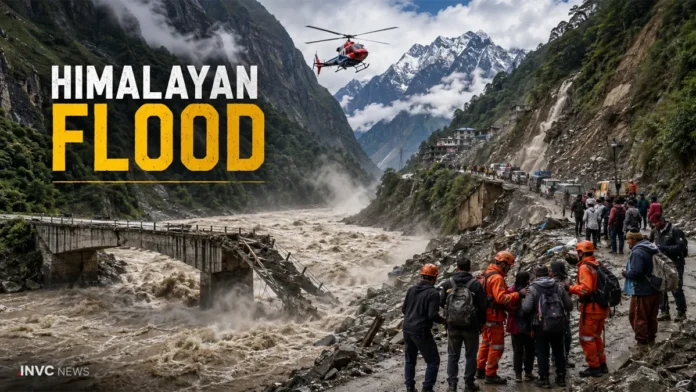
Nepal-Tibet flood disaster rescue operations intensified Thursday after catastrophic flooding triggered by a massive collapse of Himalayan ice, rock and mud killed hundreds of people and left more than 1,000 missing across Nepal and China’s Tibet region.
Nepalese authorities reported 359 deaths, while rescue teams continued searching destroyed settlements, roads and river valleys. The disaster also struck the busy Gyirong border area connecting Nepal with Tibet, a route used by tourists and pilgrims travelling toward Mount Kailash and Lake Mansarovar.
For India, the crisis has become particularly significant because hundreds of Indian citizens were travelling through the affected region.
Nepalese rescue teams said they had located about 100 Indian visitors, most of them pilgrims, during ongoing search operations.
However, the situation remains fluid, with authorities still working to verify casualty and missing-person lists.
Hundreds of Foreign Tourists Caught in Disaster
The flood struck one of the most important land routes between Kathmandu and Tibet.
Hundreds of foreign visitors from more than two dozen countries were reported missing in Nepal, while hundreds more remained unaccounted for on the Tibetan side.
Indian nationals represent one of the largest groups affected.
India’s foreign ministry said earlier Thursday that 288 Indian nationals were reported missing in Nepal, while around 200 Indians were stranded in China.
Nepalese officials later said rescuers had located around 100 Indian visitors.
Because rescue teams and governments are continuously updating separate lists, the figures should not be directly subtracted from one another until authorities issue consolidated data.
Kailash Mansarovar Pilgrims Among Those Affected
The timing of the disaster has increased concern in India because August falls within the Kailash Mansarovar pilgrimage season.
Mount Kailash and Lake Mansarovar are among the most sacred pilgrimage destinations for Hindus and Buddhists, attracting travellers from India and several other countries.
Many visitors travel through Nepal before crossing into Tibet through the Gyirong border region.
Several pilgrimage groups were reportedly travelling through the area when the flood struck.
Indian families have since contacted government helplines and tour operators seeking information about relatives who were travelling toward or returning from Kailash Mansarovar.
Also Read – : Kailash Mukti Yatra Reaches Gangotri as Supporters Call for Easier Access to Kailash Mansarovar
What Caused the Nepal-Tibet Flood?
Initial reports had raised questions about whether an earthquake triggered the disaster.
However, subsequent analysis indicated that the seismic signal detected in the region was associated with the collapse of glacial rock and ice, rather than a conventional earthquake.
A high-altitude ice avalanche appears to have triggered a massive debris flow.
As the material travelled downhill, it collected glacial sediment, rocks and water before transforming into an extremely fast-moving mudslide.
Chinese geological analysis indicated that the debris flow travelled at roughly 50 metres per second at one stage, giving people in its path very little time to escape.
The flow continued for more than 20 kilometres before devastating border infrastructure and communities downstream.
Entire Settlements, Roads and Bridges Destroyed
The scale of destruction has complicated rescue operations.
Homes, roads, bridges, power infrastructure and border facilities were swept away or buried under thick mud.
Some affected communities became inaccessible by road, forcing authorities to use helicopters to search for survivors and deliver emergency supplies.
Thousands of rescue personnel have been deployed across the affected areas.
Chinese authorities have also launched a major emergency response in Tibet, sending rescue teams, power-restoration crews and emergency supplies to Gyirong.
China’s central government allocated emergency funding and thousands of relief items, including tents, clothing, beds and other supplies.
Chinese Premier Li Qiang travelled to Gyirong on Thursday to oversee rescue and relief operations.
New Flood Risk Raises Alarm
Authorities are also watching a potentially dangerous secondary threat.
A blocked river has reportedly created a dammed lake in the Himalayan disaster zone.
Officials warned that rising water could breach the natural barrier and trigger another flood downstream.
Residents and rescue personnel near vulnerable riverbanks have been urged to move away from potentially dangerous areas.
Monitoring has intensified as additional water is expected to enter the lake over the coming days.
That risk means the disaster remains an active emergency rather than simply a recovery operation.
India Coordinates Assistance for Pilgrims
Indian authorities are coordinating with Nepal to trace affected citizens and help stranded travellers.
Families from several states have sought information about relatives who travelled through Nepal for the Kailash Mansarovar pilgrimage.
The disaster also highlights the particular risks associated with high-altitude Himalayan travel, where landslides, glacial instability, rapidly changing weather and limited road access can make rescue operations extremely difficult.
Also Read – : Amarnath Yatra 2026 Guide: Routes, Registration, Health Certificate and Safety Rules
Search for Survivors Continues
Rescue teams remain focused on finding survivors while authorities attempt to establish the full number of people affected.
The casualty figures could continue to change as isolated communities are reached and debris is cleared.
For Indian families waiting for information about pilgrims, the location of around 100 visitors offers some relief. However, hundreds of people across the Nepal-Tibet region remain unaccounted for.
Authorities have also warned that the threat has not completely passed because unstable terrain, damaged infrastructure and the possibility of another flood continue to complicate rescue operations.