New Delhi , August 15, 2026
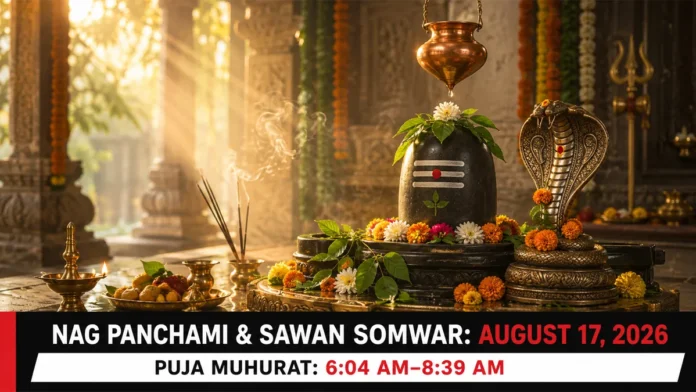
Nag Panchami 2026 will bring together two deeply revered Hindu observances on Monday, August 17, when the festival dedicated to Nag Devta coincides with Sawan Somwar, the sacred Monday associated with Lord Shiva.
This spiritually significant conjunction has drawn particular attention because serpents occupy a prominent place in the traditions surrounding Lord Shiva. The serpent Vasuki is depicted around Shiva’s neck, symbolizing fearlessness, controlled power and harmony with nature.
Devotees observing the occasion may worship Lord Shiva and Nag Devta, perform jalabhishek, chant sacred mantras, listen to the Nag Panchami Katha and participate in charitable activities. The day is also expected to carry a strong message of compassion toward animals and respect for the natural world.
When is Nag Panchami in 2026?
Nag Panchami will be observed on Monday, August 17, 2026.
The festival falls on Shukla Paksha Panchami during the Hindu month of Shravan. Panchami Tithi is expected to begin on the evening of August 16 and remain in effect until the afternoon of August 17.
| Panchang detail | Date and time |
|---|---|
| Panchami Tithi begins | August 16 at approximately 4:52 p.m. |
| Panchami Tithi ends | August 17 at approximately 5:00 p.m. |
| Nag Panchami | Monday, August 17, 2026 |
| General puja muhurat | Approximately 6:04 a.m.–8:39 a.m. |
| Sawan Somwar | Monday, August 17 |
Because Panchami Tithi will be present at sunrise, Nag Panchami will be observed on August 17 under the widely followed Udaya Tithi principle.
What is the Nag Panchami 2026 puja muhurat?
The general morning worship period for Nag Panchami is expected to run from approximately 6:04 a.m. to 8:39 a.m.
This provides devotees with a puja window of around two hours and 35 minutes. However, the precise muhurat may vary by location because Panchang calculations depend on local sunrise, latitude and longitude.
Worshippers should therefore consult a trusted local Panchang or temple before performing a time-sensitive ritual.
Why is the Sawan Somwar conjunction considered special?
Mondays during Sawan are traditionally dedicated to Lord Shiva. Devotees visit temples, offer water and bel leaves to the Shiva lingam, chant “Om Namah Shivaya” and observe a fast according to their faith and physical ability.
Nag Panchami, meanwhile, is devoted to the worship of Nag Devta. Serpent deities are associated with several important figures in Hindu tradition:
- Lord Shiva wears Vasuki around his neck.
- Lord Vishnu rests upon Shesha Nag.
- Lord Krishna is connected with the story of Kaliya Nag.
- Nag Devta is traditionally associated with protection, fertility and nature.
With Nag Panchami and Sawan Somwar occurring together, devotees can begin the day with Shiva Puja and then perform symbolic Nag Devta worship.
Pandit Ajay Kaushik said the conjunction offers worshippers an opportunity to reflect on devotion, discipline, compassion and the relationship between human life and nature.
The spiritual symbolism of the serpent
In religious traditions, the serpent does not represent fear alone. It is also viewed as a symbol of energy, alertness, protection and transformation.
Lord Shiva’s association with Vasuki conveys the idea that fear and destructive impulses can be brought under control through spiritual awareness.
The shedding of a snake’s skin is also interpreted symbolically as renewal and transformation—the ability to leave behind harmful habits and begin again with greater clarity.
Nag Panchami can therefore be observed not only through rituals but also through a personal resolution to overcome anger, dishonesty, cruelty or another negative tendency.
The traditional story behind Nag Panchami
Several traditional narratives explain the origin of Nag Panchami.
One widely narrated account describes a farmer who unknowingly harmed young snakes while plowing his field. The serpent mother, overcome with grief, sought revenge against the farmer’s family.
However, one member of the household worshipped Nag Devta with humility and asked for forgiveness. The sincere prayer calmed the serpent mother, and the family was spared.
The story is traditionally understood as a lesson about compassion, accountability and respect for all living beings. It also reflects India’s agrarian culture, in which snakes play an ecological role by controlling rodents in fields.
Different regions may narrate the Nag Panchami Katha differently, but respect for life and nature remains a central theme.
How to perform Nag Panchami Puja at home
A simple and respectful puja can be performed at home without capturing or handling a living snake.
- Wake up early, bathe and wear clean clothes.
- Clean the home altar and surrounding area.
- Place an image or idol of Lord Shiva and a symbolic representation of Nag Devta at the altar.
- Light a lamp and incense before beginning the worship.
- Take a sankalp for the well-being, peace and protection of the family.
- Offer clean water to the Shiva lingam.
- Present bel leaves, flowers, akshat and fruit to Lord Shiva.
- Offer flowers and traditional naivedya to the Nag Devta image or idol.
- Chant “Om Namah Shivaya” according to your ability.
- Read or listen to the Nag Panchami Katha.
- Perform the aarti of Lord Shiva and Nag Devta.
- Conclude the worship by praying for the protection of nature and all living beings.
Family and regional traditions may differ. Devotees may follow the customs practiced in their household or taught by their spiritual guide.
What should be offered to Lord Shiva?
The worship does not need to be expensive or elaborate. A few clean and respectfully presented items are traditionally considered sufficient.
Devotees may offer:
- Clean water
- Bel leaves
- Fresh flowers
- Akshat
- Seasonal fruit
- Sandalwood paste
- Incense
- An oil or ghee lamp
- A simple vegetarian naivedya
Bel leaves should preferably be clean and undamaged. Offerings should be made calmly and without unnecessary display.
Should milk be offered to snakes?
Living snakes should not be captured, displayed or forcibly fed milk during Nag Panchami.
Snakes do not naturally consume milk as a regular food. Forced feeding can cause serious harm to the animal and create a risk of snakebite.
Devotees who follow the tradition of offering milk may place a symbolic offering before an idol or image of Nag Devta. Water, flowers, fruit and prayers can also be offered.
A religious observance intended to honor Nag Devta should not cause suffering to a living creature.
What should devotees avoid on Nag Panchami?
Devotees should observe the day with restraint, kindness and awareness.
They should avoid:
- Capturing or disturbing snakes
- Paying handlers to display living snakes
- Forcibly feeding milk to snakes
- Harming animals or damaging natural habitats
- Anger, arguments and harsh speech
- Fear-based or excessively expensive rituals
- Making guaranteed claims about astrological remedies
Nag Panchami can instead become an occasion to support wildlife protection, provide food to someone in need or contribute to an animal-welfare initiative.
Is Nag Panchami connected with Kaal Sarp Dosha?
Traditional astrology associates Nag Panchami with Rahu, Ketu and serpent-related planetary conditions. Consequently, some devotees perform Shiva Abhishek, mantra chanting or symbolic Nag Puja while praying for relief from difficulties attributed to Kaal Sarp Dosha.
However, the presence or effect of any astrological combination can only be assessed after examining an individual birth chart.
A general festival puja should not be promoted as a guaranteed cure for personal, financial, health or relationship problems. Devotees should be cautious of anyone using fear to sell expensive remedies.
Simple observances for Sawan Somwar
Those who wish to observe Sawan Somwar alongside Nag Panchami can follow a simple devotional routine:
- Offer water to the Shiva lingam.
- Present bel leaves and flowers.
- Chant “Om Namah Shivaya.”
- Worship a symbolic Nag Devta image.
- Read the Nag Panchami Katha.
- Donate food, fruit or essential items.
- Feed a person in need.
- Practice patience and compassionate speech.
- Avoid harming animals or disturbing nature.
Devotees may keep a full or partial fast according to their health. Children, older adults, pregnant women and people with medical conditions should not undertake restrictive fasting without suitable guidance.
The deeper message of Nag Panchami
Nag Panchami is more than a ceremonial festival. It represents a cultural tradition in which nature is not regarded merely as a resource but as part of a sacred and interconnected world.
The serpent, often feared in daily life, receives reverence on this day. That reversal carries an important message: human beings must learn to coexist with the creatures and ecosystems surrounding them.
When Nag Panchami coincides with Sawan Somwar, its symbolism becomes even more closely connected with Lord Shiva—the deity traditionally associated with meditation, balance, fearlessness and the transformation of destructive energy.
The most meaningful observance may therefore be one that combines prayer with compassion, restraint and responsibility toward every living being.
Disclaimer: The religious and astrological information in this article is based on traditional beliefs and Panchang calculations. Timings may vary by location. The article does not claim guaranteed spiritual, medical or astrological results.