NEW DELHI, India | August 24, 2026 —
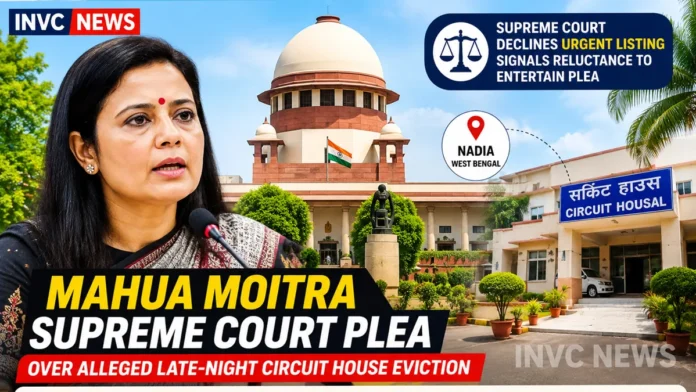
The Supreme Court on Monday declined to grant urgent listing to a plea filed by Trinamool Congress MP Mahua Moitra over her alleged late-night eviction from a government circuit house in Nadia district, West Bengal, with the Chief Justice indicating reluctance to entertain the matter at this stage.
Moitra, the Lok Sabha MP from Krishnanagar, approached the top court after alleging that Nadia district officials sought to remove her from the Circuit House late on the night of August 14, despite her having been allotted accommodation there.
Her counsel told the court that the matter raised constitutional and federal questions and sought an early hearing.
However, Chief Justice of India Surya Kant indicated that the court was not inclined to take up the matter urgently.
The development adds a new legal dimension to a controversy that has already moved through administrative, parliamentary and political channels.
What Happened in the Supreme Court?
Moitra’s plea was mentioned before the Supreme Court for urgent listing.
Her counsel argued that she had allegedly been asked to vacate her constituency accommodation late at night despite a protective order from the Calcutta High Court.
The lawyer also argued that the issue involved questions of federalism and warranted an independent investigation.
The Chief Justice, however, did not agree to urgently list the matter and signaled reluctance to entertain the petition at that stage.
That distinction is legally important.
The Supreme Court’s response should not be described as a final ruling on the merits of Moitra’s claims.
Rather, the immediate development concerns the court’s refusal to provide urgent listing and its apparent reluctance to take up the matter.
What Mahua Moitra Has Alleged
Moitra has alleged that she arrived at the Nadia Circuit House on August 14 and was allotted a room where she generally stays during visits to her constituency.
According to her version of events, she was later contacted by district officials and asked to vacate the accommodation late at night.
She has alleged that the eviction order was communicated to her at around 10:50 p.m.
Moitra has also claimed that a crowd had gathered outside the Circuit House while the dispute was unfolding.
Those claims form part of her account and should be treated as allegations unless independently established through official records or judicial findings.
Why the Nadia Circuit House Dispute Became Politically Significant
The episode quickly moved beyond a routine accommodation dispute because Moitra is a sitting Member of Parliament.
She argued that the manner in which the administration acted raised questions about the treatment of an elected representative.
The dispute also became politically charged because of competing claims involving the district administration and political workers.
Moitra subsequently sought intervention from Lok Sabha Speaker Om Birla.
She has also raised a privilege complaint against senior district officials.
That parliamentary angle makes the case more significant than a standard dispute over use of government accommodation.
INVC has recently tracked wider tensions inside Parliament, including Lok Sabha disruptions and Speaker Om Birla’s appeals for orderly debate.
What Is a Circuit House?
Circuit houses are government-owned guest facilities generally used by ministers, judges, elected representatives, senior officials and visiting government functionaries.
Rules governing allotment can vary between states and districts.
The central legal question in such disputes usually depends on the applicable allotment rules, the authority issuing the order and whether any earlier court protection applies.
Moitra’s case is complicated by her contention that the Calcutta High Court had already given her protection.
The precise scope of that protection could become important if the matter returns to court.
Why the Supreme Court’s Response Matters
A refusal to urgently list a case is not the same thing as dismissing the underlying petition.
That distinction matters for both legal accuracy and public understanding.
An urgent-listing request essentially asks the court to hear a matter sooner than the normal process.
The court may refuse that request without necessarily deciding every legal issue raised in the petition.
In Moitra’s case, however, the Chief Justice’s remarks also indicated broader reluctance to entertain the matter.
That could influence how the dispute proceeds from here.
Could Mahua Moitra Still Pursue Legal Remedies?
Potentially, yes.
The precise options will depend on the status of her petition, the contents of the Calcutta High Court order she relies on and any subsequent action taken by the Nadia district administration.
Possible legal routes could involve further proceedings before the appropriate court if a fresh cause of action arises or if she seeks enforcement of an existing judicial order.
However, any future step would depend on the specific legal record.
It would therefore be premature to say that the dispute is completely over.
Parliamentary Privilege Adds Another Layer
Moitra has also raised the matter through Parliament.
A privilege notice generally alleges conduct that may have obstructed or interfered with the functioning, dignity or rights of a Member of Parliament.
Such complaints follow parliamentary procedures separate from court proceedings.
That means the Nadia Circuit House dispute can potentially continue on more than one track.
One track involves the courts.
Another involves the Lok Sabha and parliamentary privilege mechanisms.
The political debate can continue independently of both.
West Bengal Political Context
The controversy comes at a politically sensitive time in West Bengal.
The state has seen intense political competition and frequent disputes involving administrative decisions, political parties and elected representatives.
INVC has previously covered major developments in West Bengal politics and leadership battles.
The Circuit House dispute will likely be viewed through that larger political lens even though the immediate issue before the Supreme Court is legal and procedural.
That makes careful language especially important.
Claims made by Moitra, district officials or political parties should remain clearly attributed unless confirmed by judicial findings or official documentary records.
Why “Supreme Court Dismisses Plea” Would Be Too Strong
For publishers and readers, the wording of the headline matters.
Based on the available court reports, saying that the Supreme Court definitively “dismissed” Moitra’s petition could overstate what happened.
The clearer formulation is:
The Supreme Court declined urgent listing and indicated reluctance to entertain the matter.
This reflects the procedural position more accurately.
Legal stories often change substantially depending on whether a court:
- refuses urgent listing,
- issues notice,
- dismisses a petition,
- allows withdrawal,
- declines to entertain a matter,
- or decides the dispute on merits.
Those outcomes are not interchangeable.
What Happens Next?
The next development could come from one of several directions.
Moitra could take further legal steps depending on advice from her counsel.
The Nadia administration could issue further clarification or documentation.
The parliamentary privilege complaint could also move forward.
Alternatively, the matter may remain politically active even without immediate court proceedings.
For now, the Supreme Court’s refusal to urgently list the case is the most significant fresh legal development.
The Bigger Legal and Political Question
The Mahua Moitra Circuit House dispute highlights a broader issue: how disputes involving elected representatives, local administration and government facilities should be handled when political tensions are already high.
Moitra says the late-night action violated her rights and disregarded court protection.
The administration’s legal position and the precise basis of the eviction order will be central to any future adjudication.
The Supreme Court has, for now, declined to give the matter urgent priority.
That does not automatically settle every underlying allegation.
But it does significantly alter the immediate legal trajectory of the controversy.