New Delhi, India | August 22, 2026 —
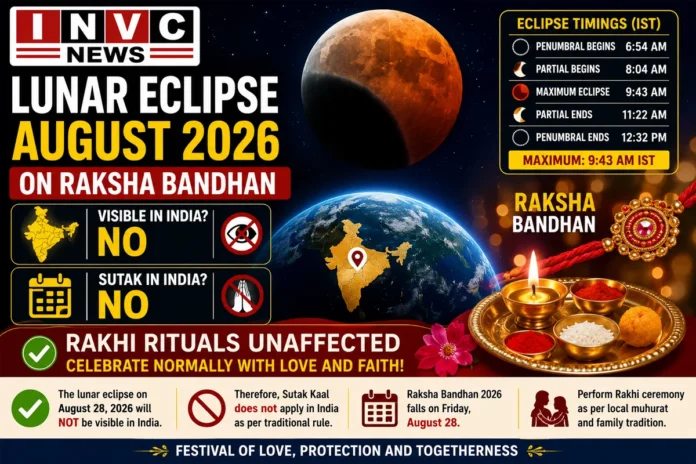
The Lunar Eclipse August 2026 will occur on Friday, August 28, the same day as Raksha Bandhan, raising widespread questions about whether the Chandra Grahan will be visible in India, whether Sutak Kaal will apply, and whether the eclipse will affect Rakhi rituals.
The short answer is clear: the August 28 partial lunar eclipse will not be visible from India, because the Moon will be below the horizon during the entire event.
As a result, under the traditional visibility-based rule followed in Hindu practice, Sutak Kaal will not apply in India.
That means Raksha Bandhan rituals can proceed according to the normal local Panchang and Rakhi Muhurat without eclipse-related restrictions.
Lunar Eclipse August 2026: Date and Time in India
The eclipse will take place on August 28, 2026.
Converted into Indian Standard Time, the approximate phases are:
Penumbral eclipse begins: 6:54 AM IST
Partial eclipse begins: 8:04 AM IST
Maximum eclipse: 9:43 AM IST
Partial eclipse ends: 11:22 AM IST
Penumbral eclipse ends: 12:32 PM IST
The main partial phase will last a little more than three hours.
These timings describe when the eclipse is taking place globally in Indian Standard Time. They do not mean the eclipse can be viewed from India.
Will the August 28 Lunar Eclipse Be Visible in India?
No.
The Lunar Eclipse August 2026 will not be visible from India.
During the eclipse, the Moon will already be below the horizon across the country.
That means viewers in cities such as New Delhi, Mumbai, Kolkata, Chennai, Bengaluru and other parts of India will not be able to see the eclipse directly.
Drik Panchang lists the eclipse as not visible from India, Nepal, Sri Lanka, Bangladesh, China, Japan and much of Asia.
Also Read: Chandra Grahan on Raksha Bandhan 2026: Will Sutak Apply in India? Here’s the Clear Answer
Where Will the Lunar Eclipse Be Visible?
The partial lunar eclipse will be visible from large parts of:
- North America
- South America
- Europe
- Africa
- Eastern Pacific regions
- Atlantic Ocean regions
The exact visibility and duration will vary by location.
In some regions, the Moon will rise or set while the eclipse is already underway.
How Deep Will the Eclipse Be?
This will be a deep partial lunar eclipse.
At maximum, most of the Moon will move into Earth’s umbral shadow.
Drik Panchang gives the eclipse a magnitude of approximately 0.929, meaning more than 90% of the Moon’s diameter will be covered by Earth’s main shadow at the peak.
Some reports describe the visible darkening as approaching roughly 96% coverage depending on the measurement used.
This is why the eclipse could appear dramatic in regions where it is visible, even though it is technically a partial eclipse rather than a total lunar eclipse.
Will the Moon Turn Red?
Part of the Moon may take on a reddish or copper-colored appearance during the eclipse.
This happens because sunlight passing through Earth’s atmosphere is filtered and refracted.
Shorter blue wavelengths are scattered more strongly, while red and orange wavelengths are more likely to reach the Moon.
This is the same broad optical process that contributes to red sunsets.
However, because this is not a total lunar eclipse, the entire Moon will not necessarily take on the uniform red appearance associated with a classic “Blood Moon.”
Does Sutak Kaal Apply in India?
No.
Because this eclipse is not visible anywhere in India, the traditional Sutak period is generally considered not applicable in India.
In Hindu practice, Sutak is usually observed before eclipses that are visible from the location where the devotee is present.
Since the Moon is below the Indian horizon throughout this event, the visibility condition is not met.
Therefore, normal religious activities are generally not restricted on account of this eclipse in India.
Does the Lunar Eclipse Affect Raksha Bandhan 2026?
This is likely to be the biggest search question.
Raksha Bandhan 2026 falls on the same day—Friday, August 28.
However, because the lunar eclipse is not visible in India and Sutak does not apply, the eclipse does not cancel or invalidate Raksha Bandhan rituals in India.
Families can perform the Rakhi ceremony according to their local Panchang and recommended Rakhi Muhurat.
For New Delhi, the recommended Rakhi tying window is approximately 5:57 AM to 9:48 AM.
That window remains valid from the standpoint of the eclipse because no Sutak restriction applies in India.
Also Read: Raksha Bandhan 2026: August 27 or 28? Correct Date, Rakhi Muhurat, Bhadra Timing and Puja Vidhi
Why Does Raksha Bandhan Coincide With a Lunar Eclipse?
Raksha Bandhan is celebrated on Shravana Purnima, or the Full Moon of the Shravana month.
A lunar eclipse can occur only around a Full Moon, when Earth moves between the Sun and the Moon.
That is why the eclipse and Raksha Bandhan can occasionally fall on the same date.
The coincidence may appear dramatic, but from an astronomical standpoint it is completely natural.
Can the Eclipse Be Watched Safely?
Yes.
Unlike a solar eclipse, a lunar eclipse is safe to view with the naked eye.
No special eclipse glasses are required.
People in regions where the eclipse is visible can watch it directly, although binoculars or a telescope can improve the view.
In India, however, direct viewing will not be possible because the Moon will be below the horizon throughout the event.
Is This the Last Lunar Eclipse of 2026?
Yes.
The August 28 event is the second and final lunar eclipse of 2026.
The year has two lunar eclipses, and this one closes the year’s lunar-eclipse calendar.
Lunar Eclipse 2026 and Religious Practices
Religious customs related to eclipses vary between families, regions and traditions.
Some devotees observe fasting, avoid cooking, postpone auspicious rituals or perform purification practices when an eclipse is visible locally.
For the August 28 eclipse, however, the usual visibility-based interpretation means those restrictions do not apply in India.
Readers who follow a specific family tradition, temple tradition or spiritual teacher may still choose to follow their customary guidance.
Raksha Bandhan 2026 Remains Unaffected in India
For families preparing to celebrate Raksha Bandhan, the key conclusion is straightforward.
The lunar eclipse and Raksha Bandhan fall on the same date, but the eclipse is not visible from India.
Therefore:
Sutak Kaal does not apply in India.
Rakhi rituals can proceed normally.
The New Delhi Rakhi Muhurat remains valid.
No eclipse-related restriction is required under the standard visibility rule.
The most important thing is to follow the correct local Rakhi Muhurat and Panchang rather than relying on alarming social-media claims about a Chandra Grahan automatically cancelling festival rituals.