KYIV, Ukraine | September 29, 2026 —
The danger facing Kyiv is changing.
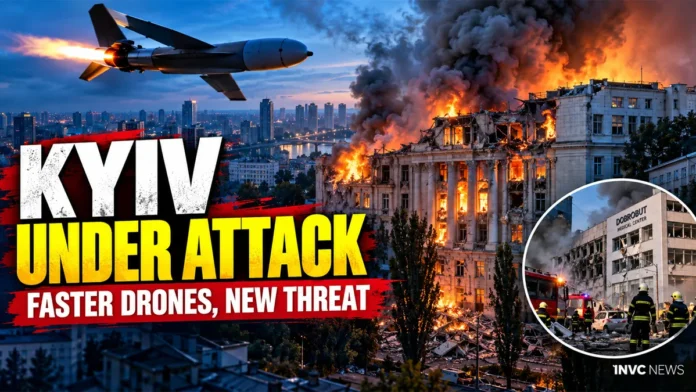
Russia is increasingly using faster jet-powered attack drones that give Ukrainian air defenses less time to react, and the latest wave has brought that threat directly into workplaces, medical facilities and residential areas of the Ukrainian capital.
A Russian drone strike on Ukraine’s National Academy of Sciences killed two people, while attacks across Kyiv left at least 24 people injured, according to later reports. A separate strike damaged the Dobrobut medical center, where seven people were reported injured, including six employees.
Then, just hours later, Kyiv woke to fresh explosions early Tuesday.
The new attack means this is no longer simply the story of damage caused on September 28. It has become a developing security crisis stretching into September 29.
THE 60-SECOND BRIEF
Russia launched more than 120 drones across Ukraine on September 28, according to Ukrainian President Volodymyr Zelenskyy.
He said about 90 of them were jet-powered attack drones.
A strike on the National Academy of Sciences in central Kyiv killed two people, according to later reporting.
Kyiv authorities reported 24 people injured during attacks on the capital.
Seven people were injured at the Dobrobut medical center.
Across Ukraine, later reports put the death toll from Monday’s attacks at at least 10, with more than 80 people injured.
Early September 29, explosions were again heard in Kyiv, while debris fell into the courtyard of a residential building.
Why This Attack Is Different
Kyiv has endured repeated drone and missile attacks during the war, but the growing use of jet-powered drones presents a more difficult challenge.
Unlike slower propeller-driven attack drones, jet-powered systems can travel faster and reduce the response time available to air-defense crews.
Zelenskyy said Ukraine was intercepting about 57% of the jet-powered drones being used in the latest attacks.
That figure helps explain why this latest assault matters beyond the immediate casualty count.
The threat is evolving, and Kyiv’s defenses are being forced to adapt.
Science Academy Hit During the Day
One of the most significant strikes hit a building belonging to the National Academy of Sciences of Ukraine in central Kyiv.
The attack caused a major fire and damaged several floors.
Emergency crews searched the building after the strike, while images from the area showed heavy smoke rising above the structure.
Later reporting said two people were killed at the academy.
The location made the attack particularly significant. This was not an isolated industrial site on the outskirts of the capital but a major scientific institution in central Kyiv.
Ukrainian officials condemned the strike and called for stronger international support for the country’s air-defense network.
Medical Center Damaged, Staff Among the Injured
The attacks also reached Kyiv’s healthcare infrastructure.
A strike damaged the Dobrobut medical center on Antonovycha Street.
The medical network said seven people were injured, six of them employees.
Upper sections of the building suffered damage, while fire affected parts of the medical facility. Windows were blown out and equipment was also damaged.
The center said it would temporarily suspend operations at the affected location while teams assessed the damage.
Other facilities within the medical network continued operating.
Why You May See Different Death Tolls
Readers following the Ukraine war may have seen figures ranging from seven deaths to nine or 10.
Those numbers are not necessarily contradictory.
Early reports reflected casualties confirmed at that specific moment, while later reports included deaths confirmed after rescue operations and information from additional regions.
Zelenskyy initially said nine people had been killed across Ukraine and more than 80 injured during the September 28 attacks.
Later reporting raised the nationwide toll to at least 10.
For Kyiv specifically, the clearest later figures showed two deaths at the National Academy of Sciences and 24 people injured across attacks on the capital.
Keeping those geographic distinctions separate matters.
A nationwide casualty figure should not be presented as the death toll for Kyiv alone.
Dnipro and Other Regions Also Hit
The assault stretched well beyond the Ukrainian capital.
In Dnipro, a drone struck a business center, killing three people and injuring 19, according to later reporting.
Other attacks were reported in areas including Zaporizhzhia, Synelnykove and several additional regions.
Residential buildings, offices and infrastructure were among the sites reported damaged during the wider wave of attacks.
The scale of the assault showed that Russia was not concentrating on a single city.
Instead, multiple areas faced drone strikes during the same period.
What Russia Says About Its Targets
Russia says its military operations target infrastructure connected to Ukraine’s military capabilities.
Moscow has repeatedly denied intentionally targeting civilians.
Ukrainian authorities dispute that characterization and point to repeated damage to homes, medical facilities and other civilian sites.
The destruction at the National Academy of Sciences and the Dobrobut medical center has renewed that dispute over the nature and impact of Russia’s aerial campaign.
Then Kyiv Was Hit Again
The most important development for September 29 came before dawn.
Explosions were heard again in Kyiv.
Mayor Vitali Klitschko said missile debris fell into the courtyard of a residential building.
A non-residential structure also caught fire elsewhere in the city.
Initial reports did not immediately confirm a new casualty toll from the Tuesday morning attack.
That distinction is crucial.
The confirmed deaths and many of the injuries reported so far relate to the September 28 attacks, while the impact of the September 29 explosions was still being assessed in the first reports.
What Happens Next
Three things now matter.
First, Ukrainian authorities will assess the full impact of the latest overnight attack.
Second, attention will remain on how effectively Ukraine can intercept Russia’s faster jet-powered drones.
Third, Kyiv is expected to renew pressure on its international partners for additional air-defense equipment and interceptor systems.
The increasingly compressed warning time created by faster drones could become one of the most consequential developments in the next phase of the air war.
INVC NEWS Bottom Line
Kyiv’s latest crisis is about more than another night of explosions. Russia’s growing use of faster jet-powered drones is putting additional pressure on Ukrainian air defenses, while strikes on a science institution, a medical center and residential areas show how quickly the threat can reach civilian life.
The National Academy of Sciences attack left two people dead, Kyiv reported 24 injured across Monday’s strikes, and the nationwide death toll rose to at least 10 in later reporting.
Now, with explosions heard again early September 29, the story remains active—and the key question is whether Ukraine’s air defenses can adapt quickly enough to a faster generation of attack drones.