By Team INVC | INVC NEWS
SEOUL, South Korea | September 18, 2026 —
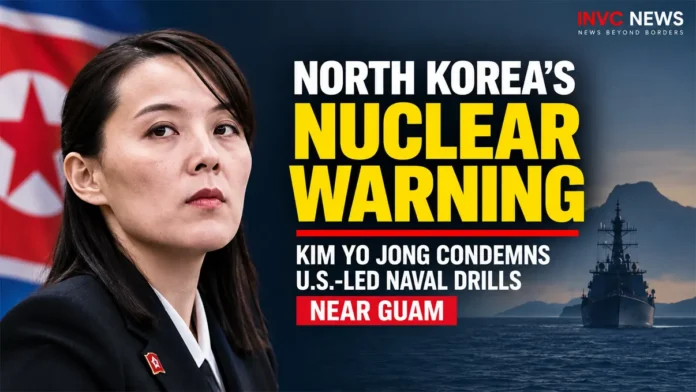
North Korea has issued a fresh warning over expanding U.S.-led military exercises in the Indo-Pacific, with Kim Yo Jong declaring that Pyongyang will continue strengthening its nuclear deterrent and could respond with measures that are “proportional or more offensive” if it believes its security interests are threatened.
Kim Yo Jong, the influential sister of North Korean leader Kim Jong Un, directed her criticism at Pacific Vanguard 2026, a multinational naval exercise conducted near Guam involving the United States and several allied countries.
Her statement adds another layer of tension to an already volatile security environment in East Asia.
However, the wording requires care.
Kim did not announce an immediate nuclear strike or identify a specific target.
Instead, she argued that expanded U.S.-led military cooperation gives North Korea further justification to strengthen its nuclear war deterrent and military response capabilities.
That distinction is critical.
Kim Yo Jong Targets Pacific Vanguard 2026
Kim Yo Jong described Pacific Vanguard as a threatening U.S.-led military exercise designed, in Pyongyang’s view, to expand American military influence in the Asia-Pacific.
The exercise brought together forces from the United States, South Korea, Japan, Australia, Canada and New Zealand.
Training included anti-ship, air-defence and anti-submarine warfare operations.
North Korea has repeatedly argued that such exercises increase military pressure around the Korean Peninsula.
The United States and its allies describe the drills differently.
They say multinational exercises improve interoperability, readiness and the ability of partner forces to respond collectively to security threats.
That difference in interpretation sits at the heart of the latest confrontation.
North Korea Says Its Nuclear Course Will Not Change
Kim’s most significant message concerned nuclear policy.
She said there would be no change in North Korea’s course of strengthening what Pyongyang calls its nuclear war deterrent.
Her statement follows a broader series of North Korean declarations rejecting international calls for denuclearisation.
Just a day earlier, Kim Yo Jong criticised renewed discussion of North Korean denuclearisation at an International Atomic Energy Agency gathering.
Pyongyang has increasingly presented its nuclear status as permanent and irreversible.
The United States, South Korea and other governments have not accepted that position.
Why Guam Matters
The location of Pacific Vanguard adds strategic significance to the dispute.
Guam is a major U.S. military hub in the western Pacific.
American air and naval forces operating from Guam play an important role in U.S. regional strategy.
North Korea has previously referred to Guam in its military rhetoric because of the island’s strategic position and U.S. military infrastructure.
However, Kim Yo Jong’s latest statement should not be interpreted as an announcement of an attack on Guam.
Her comments were directed more broadly at the U.S.-led exercise and the military network supporting it.
Kim Warns of ‘More Offensive’ Response
One phrase in Kim’s statement will receive particular attention.
She said North Korea could take responsive measures that are “proportional or more offensive in nature” if outside military pressure continues to increase.
She also said North Korean armed forces would mobilise available means if the country’s security or national interests were violated.
Those remarks represent a warning.
They do not specify exactly what military action North Korea may take.
Possible responses could range from weapons demonstrations and missile tests to military exercises or other forms of pressure.
Any specific prediction beyond that would be speculative.
Tensions Have Already Been Rising
The latest statement does not come in isolation.
North Korea recently carried out live-fire drills involving missiles, artillery and drones.
Earlier in September, Pyongyang also launched several short-range ballistic missiles toward the sea after another U.S.–South Korea–Japan military exercise.
North Korea described those exercises as provocations.
The United States and its allies said their drills were defensive and intended to improve readiness.
This cycle has become familiar.
Allied exercises are followed by North Korean criticism.
North Korea then conducts weapons tests or military demonstrations.
Those actions, in turn, strengthen arguments in Washington, Seoul and Tokyo for closer military coordination.
The result is a security spiral in which each side presents its own actions as responses to the other.
South Korea and Japan Again in Pyongyang’s Focus
Kim Yo Jong specifically highlighted South Korea and Japan’s participation in the U.S.-led military framework.
North Korea argues that growing trilateral security cooperation among Washington, Seoul and Tokyo is creating a military structure directed against Pyongyang.
The three governments say their cooperation has expanded in response to North Korea’s nuclear weapons and missile programmes.
Japan and South Korea have also increased information-sharing and coordinated military exercises with the United States.
For North Korea, that cooperation has become one of the main arguments used to justify continued weapons development.
Pacific Vanguard Was Larger Than a Trilateral Drill
Pacific Vanguard is important because it extends beyond the traditional U.S.–South Korea–Japan format.
The 2026 exercise also involved Australia, Canada and New Zealand.
That broader participation illustrates the increasingly multinational nature of Indo-Pacific military cooperation.
The U.S. Navy has presented Pacific Vanguard as an exercise aimed at improving interoperability among allied and partner forces.
Pyongyang sees the same expansion as evidence of an increasingly organised military bloc.
Those competing interpretations are unlikely to narrow soon.
Is North Korea Preparing Another Nuclear Test?
Kim Yo Jong’s remarks do not confirm that North Korea is preparing an immediate nuclear test.
They also do not establish a timetable for any new strategic weapons demonstration.
North Korea has continued developing missiles, nuclear-related capabilities and other weapons systems, but individual political statements should not automatically be treated as evidence that a particular test is imminent.
Any new test would need separate confirmation through official announcements, intelligence assessments or observable military activity.
Trump’s North Korea Diplomacy Faces Another Complication
The latest warning also complicates efforts to reopen diplomacy between Washington and Pyongyang.
U.S. President Donald Trump has previously shown interest in renewed engagement with Kim Jong Un.
South Korean President Lee Jae Myung has also expressed support for renewed dialogue if conditions permit.
North Korea, however, continues to reject denuclearisation as the basis for negotiations.
That creates a fundamental disagreement.
Washington and its allies continue to focus on nuclear risk.
Pyongyang wants its nuclear status treated as an established reality.
Until that divide narrows, diplomatic progress will remain difficult.
Why This Matters Beyond the Korean Peninsula
North Korea’s nuclear programme has consequences far beyond relations with South Korea.
Japan remains directly exposed to North Korean missile capabilities.
U.S. military forces operate throughout the region.
China and Russia also have major strategic interests on the Korean Peninsula.
The wider Indo-Pacific security architecture is changing as the United States builds closer defence coordination with regional allies.
North Korea’s response to those changes will influence missile development, military deployments and future exercises.
That makes Kim Yo Jong’s statement more than ordinary political rhetoric.
It provides another indication that Pyongyang intends to answer expanding allied military cooperation by strengthening its own deterrent rather than slowing its weapons programme.
What Happens Next?
The next important signal may come not from another statement but from military activity.
Analysts will watch for new missile launches, major weapons tests, large military exercises or announcements involving North Korea’s strategic forces.
They will also watch whether Washington, Seoul and Tokyo alter future exercises in response to Pyongyang’s warnings.
For now, neither side appears prepared to change its basic position.
The United States and its partners say military exercises are necessary for regional defence.
North Korea says those exercises justify stronger military capabilities.
That leaves the Korean Peninsula inside a familiar but increasingly dangerous cycle:
more exercises, stronger warnings, more weapons development—and fewer signs that either side is prepared to move first toward de-escalation.