By Team INVC | INVC NEWS
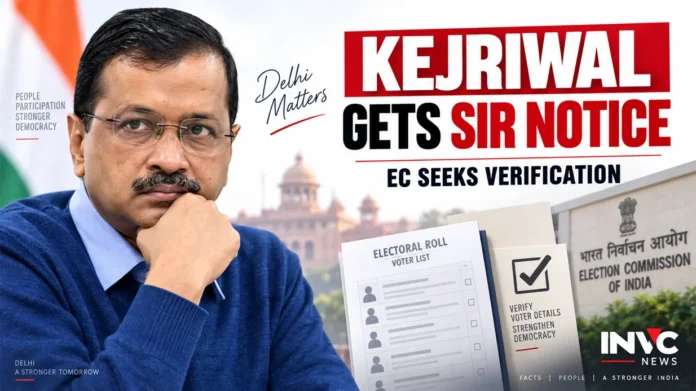
NEW DELHI, India | September 20, 2026 — A fresh political dispute has erupted over Delhi’s voter-list revision after former Chief Minister Arvind Kejriwal and four members of his family received notices under the ongoing Special Intensive Revision (SIR) of electoral rolls.
The Aam Aadmi Party questioned the development and claimed Kejriwal and his family were missing from the Delhi voter list. However, the Electoral Registration Officer for the New Delhi constituency later clarified that their names remain in the draft electoral roll and that the notices relate to document verification and their inability to link their entries with the previous intensive revision roll.
The clarification is important because receiving an SIR notice does not automatically mean that a voter has been deleted from the electoral roll.
Why Did Arvind Kejriwal and His Family Get SIR Notices?
Election officials said Arvind Kejriwal and his family were placed in the “No Mapping” category.
The notices cover Kejriwal, his wife Sunita Kejriwal, his son Pulkit Kejriwal, his father Gobind Ram Kejriwal and his mother Gita Devi.
According to the Electoral Registration Officer, the enumeration forms submitted by the family did not contain enough information to link their current electoral entries with the electoral roll used in the previous intensive revision.
As a result, election authorities generated notices asking them to provide the necessary documents and information for verification.
Election Officer Says Kejriwal’s Name Is in Draft Roll
The Election Officer rejected the suggestion that Kejriwal’s name had already been removed.
Officials said the former Delhi Chief Minister and his family members are registered as electors in Assembly Constituency 40 — New Delhi.
Their names appeared in the draft electoral roll, but they were flagged for further verification because election officials could not establish the required linkage with the previous SIR records using the information supplied in their enumeration forms.
After the required documents and facts are verified, the entries can be validated for inclusion in the final electoral roll.
AAP Questions Election Commission
AAP reacted sharply after the notices became public.
The party questioned how a three-time former Delhi Chief Minister and members of his family could face difficulties during the voter-list revision process.
However, election officials maintain that the notices form part of the standard SIR verification procedure and do not by themselves amount to deletion from the voter list.
The disagreement has now pushed what began as an administrative voter-verification exercise into Delhi’s political spotlight.
More Than 33 Lakh Delhi Electors Face Notices
Kejriwal and his family are far from the only electors affected.
Around 33.1 lakh Delhi electors have been issued notices for either “No Mapping” or “Logical Discrepancies” during the SIR process, according to election officials.
These notices broadly cover voters whose entries could not be linked with older electoral records or whose submitted information triggered discrepancies requiring further verification.
Importantly, this group should not be confused with voters whose names did not appear in Delhi’s draft electoral roll.
47.6 Lakh Names Did Not Enter Delhi Draft Roll
Delhi had approximately 1.45 crore registered electors when the SIR process began.
The draft electoral roll published on August 31 contained around 97.5 lakh names.
That left approximately 47.6 lakh previous electors outside the draft roll after the house-to-house verification exercise. Election officials classified many of them under categories including absent, shifted, dead, duplicate and others.
Those voters have a claims-and-objections process available to seek inclusion where eligible.
The deadline for claims and objections is September 30, 2026.
Delhi CM Rekha Gupta Also Received an SIR Notice
The revision exercise has also affected politicians from the ruling BJP.
Delhi Chief Minister Rekha Gupta received an SIR notice after her electoral entry was flagged under the “logical discrepancies” category.
Election officials subsequently carried out physical verification and examined her documents.
Her entry has now been validated for inclusion in the final electoral roll for Shalimar Bagh Assembly Constituency.
This demonstrates that an SIR notice is a verification step rather than, by itself, a final decision to remove an elector.
Why Are So Many Notices Being Issued?
Under the SIR process, election authorities are attempting to match current voters with entries from the previous intensive revision.
Broadly, voters can fall into two groups: those whose current records can be linked to earlier electoral entries and those for whom that linkage cannot be established.
Election officials can also flag logical discrepancies in information provided through enumeration forms.
In such cases, Booth Level Officers and Electoral Registration Officers can seek additional documents before deciding whether an entry qualifies for the final roll.
Supreme Court Hearing Adds Another Dimension
The Delhi SIR exercise is also heading back to the Supreme Court.
The court is scheduled to hear a petition on September 22 challenging aspects of the revision process.
The petition seeks greater transparency over notices issued to more than 33 lakh electors, including publication of the reasons that led voters to be classified under categories such as “No Mapping” or “Logical Discrepancies.”
The petitioners have questioned whether voters receive sufficient information to understand and respond to the discrepancies identified in their cases.
The Election Commission will have an opportunity to respond to those arguments before the court.
Final Delhi Electoral Roll Due November 4
The Election Commission revised Delhi’s SIR timetable earlier this year.
Under the current schedule, authorities will publish the final electoral roll on November 4, 2026.
Before then, officials will examine claims, objections, documents and responses to SIR notices.
For Kejriwal and his family, the immediate issue is therefore not an announced deletion.
It is whether they provide the information required to complete the linkage and verification process.
What the Kejriwal SIR Row Really Means
The controversy highlights a much larger issue than the electoral status of one political family.
Delhi is conducting a major revision involving millions of voter records.
Nearly 33.1 lakh electors have received verification notices, while around 47.6 lakh names did not make it into the August 31 draft roll.
That makes transparency, timely verification and access to the claims process important for voters across the capital.
For now, the Election Officer’s position is clear: Arvind Kejriwal and his family were issued notices because their submitted details did not establish linkage with the previous SIR roll—not because election authorities had already deleted them from the draft voter list.
The next major legal development will come when the Supreme Court takes up the Delhi SIR matter on September 22.