BEIRUT, Lebanon | September 6, 2026 —
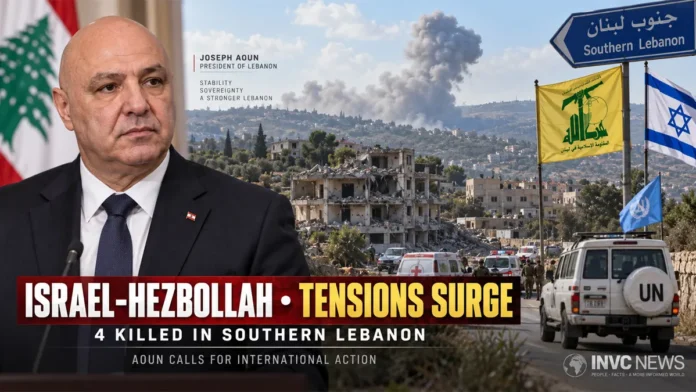
Israel Hezbollah Lebanon Strikes pushed the fragile ceasefire into fresh danger on Sunday after Israeli airstrikes killed four people in southern Lebanon, while Lebanese President Joseph Aoun condemned the attacks as a dangerous escalation and called for international intervention.
Lebanon’s Health Ministry said the strikes killed four people, including two women, and injured six others, among them two girls.
Israel said it launched the attacks after Hezbollah carried out drone attacks and said its military targeted sites connected to the Iran-backed group.
The renewed violence threatens to undermine a U.S.-brokered ceasefire that has reduced, but not ended, fighting between Israel and Hezbollah.
The latest escalation also comes as diplomatic efforts continue to prevent southern Lebanon from sliding back into full-scale war.
Israel Says Strikes Followed Hezbollah Drone Attacks
The Israeli military said its latest operations followed Hezbollah drone activity targeting Israel.
Israel said it struck Hezbollah weapons-storage facilities and a command center in southern Lebanon.
One of the sites, according to the Israeli military, had previously operated as a hospital before being used for military purposes.
Lebanese authorities have challenged Israel’s characterization of several targets and accused Israeli forces of striking civilian infrastructure.
President Aoun said the attacks hit civilian facilities, including a hospital and a Finance Ministry building.
That disagreement over the nature of the targets has added another layer to the already tense military confrontation.
Four Killed, Six Injured in Southern Lebanon
Lebanon’s Health Ministry reported four deaths from Sunday’s strikes.
Two women were among those killed.
Six other people suffered injuries, including two girls.
Some of the casualties occurred close to the security zone maintained by Israeli forces in southern Lebanon, while another deadly strike hit the Arab Salim area farther north.
The casualties have renewed fears among residents who had hoped the ceasefire would gradually reduce attacks and allow displaced families to return home.
Instead, periodic strikes and drone attacks continue to keep large parts of southern Lebanon under persistent security pressure.
Israel Issues Rare Evacuation Warning
Before one of Sunday’s strikes, Israel issued an evacuation warning to residents near the targeted area.
It marked only the second such warning since the latest ceasefire took effect.
Evacuation warnings can reduce civilian casualties by giving residents time to leave, but Lebanese authorities argue that repeated attacks still undermine the country’s sovereignty and make long-term civilian recovery extremely difficult.
The warning also underlined how sensitive the situation has become.
Israel continues to maintain that it reserves the right to act against Hezbollah infrastructure even while the ceasefire remains formally in place.
Lebanon, however, argues that continued Israeli military action violates the spirit and purpose of the truce.
President Joseph Aoun Condemns ‘Dangerous Escalation’
Lebanese President Joseph Aoun sharply condemned Sunday’s strikes.
Aoun described the attacks as a dangerous escalation and appealed for international intervention.
His response reflects growing concern inside Lebanon that the ceasefire could gradually erode if military exchanges continue.
The president has repeatedly called for Lebanese sovereignty to be respected and for international mediators to prevent the conflict from widening.
Aoun’s intervention also carries political significance because Lebanon’s government faces growing pressure from multiple directions.
It must deal with Israel’s continuing military presence in parts of the south, Hezbollah’s armed capabilities and diplomatic pressure from the United States and other international partners.
Hezbollah Accuses Israel of Increasing Pressure
Hezbollah has accused Israel of escalating military pressure on Lebanon while diplomatic negotiations continue.
The group argues that Israeli attacks are designed to pressure the Lebanese government and force political or security concessions.
Hezbollah has resisted proposals that would require it to surrender its weapons before Israel withdraws from southern Lebanese territory.
Israel, on the other hand, says Hezbollah must not be allowed to rebuild military positions close to its northern border.
This disagreement sits at the heart of the current crisis.
Each side links de-escalation to steps it expects the other side to take first.
Friday Strikes Had Already Raised Tensions
Sunday’s escalation did not emerge in isolation.
Israeli strikes on Friday killed another four people and injured 23, according to Lebanese authorities.
Those attacks took place without evacuation warnings.
The sequence of strikes over several days has therefore increased fears that the security situation is deteriorating rather than stabilizing.
Lebanese officials increasingly worry that repeated attacks could weaken public confidence in the ceasefire and trigger stronger Hezbollah retaliation.
Israel, meanwhile, argues that it must continue acting when it identifies threats or Hezbollah military infrastructure.
Ceasefire Has Failed to End Fighting Completely
The current ceasefire significantly reduced the intensity of hostilities but never produced a complete halt to military operations.
Israeli forces continue to operate inside a self-declared security zone in southern Lebanon.
Israel says the zone helps protect northern Israeli communities from Hezbollah attacks.
Lebanon considers the continuing Israeli presence a violation of its sovereignty.
Hezbollah has also remained active in the south despite military losses and repeated Israeli operations against its infrastructure.
That means the ceasefire has functioned more as a mechanism for reducing the scale of fighting than as a comprehensive political settlement.
Lebanon Still Bears Heavy Cost of Conflict
Lebanon has suffered severe human and economic damage during the renewed conflict.
Thousands have been killed since hostilities intensified in March.
Hundreds of thousands of people have also faced displacement, particularly in the south.
Homes, roads, schools and other infrastructure have sustained damage.
The displacement crisis has created additional pressure as Lebanon approaches the new school year.
Many schools have been used as shelters for displaced families, complicating efforts to reopen classrooms.
The conflict therefore continues to affect not only security but also education, housing, healthcare and the broader Lebanese economy.
Israel Targets Hezbollah Infrastructure
Israel says its military operations aim to prevent Hezbollah from rebuilding positions, weapons facilities and command networks close to the border.
Earlier this week, Israeli forces said they had cleared Hezbollah fighters from tunnels beneath the strategic Ali al-Taher ridge.
The ridge has emerged as one of the most important military flashpoints in southern Lebanon.
Its location provides strategic advantages and has made it a focus of Israeli operations.
Hezbollah has not accepted Israeli claims that its military infrastructure in the area has been neutralized.
The dispute over the ridge highlights how significant military issues remain unresolved despite the ceasefire.
Iran Factor Raises Wider Regional Stakes
Hezbollah’s close relationship with Iran adds another dimension to the conflict.
Tehran has warned against a major Israeli offensive in southern Lebanon.
Iran has treated Hezbollah’s position in Lebanon as part of its wider strategic confrontation with Israel and the United States.
That means a major escalation in Lebanon could affect much broader regional diplomacy.
Washington and Tehran are already locked in an increasingly dangerous confrontation involving sanctions, oil exports and military operations around the Strait of Hormuz.
A renewed Israel-Hezbollah war could therefore become linked to the wider Iran-US crisis.
International Mediators Face Tougher Challenge
The United States and other international actors have tried to keep the Lebanon ceasefire alive while encouraging further negotiations.
Those efforts now face increasing pressure.
Each new attack creates political difficulties for negotiators.
Lebanon wants Israeli military operations and territorial presence to end.
Israel wants guarantees that Hezbollah cannot rebuild its military infrastructure near the border.
Hezbollah rejects disarmament while Israeli forces remain on Lebanese territory.
Those positions remain difficult to reconcile.
Could the Ceasefire Collapse?
The immediate risk is not necessarily that Sunday’s strikes alone will trigger full-scale war.
The larger danger comes from accumulation.
One drone attack can provoke an airstrike.
That strike can produce casualties.
Those casualties can lead to retaliation.
Repeated cycles can eventually overwhelm diplomatic mechanisms designed to contain the conflict.
That is why President Aoun’s warning carries particular significance.
Lebanon’s government wants international mediators to intervene before individual military incidents become a broader escalation.
What Happens Next
Attention will now focus on whether Hezbollah responds militarily to Sunday’s strikes.
Israel will also face scrutiny over whether it carries out further attacks in southern Lebanon.
Any major Hezbollah retaliation against Israeli towns or military installations could produce a much larger Israeli response.
Conversely, another wave of Israeli strikes causing substantial civilian casualties could increase pressure on Hezbollah to retaliate.
The international diplomatic effort will therefore become critical over the coming days.
For now, the ceasefire technically remains in place.
But Sunday’s deaths demonstrate how fragile it has become.
Israel says it is targeting Hezbollah threats.
Hezbollah accuses Israel of deliberately escalating pressure.
Lebanon’s president is warning that the situation is becoming increasingly dangerous.
And civilians in southern Lebanon once again find themselves caught between a ceasefire on paper and military confrontation on the ground.