TEHRAN, Iran | September 8, 2026 —
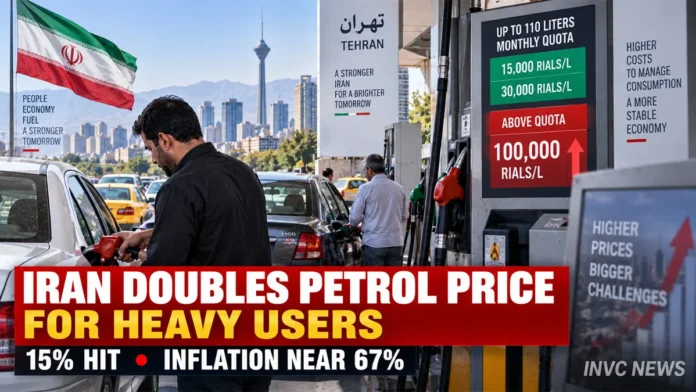
Iran Petrol Price Hike took effect Tuesday as the government doubled the price of gasoline purchased above the monthly subsidized quota, directly affecting the country’s heaviest fuel users at a time when households are already struggling with inflation of around 67%, a sharply weaker currency and declining purchasing power.
Under the new system, motorists who consume more than 110 liters of gasoline a month must now pay 100,000 rials per liter, twice the 50,000-rial rate that had applied to above-quota purchases since December.
Iranian authorities say the change will directly affect around 15% of gasoline consumers, leaving the majority of motorists within the existing subsidized quota system.
However, the impact could extend far beyond that 15%.
Economists and consumers are watching closely for possible increases in transportation costs, delivery charges and prices of everyday goods, raising fresh concerns that a fuel policy aimed at heavy users could feed into Iran’s already severe inflation problem.
Who Will Pay More for Petrol in Iran?
The government has preserved the subsidized gasoline allocations available to motorists.
Drivers continue to receive:
60 liters per month at 15,000 rials per liter
They can then buy:
Another 50 liters at 30,000 rials per liter
That gives motorists a combined monthly allocation of 110 liters under the lower-priced tiers.
Once consumption crosses that level, the new third-tier price applies.
Gasoline purchased beyond 110 liters now costs:
100,000 rials per liter
The previous third-tier rate was 50,000 rials.
In other words, the price for fuel consumed above the quota has doubled overnight.
Only 15% Directly Affected — But Wider Impact Could Be Bigger
Keramat Veis Karami, head of Iran’s state oil distribution company, said the higher rate is expected to affect about 15% of consumers.
That means most motorists should not immediately face a higher pump price if they remain within their existing monthly quotas.
But the economic impact may not stop there.
Heavy fuel users include people who drive long distances, some commercial operators and households that depend heavily on private vehicles.
If higher fuel costs are passed through to transportation and distribution networks, consumers could eventually see increases in the cost of food, services and other essential goods.
That risk has become particularly sensitive because Iran is already dealing with extremely high inflation.
Iran Inflation Running at Around 67%
Iran’s annual inflation rate is around 67%, according to the country’s national statistics authorities.
That means households are already paying substantially more for everyday goods than they were a year earlier.
At the same time, the Iranian rial has weakened sharply.
The US dollar traded at around 2.22 million rials on Monday in the open market, reflecting deep pressure on the domestic currency.
When a currency loses value, imported goods and raw materials become more expensive.
Combined with higher fuel costs, that can create additional pressure on household budgets.
For millions of people across Iran, the latest petrol increase therefore arrives in an economy where purchasing power has already been significantly eroded.
Why Did Iran Raise Gasoline Prices?
The government has linked the decision to what it described as the country’s “current situation” and the need to manage fuel consumption.
Iran is facing an increasingly difficult supply-demand imbalance.
Gasoline consumption reached a record 145 million liters per day in August.
Domestic production capacity, however, stood at around 122 million liters per day.
That leaves a gap of roughly 23 million liters a day.
Iran must cover at least part of that shortfall through imports, creating an unusual problem for a country that possesses some of the world’s largest oil reserves.
The government hopes higher prices for excessive consumption will discourage heavy fuel use and reduce pressure on domestic supply.
Cheap Petrol Has Encouraged High Consumption
Iran has historically maintained some of the cheapest gasoline prices in the world through extensive government subsidies.
Those subsidies have helped households but have also encouraged unusually high fuel consumption.
Experts have pointed to several structural reasons behind the problem.
Iran has large numbers of older vehicles that consume more fuel than modern cars.
Public transportation remains insufficient in some areas.
Economic sanctions have also complicated access to modern vehicles, replacement parts and technology.
As a result, policymakers face a difficult balance.
Keeping gasoline extremely cheap supports households, but it also encourages consumption at a time when domestic production cannot fully meet demand.
Government Says Extra Revenue Will Go to Households
Iran’s government says additional revenue generated by the higher gasoline price will be redirected to households.
Officials have presented the policy as an attempt to make fuel subsidies more targeted rather than placing the burden on all motorists.
Under that logic, people who consume significantly more subsidized fuel will pay more while lower-consumption households retain cheaper allocations.
However, the success of the policy will depend on whether redistribution offsets broader inflationary effects.
For households already facing rapidly rising food, housing and transportation costs, that question will become increasingly important.
Second Petrol Price Increase Since December
Tuesday’s change marks the second gasoline price increase since December.
The previous adjustment introduced a higher rate for consumption beyond subsidized quotas.
The government has now doubled that above-quota price again.
Repeated changes within less than a year suggest that Iran is struggling to manage both high domestic fuel demand and mounting economic pressure.
It also raises an obvious question for motorists: could petrol prices rise again?
Authorities have not announced another increase.
However, consumers remain concerned that the latest step may not be the last if fuel consumption continues to exceed production.
Why Petrol Prices Are Politically Sensitive in Iran
Fuel prices have long been one of the most politically sensitive economic issues in Iran.
For decades, heavily subsidized gasoline has effectively formed part of the social contract between the state and citizens.
Attempts to significantly raise prices have triggered public anger in the past.
In 2019, a sudden fuel price increase sparked widespread demonstrations across the country. Human-rights groups reported that hundreds of people were killed during the subsequent crackdown.
That history means Iranian authorities tend to approach fuel-price changes cautiously.
The current increase specifically targets consumers who exceed their monthly quota rather than raising subsidized prices for everyone.
War and Sanctions Add to Economic Pressure
The fuel decision also comes against an extraordinarily difficult geopolitical backdrop.
Months of conflict involving Iran and the United States have added pressure to an economy already constrained by international sanctions.
Restrictions on trade and finance have weakened investment and complicated Iran’s access to international markets.
At the same time, instability around the Strait of Hormuz has disrupted regional energy flows and pushed global crude prices higher.
Brent crude traded around $97 a barrel Tuesday, reflecting continuing concerns about Middle East supply disruptions.
Iran is a major oil producer, but its domestic refining and distribution system faces its own constraints.
That creates the paradox of an energy-rich country facing shortages and needing tighter controls on gasoline consumption.
Could Higher Petrol Prices Push Food Prices Up?
This is now one of the biggest concerns for Iranian households.
Gasoline affects more than private motorists.
Transportation is embedded in almost every part of the economy.
Farm produce needs to reach cities.
Retail goods need to move between warehouses and shops.
Businesses rely on vehicles for deliveries and services.
If transportation companies and commercial operators face higher fuel bills, some of those costs could eventually be passed on to consumers.
That does not mean every product will immediately become more expensive.
But with inflation already near 67%, even modest additional cost pressures can become significant.
What Changes for an Average Iranian Motorist?
For most drivers, the immediate answer is: nothing — provided they remain below 110 liters a month.
The first two subsidized fuel tiers remain unchanged.
The sharp increase applies only once a driver exceeds the quota.
For the roughly 15% of consumers who regularly cross that threshold, however, the financial impact is substantial.
Their marginal gasoline cost has doubled.
That gives motorists a strong incentive to reduce driving, shift trips to public transport where available or stay within subsidized allocations.
Iran Faces a Difficult Fuel Equation
The Iran Petrol Price Hike captures a much larger economic problem facing Tehran.
The government wants to protect subsidized fuel for most households.
At the same time, it needs to curb record consumption, reduce expensive imports and manage an economy under intense inflationary and geopolitical pressure.
Raising the price only for heavy users offers one compromise.
But it carries risks.
If the measure drives transportation and distribution costs higher, the economic burden could spread beyond the 15% of motorists directly paying the new price.
For Iranian households already struggling with a weaker currency and inflation near 67%, that is now the real concern: not simply how much petrol costs at the pump today, but whether higher fuel costs become the next trigger for another round of price increases across the economy.