By Team INVC | INVC NEWS
TEHRAN, Iran | September 14, 2026 —
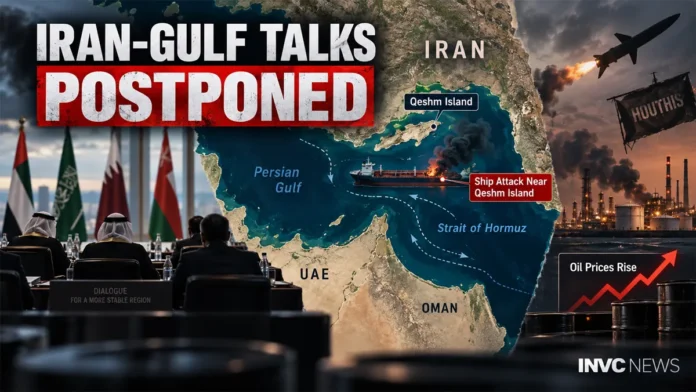
Iran Gulf talks over the Strait of Hormuz have suffered a major setback after a planned meeting between Tehran and Gulf Arab states in Oman was postponed, adding fresh uncertainty to an already dangerous Middle East security crisis.
The diplomatic delay came only hours after an Iranian commercial cargo vessel was struck near Qeshm Island in the Strait of Hormuz, killing at least one person and injuring others, according to Iranian state media.
At the same time, Iran-aligned Houthi forces in Yemen intensified attacks on Saudi Arabia as fighting around the strategic Bab el-Mandeb corridor raised fears that two of the world’s most important maritime energy routes could face disruption at the same time.
The combination of stalled diplomacy, shipping attacks and escalating regional conflict has once again pushed oil markets higher and increased pressure on Gulf governments to find a political solution.
Iran-Gulf Meeting in Oman Postponed
Iran and Gulf Arab states had planned to meet in Oman to discuss proposals aimed at stabilizing shipping through the Strait of Hormuz.
However, the talks were postponed before they could begin.
Iranian media said some regional countries requested the delay, while diplomatic reporting pointed to differences among Gulf governments over the proposed arrangement.
Oman has played a central mediation role throughout the crisis and has attempted to develop a framework that would reduce attacks on commercial shipping while giving regional governments a larger role in maintaining maritime security.
However, Gulf states have not reached a common position.
Bahrain had already indicated that it would not participate in the planned talks, while Saudi Arabia has raised concerns about the long-term implications of any agreement that could significantly strengthen Iran’s influence over shipping through Hormuz.
The postponement therefore represents more than a scheduling problem.
It exposes deeper disagreements about how Gulf states should deal with Tehran while the wider Iran-U.S.-Israel confrontation continues.
Iranian Cargo Ship Hit Near Qeshm Island
The diplomatic setback followed a fresh security incident in the Strait of Hormuz.
Iranian state media reported that a commercial cargo ship was struck near Qeshm Island.
At least one person died and several others suffered injuries.
Iranian officials blamed what they described as a hostile or terrorist attack, although responsibility had not been independently established early Monday.
The incident immediately increased concerns over commercial shipping through the narrow waterway.
The Strait of Hormuz connects the Persian Gulf with the Gulf of Oman and remains one of the world’s most important routes for crude oil, liquefied natural gas and petroleum products.
Any sustained disruption there can quickly affect global energy prices.
Houthis Open Another Pressure Point Near Bab el-Mandeb
The crisis has also widened toward Yemen.
Iran-aligned Houthi forces have expanded military operations along Yemen’s Red Sea coast and increased pressure near the Bab el-Mandeb Strait.
The group has captured strategically important territory, including areas around Mocha and Mayun Island, according to recent reports.
Those gains have increased concerns over maritime traffic through Bab el-Mandeb, which connects the Red Sea with the Gulf of Aden.
This route is especially important because ships moving between Europe and Asia use it to access the Suez Canal.
Disruption there forces vessels onto far longer routes around Africa.
That means the Middle East now faces simultaneous security pressure around both Hormuz and Bab el-Mandeb.
Houthi Attacks Put Saudi Arabia Under Pressure
Saudi Arabia has also faced renewed Houthi drone and missile attacks.
Recent strikes have targeted Saudi territory and energy infrastructure, adding another layer of risk to the regional conflict.
The kingdom has attempted to keep its direct military involvement limited while protecting critical oil facilities and shipping routes.
However, the growing Houthi presence near Bab el-Mandeb makes that strategy increasingly difficult.
Saudi Arabia depends heavily on both Gulf and Red Sea export routes.
If one route becomes unsafe, Riyadh normally has options to redirect some energy flows.
If both come under sustained pressure at the same time, those alternatives become much more limited.
Oil Prices Rise as Middle East Risk Grows
Energy markets have reacted quickly.
Brent crude moved sharply higher as investors assessed the impact of renewed attacks on Saudi infrastructure, shipping risks in Hormuz and uncertainty over diplomacy with Iran.
The market is no longer reacting only to individual military strikes.
Traders are increasingly focused on whether prolonged instability could create lasting disruption to Middle Eastern energy exports.
That concern matters far beyond the Gulf.
Higher crude prices can raise transportation and manufacturing costs, increase inflation and place new pressure on central banks around the world.
India is particularly sensitive because it imports most of its crude oil requirements.
A prolonged surge in international oil prices could therefore influence fuel costs, inflation expectations, government finances and the rupee.
Why the Strait of Hormuz Matters
The Strait of Hormuz is a narrow maritime passage between Iran and Oman.
A significant share of the world’s seaborne oil and LNG trade moves through the waterway.
That makes it one of the most strategically important shipping lanes on the planet.
Iran has repeatedly argued that regional countries should take greater responsibility for security in the Gulf.
The United States, meanwhile, maintains that international shipping must remain protected and that Tehran cannot use the waterway as leverage in broader nuclear, sanctions or security negotiations.
Those competing positions remain at the heart of the current diplomatic deadlock.
Gulf States Face Difficult Political Choice
The postponement of the Oman meeting also highlights divisions within the Gulf Cooperation Council.
Some governments want deeper dialogue with Tehran to reduce the risk of direct attacks.
Others remain concerned that a regional arrangement could normalize Iranian influence without resolving fundamental disagreements over missiles, proxy groups, maritime security and Tehran’s nuclear program.
That creates a difficult balance.
Gulf states want to avoid a broader war.
At the same time, they do not want any agreement that leaves them more vulnerable if tensions rise again.
Pezeshkian Keeps Diplomatic Door Open
Despite the military escalation, Iranian President Masoud Pezeshkian has continued diplomatic outreach.
His recent discussions with regional leaders have focused on de-escalation and cooperation.
Iran has also signaled that it remains open to a regional security framework.
However, Tehran continues to link broader maritime stability to U.S. sanctions, the blockade of Iranian trade and unresolved political disputes.
Washington, in contrast, wants a wider agreement addressing nuclear and regional security concerns.
That gap remains substantial.
Middle East Crisis Enters More Dangerous Phase
Monday’s developments show why the Middle East crisis has become increasingly difficult to contain.
A ship attack near Hormuz, Houthi advances near Bab el-Mandeb, pressure on Saudi Arabia and a postponed diplomatic meeting have combined into a single regional security problem.
The immediate question is whether Oman can revive negotiations quickly.
Without renewed diplomacy, shipping companies, Gulf governments and global energy markets may have to prepare for a longer period of instability.
For now, the key message from the region is clear: the diplomatic window remains open, but the military risks are growing faster than negotiations are progressing.