By Team INVC | INVC NEWS
Published: August 29, 2026, 9:35 AM IST
TEHRAN, IRAN | August 29, 2026 —
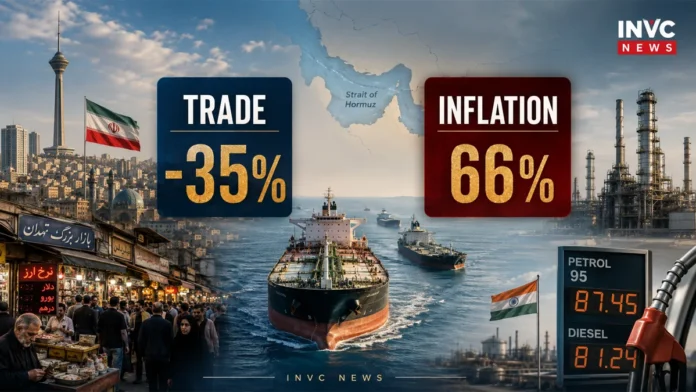
The Iran economy crisis entered a more dangerous phase Saturday as President Masoud Pezeshkian acknowledged that the country’s foreign trade has fallen nearly 35%, annual inflation surged to 66% last month, and Washington intensified its campaign to cut Tehran off from international finance.
The economic squeeze is unfolding while shipping through the Strait of Hormuz remains severely disrupted—keeping crude oil, LNG and global inflation risks alive for major energy importers including India.
Fresh shipping data showed only seven commodity vessels crossed the Strait of Hormuz on Thursday, sharply down from 17 a day earlier and well below the recent 10-day average of 15.
That combination creates a powerful economic pressure point:
Iran is earning less, importing less, facing 66% inflation—and still controlling access to one of the world’s most important energy corridors.
For India, which remains heavily dependent on imported crude, what happens next in Tehran and Hormuz could directly influence oil costs, the rupee, inflation and ultimately petrol and diesel pricing pressure.
Iran President Admits Trade Has Fallen Nearly 35%
The most striking admission came from Iranian President Masoud Pezeshkian.
Pezeshkian said Iran’s exports and imports have fallen nearly 35% because of U.S. sanctions and the naval blockade affecting Iranian ports.
That is no longer an outside estimate of economic damage.
It is an acknowledgement from Iran’s own president that the pressure campaign is cutting deeply into the country’s international trade.
Iran was able to sell approximately 90 million barrels of oil during a brief U.S.-approved window in June, Pezeshkian said.
But the temporary opening did not last.
With the conflict now around six months old and diplomatic negotiations stalled, Washington has again stepped up sanctions pressure.
Inflation Hits a Punishing 66%
Trade is only one part of Iran’s problem.
Annual inflation reached approximately:
66%
last month.
That means Iranian households are facing sharply rising prices at the same time as international trade, employment conditions and access to imported goods remain under severe pressure.
Iran’s leadership has now publicly called for action on inflation, unemployment and the prices of essential goods and services.
When inflation reaches levels this high, the damage spreads quickly.
Food becomes more expensive.
Imported goods become harder to afford.
Businesses struggle with input costs.
Savings lose purchasing power.
And pressure on the national currency can intensify.
Trump Administration Opens Another Financial Front
Washington is not easing the pressure.
The U.S. Treasury has launched what it calls Operation Economic Outcast, aimed at cutting Iran’s remaining financial channels and sanction-evasion networks.
On Friday, U.S. authorities proposed restrictions targeting Banque Misr UAE, accusing it of processing transactions linked to Iran.
The proposed measure would cut the bank’s UAE operations off from certain U.S. dollar correspondent banking relationships.
The Treasury also sanctioned an individual linked to Bank Melli and a Hong Kong-based company accused of helping Iranian financial networks.
This matters because access to dollars remains critical for global trade.
A business may be willing to trade with Iran—but if doing so threatens its access to the U.S. banking system, the commercial calculation changes dramatically.
Hormuz Traffic Drops Again
While the financial pressure intensifies, the physical trade route through the Strait of Hormuz remains unstable.
Only seven commodity vessels were recorded transiting the Strait on Thursday.
That was down from:
17 vessels a day earlier
and below the:
10-day average of 15 vessels.
The numbers are especially important because the Strait of Hormuz historically carries a major share of global oil and gas flows.
The United States says its forces have cleared Iranian mines and insists the waterway is open.
Iran’s Revolutionary Guards dispute that characterization and maintain that vessels cannot transit normally without Iranian approval.
In other words:
Washington says Hormuz is open. Tehran says it still controls access. Shipping data suggests normal traffic has not returned.
Also Read – : Iran Condemns US Over Renewed Oil Sanctions as Strait of Hormuz Tensions Escalate
Why India Cannot Ignore Iran’s Economic Crisis
For India, this is not a distant economic story.
Official government data shows India’s crude-oil import dependence has remained at roughly 88%.
Earlier government economic analysis also showed that nearly half of India’s imported crude came from the Middle East during the relevant period before the latest supply shock.
That creates a direct transmission route:
Hormuz disruption → tighter oil supply → higher freight and insurance → expensive crude → pressure on India’s import bill and inflation.
India has already been forced to diversify aggressively because of disruptions in West Asian supplies.
Russian crude has taken a larger share, while refiners have also looked toward Latin America, the United States and other suppliers.
But replacing Middle Eastern supply is neither effortless nor cost-free.
LNG Has Already Shown What Hormuz Disruption Can Do
India has already felt the impact in natural gas.
Indian companies recently paid some of their highest spot LNG prices since 2022 as disruptions around Iran and the Strait of Hormuz tightened available supply.
Also Read – : India Buys Costliest LNG Since 2022 as Iran War Chokes Supplies Through Strait of Hormuz
The same mechanism can affect crude oil if tanker traffic deteriorates again.
Higher energy costs do not remain confined to petrol pumps.
They can eventually affect:
- Transportation
- Aviation
- Fertilizers
- Manufacturing
- Logistics
- Food distribution
- Household inflation
That is why India will watch Hormuz negotiations as closely as it watches crude prices.
Iran Now Faces a Brutal Economic Choice
Tehran still possesses enormous strategic leverage because of its geography and energy resources.
But using Hormuz as leverage also carries economic costs for Iran itself.
The longer trade routes remain disrupted, the harder it becomes for Iran to export oil, receive payments, import products and stabilize domestic prices.
That creates an uncomfortable equation:
Closing economic pressure on rivals also increases economic pressure at home.
Qatar and Pakistan have been trying to revive diplomacy, while Iran and Oman have been discussing arrangements around maritime access.
But no durable breakthrough has yet restored normal shipping.
What Happens Next Could Move Oil Prices Fast
Three numbers now tell the story:
Trade: -35%
Inflation: 66%
Hormuz traffic: just 7 commodity vessels in a day
The next major trigger could be diplomatic.
If Iran agrees to a durable reopening of the Strait of Hormuz, energy markets could see significant relief.
If talks fail and Washington expands sanctions further, however, the pressure could intensify on Iran’s economy and global energy supply simultaneously.
For India, that would mean another round of uncertainty around crude prices, the rupee and imported inflation.
Iran’s economic crisis is therefore no longer just about whether Tehran can withstand U.S. sanctions.