By Team INVC | INVC NEWS
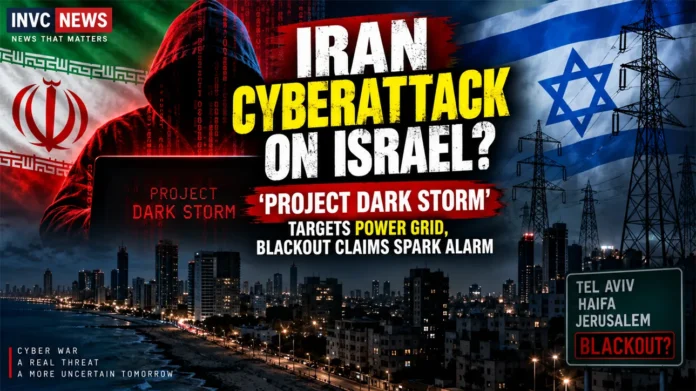
JERUSALEM, Israel | September 19, 2026 — Iran is at the centre of fresh cyberwar allegations after reports claimed that Iran-linked hackers targeted Israel’s electricity infrastructure in an operation described online as “Project Dark Storm.” The reports linked the alleged cyberattack to power disruptions in parts of Tel Aviv, Haifa and Jerusalem, intensifying fears that the Iran-Israel conflict may be expanding deeper into critical civilian infrastructure.
Iranian cyber activity against Israel is well documented. Israeli security agencies have reported a sharp increase in attempts by Iranian intelligence-linked actors to compromise Israeli officials, security personnel, journalists and other targets.
However, one crucial point remains unresolved: there is still no independent technical confirmation that “Project Dark Storm” successfully shut down Israel’s national power grid or caused all of the reported blackouts.
That means the wider Iran-linked cyber threat is real, while the scale and direct impact of this particular alleged operation remain under investigation.
Iran-Linked Hackers at Centre of Israel Cyberattack Claims
Cybersecurity researchers have tracked several groups sympathetic to or aligned with Iran that have repeatedly targeted Israeli organizations.
Among them is Dark Storm Team, also known as DarkStorm, a pro-Iranian and pro-Palestinian hacking collective associated primarily with large-scale DDoS attacks and other disruptive cyber operations.
Palo Alto Networks’ Unit 42 has documented Dark Storm Team among groups targeting Israeli digital infrastructure.
The group has previously claimed responsibility for attacks against Israeli websites and financial institutions.
That history is one reason the latest “Dark Storm” claims are attracting serious attention.
What Is ‘Project Dark Storm’?
Online reports have described the alleged attack as “Project Dark Storm.”
However, cybersecurity authorities have not publicly confirmed that this is the official name of an Iranian government operation.
It is also important to distinguish between Dark Storm Team, which is a known hacktivist group, and a directly controlled Iranian state cyber unit.
A group can support Iran politically without necessarily operating under direct orders from Tehran.
Attribution in cyber warfare often requires weeks or even months of forensic investigation.
Did Iran Shut Down Israel’s Power Grid?
This is the biggest question surrounding the story.
Claims circulating online suggest that the cyberattack disrupted electricity supplies in several major Israeli cities.
A successful penetration of Israel’s national electricity network would represent one of the most serious cyber escalations of the Iran-Israel conflict.
However, no authoritative public evidence has yet demonstrated that Iranian hackers gained operational control of Israel’s national electricity grid.
There is also no independently verified technical evidence linking all reported electricity disruptions in Tel Aviv, Haifa and Jerusalem to a single cyberattack.
Therefore, the blackout claims should currently be treated as allegations rather than a confirmed nationwide grid shutdown.
Iran Has Intensified Cyber Operations Against Israel
What is confirmed is the broader Iranian cyber offensive.
Israel’s Shin Bet security service and National Cyber Directorate said earlier this year that they had detected hundreds of cyberattack attempts linked to Iranian intelligence actors.
The targets included senior government officials, people connected with the defence establishment, academics, journalists and private citizens.
Iranian attackers have reportedly used phishing messages, fake documents and impersonation techniques to gain access to private accounts and communications.
The increase became particularly pronounced as tensions between Iran and Israel escalated.
Western Governments Warn of Iranian State-Linked Hackers
Iranian state-linked cyber activity is not only an Israeli concern.
On September 15, the United States, United Kingdom and Netherlands issued a joint cybersecurity advisory about an Iranian-linked spyware campaign called CHOSEN BRICK.
Authorities attributed that operation to actors associated with Iran’s Ministry of Intelligence and Security.
The spyware campaign targeted dissidents, activists and journalists through sophisticated spear-phishing attacks.
The operation was designed to steal communications, account information and other sensitive data.
This latest warning provides fresh evidence that Iranian intelligence-linked cyber operations remain active.
Israel’s Critical Infrastructure Is a Major Target
Electricity, water, communications and transport systems have become some of the most valuable targets in modern warfare.
An attack on a power grid can potentially disrupt hospitals, transportation networks, telecommunications, financial systems and military facilities at the same time.
That makes electricity infrastructure extremely attractive to hostile cyber actors.
Iran-linked groups have previously claimed attempts to penetrate industrial-control systems and other operational technology connected with Israeli organizations.
Some pro-Iranian groups have also claimed access to SCADA and PLC systems, which are used to monitor and control industrial equipment.
Such claims demonstrate the attackers’ interest in infrastructure capable of producing real-world disruption.
Israel Says Cyber Threat Can Affect Daily Life
Israel is already treating cyber defence as a national-security issue.
The country’s National Cyber Directorate has warned that cyberattacks can directly affect civilians, the economy, public services and the government’s ability to function during emergencies.
Israel has also been strengthening legislation aimed at protecting organizations considered essential to national infrastructure.
The move reflects a growing concern that future conflicts may involve simultaneous military and cyberattacks.
Missiles could target physical infrastructure while hackers attack digital systems managing the same networks.
Dark Storm Team Has Targeted Israel Before
Dark Storm Team is not a new name in the Israel cyberwar.
Security researchers have previously associated the group with DDoS campaigns against Israeli targets.
These attacks attempt to overwhelm websites or online services with enormous volumes of internet traffic.
While disruptive, a DDoS attack is very different from taking control of an electricity grid.
Shutting down a national power network would generally require access to protected operational systems rather than simply overwhelming a public website.
That is why the latest claims require much stronger evidence.
Cyberwar Is Also an Information War
Another complication is that cyberwarfare does not take place only inside computer systems.
It also takes place through information.
Hacktivist groups sometimes claim responsibility for disruptions before technical investigations establish what actually happened.
In some cases, attackers exaggerate the impact of operations to create fear or increase their visibility.
A claim that hackers have taken down a national power grid can itself have psychological impact even if the technical disruption was limited.
This makes verification especially important during an active war.
Why Tel Aviv, Haifa and Jerusalem Matter
Reports mentioning Tel Aviv, Haifa and Jerusalem have attracted particular attention because all three cities are strategically and economically important.
Tel Aviv is Israel’s main commercial and technology hub.
Haifa contains strategically important industrial and port infrastructure.
Jerusalem is home to major government institutions.
Simultaneous electricity disruption across these areas would therefore represent an extraordinary development.
For exactly that reason, claims of a coordinated blackout require evidence from power operators, emergency services and cybersecurity investigators.
Iran-Israel War Moves Deeper Into Cyberspace
The larger story is already clear even without confirmation of the alleged nationwide blackout.
The confrontation between Iran and Israel is no longer restricted to missiles, drones and conventional military operations.
Cyber operations have become an important part of the conflict.
Iranian-linked hackers are using espionage, phishing, malware, data theft and disruptive attacks against Israeli targets.
At the same time, Israel possesses some of the world’s most advanced cyber capabilities.
That creates the possibility of a parallel digital conflict unfolding alongside the physical war.
Could Power Grids Become the Next Battlefield?
Critical infrastructure is becoming increasingly connected to software, sensors and communications networks.
That digitalisation improves efficiency but also creates new vulnerabilities.
A sophisticated attacker who gains access to industrial-control systems could potentially disrupt electricity generation or distribution.
Energy companies around the world are already strengthening cyber defences against threats linked to state actors.
The possibility that the Iran-Israel confrontation could eventually target electricity systems therefore cannot be dismissed.
What Is Confirmed Right Now?
The situation can be separated into verified facts and claims.
Confirmed: Iranian intelligence-linked cyber actors are actively targeting Israeli individuals and organizations.
Confirmed: Dark Storm Team is a known pro-Iranian hacktivist group that has targeted Israeli entities.
Confirmed: Western governments continue to warn about active Iranian state-linked cyber operations.
Not independently confirmed: That an operation officially called “Project Dark Storm” penetrated Israel’s national electricity grid.
Not independently confirmed: That Iran-linked hackers caused widespread simultaneous blackouts across Tel Aviv, Haifa and Jerusalem.
The cyber confrontation is real.
The specific national-grid shutdown claim still requires technical confirmation.
A New Front in the Iran-Israel Conflict
Whether “Project Dark Storm” eventually proves to be a major infrastructure attack or a cyberwar claim whose impact was overstated, the episode highlights a much larger danger.
Wars are increasingly being fought not only through aircraft, missiles and soldiers, but also through malware, stolen passwords and compromised computer systems.
For Iran and Israel, cyberspace has become another battlefield.
And if electricity grids, water networks or telecommunications infrastructure become direct targets, the impact of that cyberwar could move rapidly from computer screens into the daily lives of millions of people.