MUMBAI, August 14, 2026 —
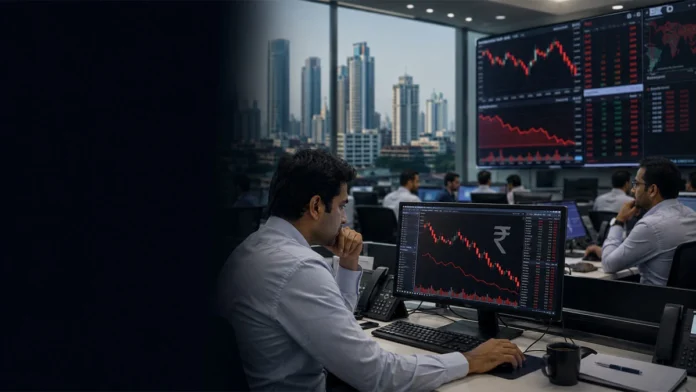
Indian Stock Market Today opened under pressure on Friday as cautious global sentiment and geopolitical uncertainty weighed on investors. The benchmark Sensex declined nearly 300 points during early trading, while the Nifty 50 slipped below the 24,350 level.
At one point during the morning session, the BSE Sensex traded at 77,800.37, down 279.59 points or 0.35% from its previous close. The NSE Nifty 50 stood at 24,330.00, recording a decline of 65.85 points or 0.27%.
These are intraday readings rather than closing figures, as Friday’s trading session was still underway when the data was recorded.
Both benchmarks remained within a relatively narrow range as investors assessed international market movements, crude-oil prices and geopolitical developments.
How Did Sensex and Nifty Perform?
The Sensex began Friday’s session at 77,903.43, representing an opening decline of approximately 0.23%. Selling pressure subsequently pushed the index close to the 77,800 level.
The Nifty opened at 24,361.90, down around 0.14%, before declining below 24,350 during early trading.
On Thursday, the Sensex had closed at 78,079.96, down 113.61 points or 0.15%. The Nifty 50 ended the previous session at 24,395.85, registering a decline of 40.10 points or 0.16%.
The movement indicates that investors remain cautious rather than engaging in broad panic selling. Market participants are closely monitoring whether the Nifty can regain the 24,400 level or face additional pressure during the session. Check the official NSE market dashboard
Trent and Hindalco Among the Major Laggards
Selling was visible across most sectoral indexes during the opening phase. Trent and Hindalco Industries were among the major Nifty laggards, with both stocks declining by approximately 2%.
Hindalco faced pressure following recent volatility in metal prices and its sharp movement during earlier sessions. Trent also witnessed selling as investors reduced exposure to some of the market’s highly valued consumer-focused stocks.
However, intraday share prices can change rapidly. Investors should verify the latest traded price before taking any financial decision.
Why Did the Indian Market Fall?
Several factors contributed to the cautious trading environment.
Geopolitical uncertainty
Escalating tensions in the Middle East continued to affect investor confidence. Concerns surrounding Iran, shipping routes and possible disruptions to global trade encouraged traders to reduce risk.
Weak global cues
Asian markets delivered a mixed performance. While Japanese equities moved higher, markets in Hong Kong, mainland China and Australia traded in negative territory.
This divergence provided little directional support for Indian equities and encouraged a wait-and-watch approach.
Range-bound crude-oil prices
International crude-oil prices stabilized near elevated levels. Although prices did not record a fresh surge, high energy costs remain a concern for India because the country imports most of its crude-oil requirements.
Sustained increases in crude prices can affect inflation, the rupee, corporate costs and the country’s import bill.
Weekly market weakness
The Sensex and Nifty entered Friday’s session with weekly losses of approximately 0.8%. Middle East tensions overshadowed generally positive corporate earnings and expectations that the U.S. Federal Reserve would maintain its existing policy stance. Review the reported opening-market data
How Did Global Markets Perform?
Global equities showed a mixed trend during Asian trading hours.
- Japan’s Topix advanced approximately 0.7%.
- Australia’s S&P/ASX 200 declined around 0.8%.
- Hong Kong’s Hang Seng fell approximately 0.7%.
- The Shanghai Composite slipped around 0.2%.
- S&P 500 futures showed little movement.
- Euro Stoxx 50 futures gained approximately 0.3%.
The uneven performance reflected uncertainty over geopolitical developments, energy prices and the interest-rate outlook.
Broader Market Remains Relatively Stable
Despite weakness in the large benchmark indexes, the broader market avoided a severe decline during early trading. Mid-cap and small-cap indexes remained comparatively stable.
That divergence suggests selling was concentrated in selected heavyweight and sectoral stocks rather than representing a complete withdrawal from Indian equities.
Nevertheless, market breadth remained weak, with most sectoral indexes trading in negative territory during the opening phase.
Key Levels Investors May Watch
For the Nifty 50, the area around 24,300 is an important short-term level. Sustained trading below it could increase selling pressure, while a recovery above 24,400 may improve sentiment.
For the Sensex, traders may monitor support near the 77,700–77,800 range. On the upside, the previous close near 78,080 could act as an immediate hurdle.
These levels are technical reference points, not guaranteed market outcomes.
What Could Influence the Market Next?
Investor attention is expected to remain focused on:
- Developments in the Middle East
- International crude-oil prices
- Foreign institutional investment flows
- Movement in the Indian rupee
- U.S. interest-rate expectations
- Corporate earnings and management commentary
- Performance of Asian and European markets
Volatility may continue through the remainder of the session as traders adjust positions before the weekend.
Disclaimer: This report is for informational purposes only and does not constitute investment advice. Market prices and index levels can change rapidly.