NEW DELHI, August 13, 2026
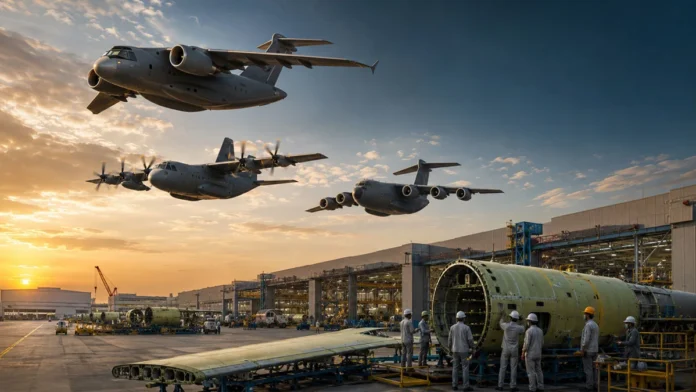
Indian Air Force transport aircraft tender: India has launched an estimated ₹1 lakh crore procurement program for 60 medium multirole transport aircraft as the Air Force prepares to replace part of its aging Soviet-origin cargo fleet and expand its tactical airlift capabilities.
The Ministry of Defence has invited proposals from Indian companies, with Hindustan Aeronautics Limited, Tata Advanced Systems and Mahindra among the domestic groups expected to participate. Indian companies will lead the bids and work with international aircraft manufacturers on production, assembly and long-term maintenance.
The leading aircraft under consideration are expected to include Embraer’s C-390 Millennium, offered with Mahindra; Lockheed Martin’s C-130J Super Hercules, backed by its partnership with Tata Advanced Systems; and Airbus’ larger A400M Atlas.
No aircraft has been selected, and the tender process is expected to involve extensive technical evaluation, commercial negotiations and scrutiny of technology-transfer and local-production commitments.
What Is the ₹1 Lakh Crore Transport Aircraft Program?
The program seeks to acquire 60 medium transport aircraft capable of carrying troops, military vehicles, equipment and humanitarian supplies.
The aircraft would help replace the Indian Air Force’s aging Antonov An-32 fleet while bridging the capability gap between the lighter C-295 and heavier strategic transport aircraft such as the C-17 Globemaster III and IL-76.
The final project value will depend on the selected platform, weapons and defensive systems, maintenance arrangements, infrastructure, simulators, spare engines, training and the extent of technology transfer.
The reported ₹1 lakh crore figure is therefore an estimated program cost rather than the price of the aircraft alone.
Which Companies and Aircraft Are Competing?
| Indian participant | International partner or supplier | Aircraft expected to be offered |
|---|---|---|
| Mahindra Group | Embraer Defense & Security | C-390 Millennium |
| Tata Advanced Systems | Lockheed Martin | C-130J Super Hercules |
| Indian company to lead local bid | Airbus Defence and Space | A400M Atlas |
| Hindustan Aeronautics Limited | Partnership structure not publicly finalized | Potential production or support role |
The tender has reportedly been sent to multiple Indian companies. However, every final bid, partnership and joint-venture structure has not yet been publicly disclosed.
Mahindra and Embraer Offer the C-390 Millennium
Mahindra Group has formed a strategic partnership with Brazilian aerospace company Embraer to promote the C-390 Millennium for the Air Force’s requirement.
The two companies signed a cooperation agreement covering joint marketing, industrialization and the possible production of the C-390 in India. They are also studying an Indian maintenance, repair and overhaul center if the aircraft wins the competition.
The jet-powered C-390 can perform troop and cargo transport, medical evacuation, disaster-relief and aerial-delivery missions. Its KC-390 configuration can also conduct air-to-air refueling.
Embraer has promoted India as a potential manufacturing and regional support hub for the aircraft. Embraer–Mahindra C-390 partnership
Tata and Lockheed Martin Back the C-130J
Tata Advanced Systems has partnered with Lockheed Martin to expand opportunities involving the C-130J Super Hercules in India.
The two companies signed an agreement in 2024 covering the Indian medium-transport competition, local maintenance capabilities and the possibility of establishing a C-130J production line in India if Lockheed Martin secures the order.
Tata Lockheed Martin Aerostructures already manufactures C-130J tail assemblies in Hyderabad for the aircraft’s worldwide supply chain. That existing industrial relationship could support Lockheed Martin’s localization proposal.
The C-130J is a four-engine turboprop tactical transport aircraft designed for operations from short and relatively austere airfields. It can perform cargo transport, special operations, medical evacuation, humanitarian relief and aerial-delivery missions.
The Indian Air Force already operates a fleet of 12 C-130J-30 Super Hercules aircraft, primarily for special operations and tactical airlift.
The existing fleet gives the Air Force operational experience with the platform, although a larger procurement would require a separate manufacturing, support and lifecycle-cost assessment. Lockheed Martin–Tata C-130J agreement
Is the Airbus A400M Also in the Competition?
Airbus has promoted its A400M Atlas for India’s medium-transport requirement.
The A400M is larger than the C-130J and C-390 and offers a higher payload capacity. It is designed to combine tactical operations from relatively short airfields with the range and capacity associated with strategic transport.
Its size could give the Air Force greater cargo flexibility, including the ability to move heavy equipment. However, acquisition and operating costs, infrastructure requirements and whether its higher capacity fits the tender’s technical parameters will be important considerations.
Airbus already has a major Indian manufacturing partnership with Tata Advanced Systems for the C-295 program. The final Indian partner and production structure for an A400M bid have not yet been formally announced.
How Many Aircraft Will Be Built in India?
About 20% of the 60 aircraft—or approximately 12 planes—are expected to arrive in flyaway condition from the selected foreign manufacturer.
The remaining 48 aircraft would be manufactured or assembled in India through an arrangement led by the selected Indian company.
The program reportedly targets more than 60% indigenous content during the local-production phase. However, the precise definition of indigenous content, the stages at which the target must be achieved and the components covered will depend on the tender conditions and final contract.
Local work could include:
- Aircraft assembly
- Structural manufacturing
- Wiring and electronic systems
- Mission-system integration
- Testing and certification
- Maintenance, repair and overhaul
- Spare-parts production
- Simulator and crew-training support
The winning proposal will likely be assessed not only on aircraft performance and price but also on the depth of technology transfer and long-term value created for India’s aerospace industry.
What Role Could HAL Play?
HAL is one of the Indian companies expected to participate in the tender. Its final role has not been publicly defined.
Depending on the winning industrial structure, HAL could potentially contribute to manufacturing, systems integration, testing, certification, maintenance or component production. It could also submit its own bid with an international manufacturer.
The tender’s Indian-led model means domestic companies will compete not merely as suppliers but as central participants responsible for manufacturing and lifecycle support.
How Is This Different From the C-295 Program?
The new medium-transport tender is separate from India’s ongoing C-295 program.
India signed a contract for 56 Airbus C-295 aircraft, not 70. The first 16 were to arrive in flyaway condition from Spain, while the remaining 40 are being manufactured by Tata Advanced Systems at its Vadodara facility.
The C-295 is a lighter aircraft capable of carrying up to about eight tonnes of payload. It is replacing the Indian Air Force’s Avro HS-748 fleet.
By comparison, the aircraft in the new competition offer substantially greater payload capacity:
- C-130J: approximately 20 tonnes, depending on configuration
- C-390 Millennium: approximately 26 tonnes
- A400M Atlas: up to approximately 37 tonnes
The new aircraft would therefore occupy the space between the C-295 and India’s larger strategic airlifters. Official C-295 production program
Can the New Aircraft Serve as Aerial Refueling Tankers?
The Air Force may examine aerial-refueling capability as part of the multirole requirement, but the final missions will depend on the selected aircraft and contracted configuration.
The C-390 is available in a KC-390 tanker-transport version capable of refueling fixed-wing aircraft through a probe-and-drogue system. The A400M can also perform tanker missions with appropriate equipment.
The C-130 family includes aerial-refueling variants, although the standard C-130J transport configuration does not automatically provide every tanker capability.
If India orders a tanker-capable configuration, the aircraft could supplement troop and equipment transport with:
- Air-to-air refueling
- Medical evacuation
- Paratrooper operations
- Special-forces deployment
- Humanitarian assistance
- Disaster-relief missions
- Aerial delivery of supplies
- Rapid deployment to forward airfields
The Air Force will need to evaluate whether tanker capability should be installed across the fleet or limited to selected aircraft.
Why Does the Air Force Need New Transport Aircraft?
The An-32 has served the Indian Air Force for decades, including operations in high-altitude and remote regions. However, maintaining aging aircraft becomes increasingly expensive as airframes, engines and components approach the end of their planned service lives.
Modern transport aircraft offer longer range, higher payload capacity, improved fuel efficiency, advanced avionics and better defensive systems.
The requirement is particularly important for India because the Air Force must support widely separated operational areas, including high-altitude bases, island territories and regions with limited road connectivity.
The aircraft would also strengthen India’s capacity to respond to earthquakes, floods, cyclones and overseas evacuations.
How Does the Tender Fit Into Wider IAF Modernization?
The transport-aircraft program forms part of a broader effort to modernize the Air Force’s combat, logistics and training fleets.
India is also advancing a proposed acquisition of 114 Rafale fighters, for which France has submitted a technical and commercial offer. That process remains subject to negotiations and final government approvals.
Separately, the Air Force has ordered 70 HAL HTT-40 basic trainers, with an option for additional aircraft. Plans for further trainer acquisitions should not be presented as a finalized order until contracts are signed.
Other modernization priorities include Tejas Mk1A fighters, airborne early-warning aircraft, tanker capability, remotely piloted systems and upgrades to existing Su-30MKI aircraft.
What Happens Next?
The Indian companies and their foreign partners will now prepare detailed technical and commercial proposals.
The evaluation process is expected to examine:
- Payload and range
- High-altitude performance
- Short-runway capability
- Operating and maintenance costs
- Aerial-refueling potential
- Defensive systems
- Indigenous-content commitments
- Technology transfer
- Production timelines
- Lifecycle support
- Export and regional maintenance opportunities
Flight evaluations and field trials could follow before commercial negotiations begin. A contract would require additional approvals after the preferred aircraft and industrial offer are selected.
Given the program’s scale and technical complexity, the tender marks the beginning of a lengthy acquisition process—not an immediate purchase or final aircraft selection.