MUMBAI, INDIA | AUGUST 25, 2026 —
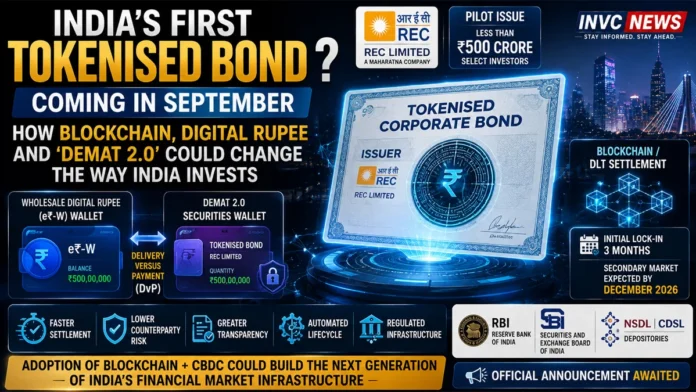
India tokenised bond pilot could mark a major shift in the country’s financial-market infrastructure, with state-owned REC expected to issue India’s first tokenised corporate bonds in September as regulators test whether blockchain and the digital rupee can make bond transactions faster and more efficient.
Current plans indicate that REC could issue less than ₹500 crore of tokenised bonds during an initial pilot involving a limited group of investors.
Instead of settling through only conventional securities infrastructure, participating investors are expected to use two digital accounts: a wholesale digital rupee, or e₹-W, wallet supplied through a participating bank and a new securities wallet being developed under the reported name DEMAT 2.0.
The securities wallet would record tokenised bond ownership through distributed-ledger technology, while the digital rupee would handle the payment side of the transaction.
The combination could allow the security and money to move almost simultaneously, potentially reducing settlement delays and counterparty risk.
However, one distinction is critical:
The September pilot has not yet been formally announced by RBI, SEBI, REC, NSDL or CDSL.
The current details are based on reports citing people directly familiar with the project. Timelines, investor participation and technical specifications could therefore change before launch.
India Tokenised Bond Pilot: What We Know So Far
The proposed pilot currently points to the following structure:
| Feature | Reported Plan |
|---|---|
| Expected issuer | REC |
| Expected launch | September 2026 |
| Issue size | Less than ₹500 crore |
| Technology | Blockchain / Distributed Ledger Technology |
| Payment leg | Wholesale Digital Rupee, e₹-W |
| Securities wallet | DEMAT 2.0 |
| Initial investors | Selected participants |
| Initial lock-in | Three months |
| Secondary market | Expected by December 2026 |
| Conventional EBP platform | Not expected to be used for pilot |
| Official final announcement | Still awaited |
The issue is reportedly expected to be unveiled around a major financial-technology event in Mumbai in September.
What Is a Tokenised Bond?
A tokenised bond is still a bond.
An investor effectively lends money to an issuer and receives a financial security representing that debt obligation.
What changes is the infrastructure used to record ownership and settle transactions.
In a traditional securities system, different intermediaries and databases can be involved in issuing, holding, trading and settling the bond.
Under a tokenised framework, ownership can be represented digitally on a distributed ledger.
That can potentially allow:
issuance → ownership → transfer → payment → settlement
to operate through more closely connected digital infrastructure.
The underlying economic risks of the bond do not disappear.
A tokenised corporate bond can still have:
- Credit risk
- Interest-rate risk
- Liquidity risk
- Market risk
- Issuer-specific risk
Blockchain changes the infrastructure. It does not magically make the investment risk-free.
This Is Not a Cryptocurrency Launch
That distinction will be extremely important for readers.
A tokenised bond should not automatically be confused with Bitcoin, Ether or an unregulated crypto token.
In this proposed pilot, the underlying asset would be a regulated corporate debt security.
The blockchain or distributed ledger is being considered primarily as record-keeping and settlement infrastructure.
Similarly, the digital rupee involved in the transaction would be central-bank money issued by the Reserve Bank of India rather than a privately issued cryptocurrency.
Why REC Could Be the First Issuer
REC is one of India’s major public-sector infrastructure financiers, with a long history of raising money through domestic and overseas debt markets.
Using an established institutional bond issuer makes sense for a tightly controlled pilot because regulators and market participants can focus on testing the new infrastructure rather than introducing an unfamiliar issuer at the same time.
The planned issue size of less than ₹500 crore would also make the first test relatively small compared with India’s wider corporate-bond market.
That appears intentional.
The purpose of the initial transaction is likely to be learning whether the technology works reliably before considering much larger-scale adoption.
What Is DEMAT 2.0?
This may become one of the most searched terms around the pilot.
DEMAT 2.0 is the reported name for a new electronic securities wallet being developed by Indian depositories for tokenised securities.
It is expected to record bond holdings on a distributed-ledger network.
In simple terms:
Digital Rupee Wallet = Money
DEMAT 2.0 Wallet = Tokenised Securities
When an eligible investor purchases a tokenised bond, the payment could move through the wholesale CBDC wallet while ownership of the security moves through DEMAT 2.0.
The intention is to make the two sides of the transaction work together.
Will DEMAT 2.0 Replace Your Existing Demat Account?
No such conclusion should be drawn at this stage.
The pilot does not mean India’s conventional demat system is being abolished or immediately replaced.
Existing demat accounts operated through the established securities-market infrastructure remain central to stock, bond, ETF and other investment holdings.
DEMAT 2.0 should currently be viewed as a specialized pilot infrastructure for tokenised securities, not as a replacement for every investor’s existing demat account.
The final architecture will depend on what regulators and market institutions announce.
Also Read – : IPO This Week: ₹3,300 Crore-Plus Rush as 10 Companies Hit Dalal Street
How the Digital Rupee Fits Into the Bond Transaction
The other major innovation is India’s central bank digital currency.
The Reserve Bank of India launched the wholesale digital rupee pilot in November 2022, initially for settlement of secondary-market transactions in government securities.
The wholesale CBDC is designed for financial institutions and large-value transactions rather than normal consumer shopping.
It differs from the retail digital rupee used by individuals.
In the tokenised-bond pilot, participating investors are expected to use e₹-W to pay for the securities.
That potentially allows both sides of the trade to be digital:
Tokenised security moves to buyer
while
Digital central-bank money moves to seller
This is important because a blockchain-based security provides only part of the efficiency gain if the payment side still depends on slower or disconnected infrastructure.
Why RBI Has Been Testing Wholesale CBDC
RBI has previously said wholesale CBDC could improve settlement efficiency and reduce settlement risk.
Its initial wholesale pilot focused on government securities.
The scope was later expanded to interbank lending and borrowing.
Using e₹-W for tokenised corporate bonds would therefore represent another significant use case if the September plan proceeds.
Rather than viewing the digital rupee merely as a replacement for physical cash, the wholesale experiment demonstrates another possible role:
rebuilding parts of financial-market infrastructure around programmable central-bank money.
Digital Rupee Is Not the Same as UPI
This is another common source of confusion.
UPI and the digital rupee can both move money digitally, but they are fundamentally different.
UPI is a payment infrastructure that moves money between bank accounts.
Digital Rupee is itself central-bank digital money issued by RBI.
UPI has already transformed everyday payments in India.
INVC NEWS has tracked that expansion as monthly transaction volumes moved beyond 22 billion transactions.
Also Read – : UPI Sets New Milestone: India Records 22.35 Billion Transactions in April 2026
The tokenised-bond experiment could test whether India can bring a similar degree of digital innovation into securities settlement.
Could Tokenised Bonds Settle Instantly?
That is one of the biggest potential advantages.
Traditional securities markets separate trade execution from final settlement.
During that interval, counterparties can remain exposed to each other and financial institutions may need liquidity, collateral and reconciliation processes.
A distributed-ledger structure combined with wholesale CBDC could potentially support near-instant delivery-versus-payment settlement.
That means the bond would transfer only when the corresponding payment also transfers.
Potential advantages include:
- Faster settlement
- Lower counterparty exposure
- Reduced reconciliation
- Fewer manual processes
- Better transaction traceability
- More efficient use of collateral
However, faster settlement also creates new operational questions.
Participants may need to have money available immediately rather than relying on longer settlement windows.
Technology resilience and wallet interoperability also become critical.
Blockchain Does Not Remove Every Middleman
Blockchain stories are often presented as if distributed ledgers automatically eliminate intermediaries.
Financial markets are more complicated.
Regulators, issuers, depositories, banks, exchanges and other institutions can still play important roles in:
- Investor identification
- KYC
- Custody
- Regulatory reporting
- Issuer disclosures
- Compliance
- Market surveillance
- Investor protection
- Dispute resolution
The real question is not whether blockchain eliminates every intermediary.
It is whether the technology can remove unnecessary duplication and reconciliation while retaining regulatory protections.
Why RBI and SEBI Cooperation Matters
A tokenised corporate bond sits at the intersection of two regulatory worlds.
RBI oversees monetary and payment-system infrastructure, including the digital rupee.
SEBI regulates India’s securities markets.
For the system to work, digital money infrastructure and securities-market infrastructure must connect safely.
That makes cooperation between the central bank and securities regulator particularly important.
India has already been evolving its broader digital-payments governance framework.
Also Read – : RBI Payment Regulatory Board Replaces BPSS in Major Digital Payment Governance Shift
Why DEMAT 2.0 Could Be More Important Than the Word “Blockchain”
“Blockchain” is the term most likely to grab attention.
But from an investor perspective, DEMAT 2.0 may ultimately be the more consequential innovation.
India already transformed physical share certificates into electronic securities through dematerialization.
A new DLT-based securities wallet could represent another stage of that evolution.
The question is whether tokenized infrastructure can eventually support:
- Corporate bonds
- Government securities
- Other debt instruments
- Fund units
- Additional regulated financial assets
There is no official indication that all these asset classes will be included.
But a successful bond pilot would provide regulators with real-world evidence about what may be technically possible.
Who Can Invest in the First Tokenised Bond?
Initially, apparently not everyone.
The September pilot is expected to be restricted to a select group of investors.
Their identities have not been publicly disclosed.
That means retail investors should not assume they will be able to open a new wallet and buy the REC tokenised bond immediately.
The first phase appears designed as a controlled-market experiment.
If the infrastructure works reliably, participation could potentially broaden later—but no such expansion should be treated as confirmed.
Why Is There a Three-Month Lock-In?
The proposed securities are expected to carry an initial three-month lock-in period.
That could give regulators, depositories, banks and investors time to test primary issuance and settlement before introducing more active trading.
A secondary market is reportedly expected to be developed by December.
Again, that timeline is part of the reported plan rather than a final publicly issued regulatory schedule.
What Could Happen in December?
Indian exchanges are expected to work toward a secondary market for tokenised bonds by December 2026.
If implemented, investors holding compatible CBDC and securities wallets could potentially trade tokenised bonds with one another.
That would be important.
Issuing one bond on blockchain proves only that the primary transaction can work.
A functioning secondary market must demonstrate that the infrastructure can handle:
- Repeated transfers
- Price discovery
- Settlement
- Liquidity
- Custody
- Market supervision
Those tests would bring the experiment much closer to real financial-market use.
Could Retail Investors Eventually Benefit?
Potentially.
If tokenisation succeeds at scale, future investors could benefit from faster settlement and more efficient securities infrastructure.
Tokenisation can also theoretically support smaller units of ownership, although fractional access has not been announced as part of this REC pilot.
Therefore, investors should not assume that tokenised bonds will automatically mean ₹100 or ₹500 bond investments.
The first Indian pilot appears focused on settlement technology rather than mass-market fractional investing.
Could Tokenisation Reduce Bond Investment Costs?
Possibly, but that is not guaranteed.
Automation can reduce reconciliation and operational processes.
That could lower infrastructure costs over time.
But regulated financial markets still require technology, custody, cybersecurity, compliance and supervision.
Those systems cost money.
The key question is whether blockchain infrastructure can lower total friction enough to outweigh the cost of maintaining the new system.
Security Becomes Even More Important
Digital securities wallets also create cybersecurity challenges.
A regulated tokenised bond cannot afford the kind of security weaknesses sometimes associated with poorly designed crypto projects.
Market institutions will need strong controls around:
- Wallet access
- Authentication
- Private credentials
- Cyberattacks
- Operational outages
- Transaction recovery
- Identity verification
Investors should also be careful not to confuse legitimate tokenised securities with fraudulent crypto schemes using words such as “government bond token” or “digital rupee investment.”
No public retail offer of the September REC pilot has been announced.
Could Tokenised Bonds Change Corporate Fundraising?
If the technology scales successfully, issuers could eventually gain a new method of raising debt.
Potential advantages could include:
- Faster issuance
- Faster settlement
- Improved record keeping
- Greater automation
- Better transparency
- Potentially wider future investor access
For large issuers, even modest improvements in market infrastructure can become economically significant when borrowing volumes are large.
But adoption will depend on whether investors and institutions see tangible benefits over the existing bond market.
Why This Matters for India’s FinTech Story
India’s FinTech success has so far been most visible in consumer payments.
UPI changed how consumers transfer money and pay merchants.
Payment companies built entire businesses around that infrastructure.
Also Read – : UPI Payments Are Free—Here’s How Google Pay and PhonePe Still Make Billions
The next phase of India’s financial technology story could increasingly involve the underlying infrastructure of financial markets:
digital money + tokenised securities + programmable settlement + regulated wallets.
That would move FinTech beyond payment apps and into the architecture through which large financial assets are issued and traded.
UPI’s Growth Shows Why Financial Infrastructure Can Scale Quickly
India already has evidence that interoperable digital financial infrastructure can move from pilot-scale technology to mass adoption.
UPI’s extraordinary growth demonstrates the importance of systems that are simple, interoperable and supported by major financial institutions.
But tokenised securities present a different challenge.
UPI moves payments.
Bond infrastructure must also manage ownership rights, disclosures, custody, interest payments, maturities and investor protection.
So the transition will likely be much more cautious.
What About UPI Charges and Digital-Payment Economics?
Another lesson from UPI is that scale and sustainable economics must eventually coexist.
India continues to debate how digital-payment infrastructure should be funded while maintaining affordability for users.
Also Read – : Will UPI Payments Above ₹2,000 Face Charges? What India’s New Digital Payments Law Means
Tokenised securities will face a similar long-term question:
Who pays for the infrastructure?
Issuers?
Investors?
Market intermediaries?
Banks?
Exchanges?
Those economics will matter if tokenised bonds move beyond pilot projects.
What Investors Should Not Assume
The September experiment is exciting, but several assumptions would be premature.
Do not assume:
- Retail investors can participate immediately.
- DEMAT 2.0 will replace existing demat accounts.
- Tokenised bonds eliminate credit risk.
- Tokenisation guarantees higher returns.
- Blockchain guarantees zero fraud.
- The September launch date cannot change.
- The December secondary market is already finalized.
- Every corporate bond will eventually move to blockchain.
This is a pilot, and that word matters.
India Tokenised Bond FAQ
Is India launching its first tokenised corporate bond?
Current reports indicate that India is preparing a pilot for September 2026, with REC expected to be the issuer. Final official confirmation is still awaited.
How large will the REC tokenised bond be?
The reported issue size is less than ₹500 crore.
What technology will the bond use?
The ownership and settlement infrastructure is expected to use blockchain or distributed-ledger technology.
What is DEMAT 2.0?
DEMAT 2.0 is the reported name of a new securities wallet being developed to record tokenised bond holdings on a distributed ledger.
Will investors use the digital rupee?
Participants are expected to use a wholesale CBDC wallet to pay for the tokenised bonds.
Is wholesale digital rupee the same as UPI?
No. Wholesale e₹ is central-bank digital money designed mainly for financial institutions and large-value settlement. UPI is a payment infrastructure connecting bank accounts.
Can retail investors buy the September bond?
The initial pilot is expected to be limited to selected investors. Public retail participation has not been announced.
Is a tokenised bond cryptocurrency?
No. A regulated tokenised corporate bond remains a debt security. Blockchain is being used as financial-market infrastructure.
When could trading begin?
A secondary-market framework is reportedly expected by December 2026, but final arrangements remain subject to regulatory and institutional decisions.
Bottom Line
India’s proposed first tokenised corporate bond could become an important test of what happens when three major financial technologies meet:
Blockchain + Digital Rupee + Digital Securities
REC is expected to issue less than ₹500 crore during the initial September pilot.
Selected investors could use a wholesale digital-rupee wallet to provide payment and a new DEMAT 2.0 wallet to hold the tokenised security.
If the infrastructure works as intended, bonds could potentially move toward near-instant settlement while reducing some of the reconciliation and settlement friction found in conventional systems.
But investors should not mistake a technology pilot for an investment revolution that has already happened.
The specific September plan is still awaiting formal public confirmation from the institutions involved.
The real importance of the pilot will therefore be what happens next.
If India can prove that regulated securities and central-bank digital money can operate together safely at scale, the experiment could eventually influence far more than one REC bond.
It could help define the next generation of India’s financial-market infrastructure.