NEW DELHI, INDIA | AUGUST 26, 2026 —
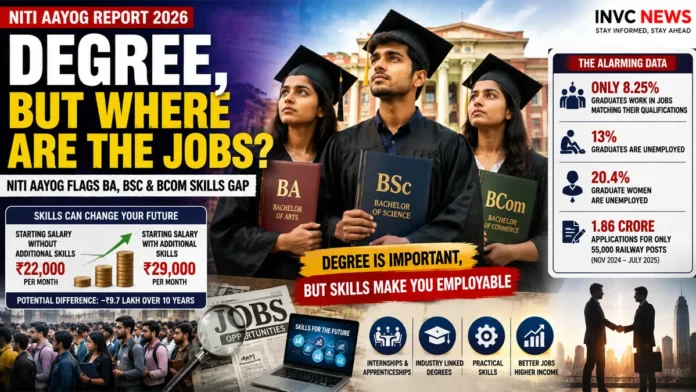
India’s graduate jobs crisis has come under fresh scrutiny after NITI Aayog warned of a deep disconnect between higher education and the labor market, saying only 8.25% of graduates are employed in roles aligned with their qualifications.
The government’s policy think tank has also flagged heavy dependence on conventional degrees such as BA, BSc and BCom, saying these programs often have weak direct links with employment unless students acquire additional practical and workplace skills.
The findings are part of NITI Aayog’s August 2026 report, “Reimagining Skilling for Viksit Bharat@2047,” which calls for major changes in how India prepares students for jobs.
Graduate Unemployment at 13%
The report highlights a significant employment gap among educated Indians.
According to data cited by NITI Aayog:
- 13% of graduates are unemployed
- 20.4% of graduate women are unemployed
- The national unemployment rate cited in the report is 3.2%
- Only 8.25% of graduates work in roles aligned with their qualifications
The numbers highlight an uncomfortable reality: obtaining a university degree does not necessarily mean a smooth transition into a job matching that degree.
NITI Aayog says India’s higher and technical education system faces a fundamental mismatch between what many institutions teach and what employers actually need.
More Than 2 Crore Students Pursue BA, BSc and BCom
The scale of the issue is particularly significant because conventional undergraduate degrees dominate India’s higher-education system.
Of approximately 3.4 crore students enrolled in undergraduate programs, around 1.13 crore are studying BA alone.
Combined enrollment in BA, BSc and BCom exceeds 2 crore students, according to the report.
NITI Aayog describes this heavy dependence on generic degree programs as a structural challenge because many courses do not provide a clear pathway into specific occupations.
This does not mean BA, BSc or BCom degrees have no value.
Instead, the report argues that conventional academic programs need stronger integration with practical skills, apprenticeships, industry exposure and job-linked specializations.
₹22,000 vs ₹29,000: Skills Can Change Starting Salary
One of the report’s most useful findings concerns the potential value of additional skills.
Based on survey data cited by NITI Aayog, graduates from generic undergraduate programs such as BA, BSc and BCom without additional skilling earned an average starting salary of approximately:
₹22,000 per month
Those combining a generic degree with additional skills earned around:
₹29,000 per month
That is a difference of roughly ₹7,000 per month at the start of a career.
According to the report’s cited analysis, the earnings gap could compound to approximately ₹9.7 lakh over 10 years, although NITI Aayog also cautions that these findings are based on a limited sample and broader outcome tracking is needed.
Why Are Graduates Struggling to Find Matching Jobs?
NITI Aayog identifies several problems.
Traditional curricula in many institutions remain disconnected from rapidly changing workplace requirements.
Students may graduate with academic knowledge but still lack practical capabilities in areas such as:
- Digital tools
- Communication
- Workplace software
- Problem-solving
- Industry-specific applications
- Interview preparation
- Practical work experience
The report specifically notes that even entry-level employment can require additional capabilities such as Tally or office applications.
This gap becomes increasingly important as companies move toward skills-based recruitment.
INVC NEWS previously examined this shift in our report on Job Market Trends Shaping Careers in 2026, including the growing importance of skills, portfolios and practical experience.
Government Job Competition Adds Another Dimension
Government jobs remain one of the biggest attractions for graduates from conventional degree programs.
NITI Aayog notes that many students pursue degrees partly because graduation keeps them eligible for government recruitment examinations.
The report cites an extraordinary example: around 1.86 crore applications were submitted for only 55,000 railway posts between November 2024 and July 2025.
That level of competition illustrates why simply becoming eligible for government recruitment does not guarantee employment.
For students, developing an alternative private-sector or entrepreneurship pathway is therefore becoming increasingly important.
What Changes Does NITI Aayog Recommend?
NITI Aayog wants universities and colleges to move toward applied, industry-linked degrees.
Among the examples suggested are:
BA Hospitality
BCom Analytics
BSc Applied Technology
The idea is not necessarily to eliminate traditional degrees but to combine academic education with clearly identifiable workplace capabilities.
The report also recommends wider adoption of:
- Apprenticeship-embedded degree programs
- Work-integrated learning
- Industry partnerships
- Flexible courses
- Earn-while-you-learn models
- Short-term skill programs
- Career counseling
- Skills-first hiring
Students can read the complete official report on the NITI Aayog website.
Apprenticeships Could Become More Important
Work experience is emerging as one of the most important missing pieces in traditional university education.
Apprenticeships allow students to gain real workplace exposure while completing or supplementing their qualifications.
India has already been expanding internship and apprenticeship-oriented programs.
For example, INVC NEWS previously explained the PM Internship Scheme offering 12-month internships in major companies.
Such programs could become increasingly relevant if India shifts from degree-based hiring toward skills and experience-based recruitment.
What BA, BSc and BCom Students Should Do
Students should not interpret the NITI Aayog report as a warning to abandon traditional degrees.
The bigger message is to avoid depending on the degree alone.
A BCom student could add accounting software, analytics or financial modeling skills.
A BA student could develop capabilities in digital marketing, research, communications, foreign languages, hospitality or policy analysis.
A BSc student could combine academic study with data analysis, laboratory skills, coding or applied technology.
Internships and apprenticeships can also help students demonstrate workplace experience before graduation.
India’s Degree-to-Job Model Could Be Changing
India has succeeded in bringing millions of young people into colleges and universities.
The next challenge is ensuring that those qualifications translate into productive careers.
With more than 2 crore students enrolled across BA, BSc and BCom programs, even a modest improvement in job alignment could affect millions of households.
NITI Aayog’s message is therefore significant: India’s higher-education system may increasingly need to measure success not merely by the number of degrees awarded, but by whether students leave college with skills that employers are prepared to pay for.