NEW DELHI, India | September 8, 2026 —
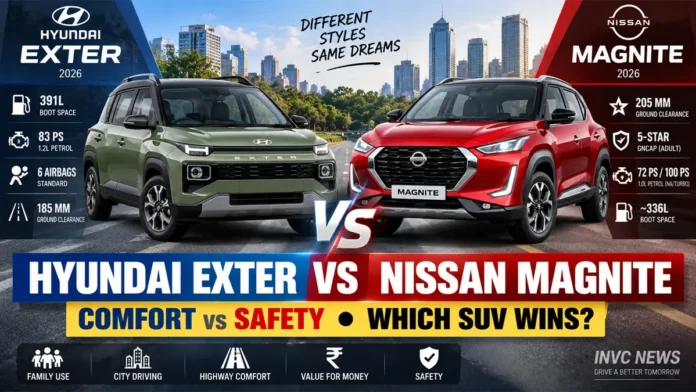
Hyundai Exter vs Nissan Magnite 2026 has become an interesting battle for buyers looking for an affordable compact SUV without stretching far beyond the ₹6 lakh ex-showroom mark. The refreshed Hyundai Exter brings a smooth four-cylinder petrol engine, strong everyday features and a factory-fitted CNG option, while the Nissan Magnite counters with a lower starting price, 205 mm ground clearance, a 5-star Global NCAP adult safety rating and an optional turbo-petrol engine.
The price difference at the entry level is surprisingly small.
The Hyundai Exter currently starts at around ₹5.81 lakh ex-showroom, while the Nissan Magnite starts at approximately ₹5.68 lakh ex-showroom.
That means both SUVs target almost the same budget-conscious buyer.
But they take very different approaches.
The Exter focuses heavily on refinement, cabin convenience and city-friendly usability. The Magnite offers stronger SUV proportions, more ground clearance and the option of substantially higher turbo-petrol performance.
So, if you have roughly ₹6 lakh to spend before registration and insurance, which one should you buy?
Exter vs Magnite Price: Nissan Starts Cheaper
Price immediately gives the Magnite an advantage.
The base Nissan Magnite Visia manual starts at around ₹5.68 lakh ex-showroom.
The Hyundai Exter starts at approximately ₹5.81 lakh ex-showroom.
That makes the Magnite roughly ₹12,000-₹13,000 cheaper at the entry point, although prices can vary slightly by location and revision.
However, a base-price comparison never tells the complete story.
Features such as touchscreen infotainment, automatic climate control, connected-car technology, alloy wheels and cameras sit on higher variants.
Buyers should therefore compare the exact variant they plan to purchase rather than judging the cars only by their advertised starting prices.
Hyundai Exter Gets a Smoother Four-Cylinder Engine
The Exter uses Hyundai’s 1.2-liter Kappa naturally aspirated petrol engine.
It produces:
Power: 83 PS
Torque: 113.8 Nm
Buyers can pair it with either a five-speed manual gearbox or a Smart Auto AMT.
One of the Exter’s biggest everyday advantages is its four-cylinder configuration.
Compared with many three-cylinder engines in this price segment, the Hyundai motor delivers relatively smooth and refined performance, particularly during city driving and idling.
It is not designed as a performance SUV.
Instead, it prioritizes predictable throttle response, easy drivability and refinement.
For buyers who spend most of their time commuting in urban traffic, that character could prove more useful than outright acceleration.
Nissan Magnite Offers Two Petrol Personalities
The Magnite gives buyers more engine choice.
Its entry-level naturally aspirated 1.0-liter three-cylinder petrol engine produces around:
Power: 72 PS
Torque: 96 Nm
This engine is available with a manual gearbox and EZ-Shift automated manual transmission.
However, Nissan also offers a much more powerful 1.0-liter turbo-petrol engine on higher variants.
The turbo unit develops approximately:
Power: 100 PS
Torque: up to 160 Nm with the manual gearbox
A CVT automatic is also available with the turbo engine.
That means the Magnite has a wider performance range.
Around the ₹6 lakh mark, however, buyers will primarily be comparing the naturally aspirated Magnite with the petrol Exter.
In that direct comparison, the Exter has more power and torque.
Mileage: Both Are Closely Matched
Fuel economy is another important consideration for budget SUV buyers.
The Hyundai Exter petrol delivers claimed efficiency of approximately:
Manual: 19.4 km/l
AMT: 19.2 km/l
The naturally aspirated Magnite manual delivers around 19.35 km/l, while the EZ-Shift version is rated at approximately 19.70 km/l.
In practical terms, the official figures place both cars very close to each other.
Real-world mileage will depend on traffic, driving style, air-conditioning use, road conditions and load.
Therefore, mileage alone is unlikely to decide this contest.
Unlike the previous Baleno-versus-Punch comparison, where fuel economy created a clear separation, Exter and Magnite are much more evenly matched on petrol efficiency.
Safety: Magnite Has a Major Independent Rating Advantage
Safety gives the Nissan Magnite one of its biggest advantages.
The updated Magnite achieved a 5-star rating for adult occupant protection under Global NCAP testing and a 3-star rating for child occupant protection.
The latest version comes with six airbags as standard.
Nissan also equips the Magnite with safety systems including electronic stability control, traction control, hill-start assist, hydraulic brake assist and ABS with EBD.
The Exter also provides a strong safety equipment package.
Hyundai offers six airbags as standard across the Exter range, along with electronic stability control and hill-start assist.
The refreshed 2026 Exter offers more than 45 safety features depending on the variant, with 30 safety features standard across the lineup.
However, based on currently available comparable independent crash-test information, the Magnite has the stronger published NCAP credential.
For buyers who place heavy weight on an independent crash-test result, Magnite has the advantage.
Ground Clearance: Magnite Wins Again
This is another area where the difference is substantial.
The Nissan Magnite offers:
205 mm ground clearance
The Hyundai Exter offers:
185 mm ground clearance
That gives the Magnite an extra 20 mm of clearance.
On smooth urban roads, this may not matter much.
But on broken roads, deep potholes, large speed breakers and rural routes, extra clearance can provide greater confidence.
The Magnite also looks more like a conventional compact SUV because of its longer, wider stance.
For buyers frequently traveling beyond well-paved city roads, Magnite makes a stronger case.
Exter Is Taller and More Upright
The Exter takes a different approach to exterior proportions.
Hyundai Exter
Length: 3,830 mm
Width: 1,723 mm
Height: 1,643 mm
Wheelbase: 2,450 mm
Nissan Magnite
Length: 3,994 mm
Width: 1,758 mm
Height: 1,572 mm
Wheelbase: 2,500 mm
The Magnite is longer and wider and also has a longer wheelbase.
The Exter, however, is considerably taller.
That tall-body design gives the Exter an upright seating position and strong headroom.
Drivers who prefer sitting high in a compact footprint may appreciate the Hyundai.
The Magnite feels more substantial from the outside because of its nearly four-meter length and wider body.
Boot Space: Exter Takes the Lead
Family buyers should pay close attention here.
The petrol Hyundai Exter provides approximately:
391 liters of boot space
The Nissan Magnite offers:
336 liters of boot space
The Magnite can expand its cargo area by folding the second row, but with all seats in use, the Exter offers more luggage capacity.
That 55-liter difference can matter during airport runs, family holidays or weekend travel.
Therefore, if five people are traveling with luggage, Exter offers the more useful standard boot.
Exter Makes a Strong Case With Cabin Features
The refreshed 2026 Exter received more than 25 updates across styling, technology, comfort and safety.
Depending on the variant, equipment includes:
- Wireless Android Auto and Apple CarPlay
- Digital instrument cluster
- Hyundai Bluelink connected-car technology
- Wireless smartphone charging
- Electric sunroof
- Automatic climate control
- Rear AC vents
- Cruise control
- Dashcam
- Folding driver armrest
- Tyre-pressure monitoring system
The Exter’s feature list is particularly attractive to young urban buyers who want a connected and modern cabin.
However, many premium features are not available on the base model.
Magnite Counters With 360-Degree Camera and Premium Tech
The Magnite also has a strong technology package on higher variants.
Available features include:
- 8-inch touchscreen
- Wireless Android Auto and Apple CarPlay
- 7-inch digital instrument cluster
- Around View Monitor
- Remote engine start
- Automatic climate control
- Cruise control
- Ambient lighting
- Auto-dimming rear-view mirror
- Wireless connectivity
- Premium leatherette upholstery on selected trims
The Around View Monitor remains particularly useful for city parking.
So, while the Exter has a strong convenience advantage, the Magnite does not feel like a bare-bones budget SUV once buyers move up the variant range.
CNG Buyers Get Very Different Options
This is another important difference.
Hyundai offers the Exter with a factory-fitted dual-cylinder CNG system.
That makes the CNG setup part of the original vehicle package.
Hyundai has also moved the spare wheel beneath the vehicle on the new CNG version to preserve useful cargo space.
The Magnite offers a government-approved CNG retrofitment kit for the naturally aspirated manual version.
That means buyers looking specifically for a factory-integrated CNG model may find the Exter more straightforward.
For high-mileage urban users, especially where CNG availability is strong, the Exter CNG deserves serious consideration.
Which Car Is Better in City Traffic?
For everyday city use, the Exter has the edge.
The 1.2-liter four-cylinder engine feels better suited to smooth low-speed operation, while its tall cabin provides good visibility.
Hyundai also offers AMT convenience for buyers dealing with heavy traffic.
The Exter’s relatively compact 3,830 mm length should also help while parking in tight spaces.
Its strong feature package makes it particularly attractive as an urban family car.
Which One Is Better for Highway Driving?
This depends heavily on the variant.
Against the naturally aspirated Magnite, the Exter offers more power.
But the Magnite turbo changes the equation completely.
With around 100 PS and up to 160 Nm, the turbo Magnite delivers substantially stronger highway overtaking performance.
It costs considerably more than the base model, but buyers who regularly drive on expressways should test-drive it before deciding.
The CVT option also gives the turbo Magnite a more premium automatic alternative than an AMT.
Which Is Better for Bad Roads?
Magnite wins this round.
Its 205 mm ground clearance provides more protection against rough surfaces than the Exter’s 185 mm.
The longer and wider body also gives it stronger traditional compact-SUV proportions.
For owners living in areas with poor road surfaces or regularly taking highway and rural trips, this difference could matter more than touchscreen size or connected features.
Exter vs Magnite 2026: Quick Comparison
| Feature | Hyundai Exter | Nissan Magnite |
|---|---|---|
| Starting Price | Around ₹5.81 lakh | Around ₹5.68 lakh |
| Base Engine | 1.2L Petrol | 1.0L Petrol |
| Base Power | 83 PS | 72 PS |
| Base Torque | 113.8 Nm | 96 Nm |
| Turbo Option | No | Yes, 100 PS |
| Manual Mileage | Around 19.4 km/l | Around 19.35 km/l |
| Automatic Option | AMT | AMT / Turbo CVT |
| Ground Clearance | 185 mm | 205 mm |
| Boot Space | 391 liters | 336 liters |
| Six Airbags | Standard | Standard |
| Independent Safety Highlight | Strong standard safety kit | 5-star GNCAP adult rating |
| CNG | Factory-fitted | Approved retrofit option |
| Best For | City comfort and family use | Safety, rough roads and value |
Final Verdict: Exter or Magnite?
Unlike some car comparisons, there is no runaway winner here.
Both SUVs make strong arguments around ₹6 lakh.
Buy the Hyundai Exter if: you want a smoother four-cylinder engine, larger boot, tall cabin, factory CNG option and a strong collection of everyday convenience features.
Buy the Nissan Magnite if: you want the lower starting price, 205 mm ground clearance, a strong independent crash-test result and the option to upgrade to a much more powerful turbo-petrol engine later in the range.
For a buyer primarily driving in the city with family, our preference would lean toward the Hyundai Exter because of its engine refinement, boot space and everyday usability.
For a buyer who prioritizes published crash-test performance, rough-road ability and maximum SUV value, the Nissan Magnite makes the stronger case.
And if performance is important and the budget can stretch substantially beyond ₹6 lakh, the turbocharged Magnite deserves a separate look altogether.
Before booking either SUV, compare the exact variant rather than the headline starting price. Registration, insurance, accessories and local taxes will also push the final on-road cost above the advertised ex-showroom figure.