By Team INVC | INVC NEWS
RIYADH, Saudi Arabia | September 20, 2026 —
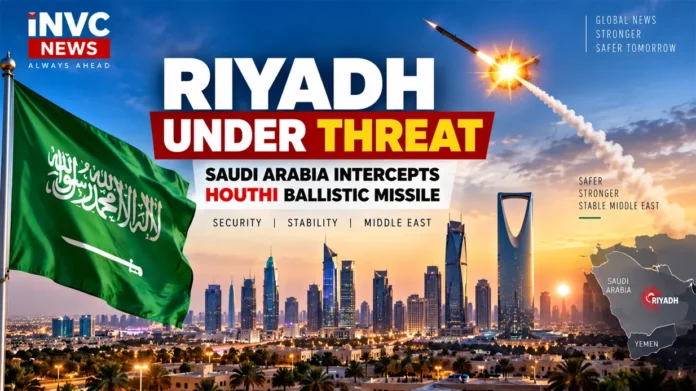
Saudi Arabia says its forces intercepted a ballistic missile launched by Yemen’s Houthi movement toward Riyadh, bringing the latest escalation in the Yemen conflict directly to the Saudi capital.
The attempted strike occurred on September 19 and marked the first reported Houthi targeting of Riyadh since the latest round of fighting intensified. Saudi authorities reported no casualties or confirmed damage from the intercepted ballistic missile.
The incident came as Saudi Arabia issued emergency alerts over an aerial threat and residents reported hearing an explosion around the capital.
Hours earlier, flames and thick black smoke were seen near Riyadh’s King Khalid International Airport. However, the cause of that fire was not immediately established, and authorities had not publicly linked it to the intercepted missile in the initial reporting.
Saudi Arabia Says Ballistic Missile Was Fired at Riyadh
The Saudi-led coalition said the Houthis launched a ballistic missile toward Riyadh at dawn on Saturday.
Saudi forces intercepted the missile, according to the coalition.
The episode immediately raised the stakes in a conflict that has expanded from Yemen’s battlefields toward Saudi cities, energy installations and important maritime routes.
The Houthi movement later claimed that it had targeted what it described as “sensitive sites” in Riyadh using missiles and drones.
Those specific targeting claims were not independently verified.
Smoke and Flames Seen Near Riyadh Airport
Separate images and eyewitness accounts showed flames and a large plume of black smoke near Riyadh’s main international airport.
Reuters reported that an eyewitness saw flames and heavy smoke in the area, but the exact cause was unclear at the time.
Other reporting described firefighters extinguishing a blaze at a fuel facility near the airport.
That makes the distinction important: Saudi Arabia has confirmed the ballistic missile attempt, but available evidence does not establish that the airport-area fire resulted from that missile.
Houthis Claim Attacks on Saudi Energy Facilities
The Houthis also claimed attacks against Saudi Aramco facilities in Yanbu and other locations inside Saudi Arabia.
Saudi officials said attempted attacks against infrastructure in Yanbu, Taif, Baysh and Farasan had been thwarted.
The Houthis did not provide independently verifiable evidence for all of their claimed strikes, while Saudi Aramco had not immediately confirmed the Houthi account of damage to its facilities.
The dispute over what was hit and what was intercepted highlights how quickly conflicting claims emerge during the current escalation.
Why Yanbu Matters
Yanbu is particularly important because it sits on Saudi Arabia’s Red Sea coast and plays a major role in the kingdom’s oil-export infrastructure.
Its strategic importance has increased amid instability around the Strait of Hormuz and repeated attacks on energy and maritime infrastructure.
A recent drone attack severely damaged Saudi Arabia’s East-West oil pipeline, restricting an important route used to move crude toward the Red Sea when Gulf shipping faces disruption.
As a result, any credible threat to Yanbu has implications extending beyond Saudi Arabia.
Oil markets, shipping companies and energy-importing countries are watching the region closely.
Yemen War Has Entered a More Dangerous Phase
The latest missile attack comes amid renewed fighting inside Yemen.
Houthi forces have made significant advances along parts of Yemen’s Red Sea coast, while Saudi-led forces have carried out strikes against Houthi positions.
The renewed conflict has also displaced tens of thousands of Yemenis.
Reuters reported this week that more than 115,000 people had fled their homes as fighting intensified, while thousands more crossed toward Djibouti.
The humanitarian consequences are therefore growing alongside the military escalation.
Saudi Arabia Looks for More Defence Support
The intensifying Houthi attacks have also triggered wider regional security discussions.
Turkish Foreign Minister Hakan Fidan said Turkey could help meet Saudi Arabia’s military requirements under its defence arrangement with Saudi Arabia and Pakistan.
Pakistan, meanwhile, has not announced an immediate military response.
The development shows how the Yemen conflict is increasingly intersecting with broader regional defence relationships.
Iran Connection Keeps Regional Tensions High
The Houthis have longstanding political and military ties with Iran.
Their expanding role in the current regional confrontation has increased pressure on Saudi Arabia while complicating diplomatic efforts involving Tehran and Washington.
The escalation is particularly significant because Iran has simultaneously said that Qatar has transmitted Tehran’s conditions for ending its conflict with the United States.
That means military escalation and diplomacy are now moving in parallel.
Oil Markets Are Watching Saudi Infrastructure
Energy markets have already reacted strongly to disruptions across the Middle East.
Brent crude closed at $104.87 a barrel on September 18, while U.S. West Texas Intermediate settled at $100.30, as traders assessed threats to Saudi oil infrastructure and maritime supply routes.
Any prolonged disruption involving Saudi energy installations, the Red Sea or the Strait of Hormuz could affect global fuel supplies.
For India and other major oil-importing economies, that makes the Saudi-Houthi escalation particularly important.
What Happens Next?
Saudi air defences now face continued pressure from missile and drone threats.
The Houthis have demonstrated that they can attempt strikes far beyond Yemen’s borders, while Riyadh is trying to protect cities, oil infrastructure and critical transport routes simultaneously.
At the same time, regional governments are pursuing diplomatic efforts aimed at preventing a wider confrontation.
For now, Saudi Arabia says the ballistic missile aimed at Riyadh was intercepted.
But the appearance of Riyadh itself on the target list marks a significant new phase in the current Saudi-Houthi escalation.