Washington, D.C., United States | July 25, 2026
H-1B Visa Bill 2026
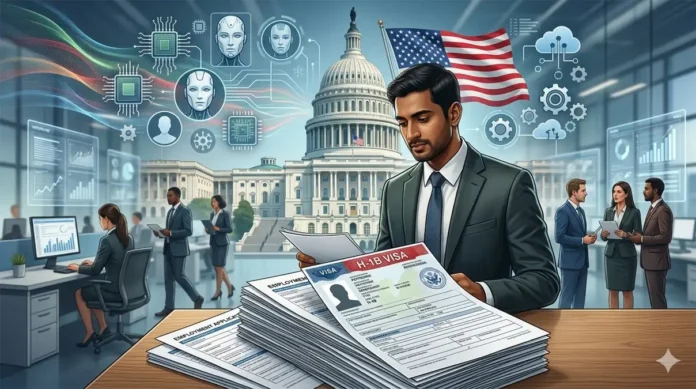
Republican Senator Tim Sheehy has introduced the End H-1B Visa Abuse Act of 2026, a bill that proposes a three-year suspension on issuing new H-1B visas while significantly tightening rules governing foreign workers, international students, and employment-based immigration.
The legislation, which has not yet become law, is intended to prioritize American workers, reduce what supporters describe as abuse of the H-1B program, and strengthen national security.
Bill Seeks to Prioritize American Workers
Announcing the proposal, Senator Sheehy said the H-1B program was originally designed to fill specialized positions only when qualified American workers were unavailable.
He argued that the program was never intended to replace skilled U.S. employees with lower-cost foreign labor.
“The H-1B program was created to address shortages in specialized occupations—not to replace qualified and hardworking American workers with cheaper foreign labor,” Sheehy said.
According to the senator, the bill would restore the program to its original purpose by closing legal loopholes, preventing misuse, and strengthening security safeguards.
Three-Year Freeze on New H-1B Visas
According to Senator Sheehy’s office, if enacted, the legislation would:
- Suspend the issuance of new H-1B visas for three years.
- Reduce the annual H-1B visa cap to 25,000 after the suspension period.
- Limit H-1B visa validity to three years.
The bill remains a legislative proposal and must pass both chambers of Congress and be signed by the President before becoming law.
$100,000 Petition Fee and Salary-Based Selection
The legislation would also incorporate a proposal previously supported by President Donald Trump requiring a $100,000 filing fee for each H-1B petition.
Additional proposed reforms include:
- Eliminating the current H-1B lottery system.
- Introducing a salary-based selection process.
- Requiring employers to pay H-1B workers a minimum annual salary of $200,000.
- Prohibiting H-1B employees from working simultaneously for multiple employers.
- Banning third-party staffing firms from sponsoring H-1B workers.
Green Card Pathway and Family Sponsorship Could End
One of the bill’s most significant proposals would eliminate the dual-intent provision.
Currently, H-1B visa holders may work in the United States while simultaneously applying for permanent residency (a Green Card).
Under the proposed legislation:
- H-1B holders would no longer be eligible to pursue permanent residency through dual intent while on the visa.
- H-category visa holders would not be permitted to bring dependent family members to the United States.
Changes for International Students
The bill also proposes major changes affecting foreign students and exchange visitors.
Among the proposals:
- Ending employment authorization for many international students and certain exchange visitors.
- Eliminating programs such as Optional Practical Training (OPT).
- Preventing most non-immigrant visa holders from changing their immigration status while remaining in the United States.
New Employer Requirements
Employers seeking to hire foreign workers would face stricter certification requirements.
Before sponsoring an H-1B employee, companies would need to certify that:
- No qualified American worker is available for the position.
- The company has not conducted layoffs during the previous year.
- The company will not conduct layoffs during the following year.
The proposal also bars federal agencies from sponsoring or employing non-immigrant visa holders.
National Security Concerns Highlighted
Senator Sheehy’s office argued that the H-1B program has increasingly become a mechanism for replacing American workers rather than addressing genuine labor shortages.
The office also raised national security concerns, claiming that employing large numbers of foreign contract workers in sectors such as:
- Artificial Intelligence
- Defense
- Sensitive national security industries
could increase risks related to data security, insider threats, and foreign influence.
Support and Legislative Outlook
The proposed legislation has received support from advocacy organizations including:
- Immigration Accountability Project
- Federation for American Immigration Reform (FAIR)
However, the bill is still at an early stage in the legislative process. It must be considered by congressional committees, approved by both the Senate and the House of Representatives, and signed into law before any of its provisions could take effect.
Key Highlights
- Republican Senator Tim Sheehy introduced the End H-1B Visa Abuse Act of 2026.
- The bill proposes a three-year suspension on issuing new H-1B visas.
- It would reduce the annual H-1B cap to 25,000 and require a minimum salary of $200,000 for H-1B workers.
- The proposal would eliminate the current lottery system in favor of a salary-based selection process.
- It also seeks to end the dual-intent provision, restrict dependent visas, and eliminate employment authorization programs such as OPT.
- The legislation has not been enacted and remains subject to the U.S. legislative process.