New Delhi | August 5, 2026
India’s E20 petrol policy has become one of the country’s most debated fuel reforms. While the government says the initiative will reduce crude oil imports, lower emissions, and increase farmers’ income, opposition parties and many vehicle owners argue that the fuel is causing lower mileage, higher maintenance costs, and problems for older vehicles.
The issue has now moved beyond social media debates to political protests, legal battles, and public campaigns. Here’s everything you need to know about the E20 petrol controversy.
What Is E20 Petrol?
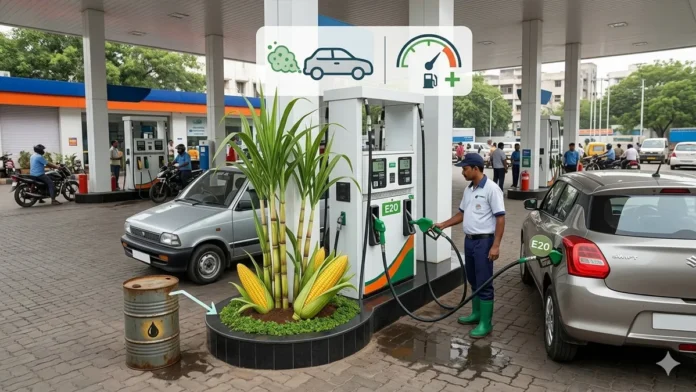
E20 petrol is a fuel blend consisting of:
- 20% Ethanol
- 80% Petrol
Ethanol is a renewable biofuel produced mainly from:
- Sugarcane
- Corn (Maize)
- Agricultural biomass and other feedstocks
The Government of India introduced E20 under its Ethanol Blended Petrol (EBP) Programme with three primary objectives:
- Reduce dependence on imported crude oil
- Lower carbon emissions and air pollution
- Increase farmers’ income by creating demand for agricultural produce
India originally targeted 20% ethanol blending by 2030, but achieved the milestone ahead of schedule.
Why Did the Controversy Begin?
The controversy intensified after E20 became the default fuel at many petrol stations across India.
Owners of older vehicles began reporting problems such as:
- Reduced fuel efficiency
- Lower engine performance
- Damaged rubber hoses and fuel lines
- Increased maintenance costs
- Difficulty finding regular petrol
Most complaints came from owners of vehicles manufactured before April 2023, as many of these were not originally designed for E20 fuel.
These concerns quickly spread across social media and later became a political issue.
Latest Political Developments
Aam Aadmi Party Protest
AAP National Convenor Arvind Kejriwal announced a march to the Prime Minister’s residence with nearly 100 supporters.
The party claimed to have collected 233,000 public signatures demanding changes to the E20 policy.
Delhi Police denied permission for the march, stopping protesters near Feroz Shah Road. After over an hour of protest, police assured party leaders that their memorandum would be forwarded to the Prime Minister’s Office.
Kejriwal later announced that the campaign against mandatory E20 fuel would continue.
Youth Congress Protest
A day earlier in Nagpur, Youth Congress workers attempted to march toward Union Road Transport Minister Nitin Gadkari’s residence.
Police stopped the march using barricades and detained several protesters.
What Are the Opposition’s Objections?
Aam Aadmi Party (AAP)
AAP argues that consumers are being forced to use a single type of fuel.
Its major demands include:
- Availability of Regular Petrol and E10 alongside E20
- Reduction of petrol prices to ₹82 per litre
- Review of the E20 fuel policy
The party also launched StopE20Petrol.com, an online signature campaign demanding policy changes.
Congress
The Congress says that although the government cites scientific studies, mechanics and vehicle owners continue reporting problems such as:
- Lower mileage
- Engine performance issues
- Fuel injector blockage
- Damaged fuel pipes
- Cracked rubber components
The party has asked the government to respond to these complaints with technical evidence.
Shiv Sena and MNS
Shiv Sena (UBT) leader Uddhav Thackeray urged young people to continue opposing the policy.
MNS chief Raj Thackeray also expressed support for protesters, saying public pressure had brought national attention to the issue.
What Is the “E20 Janata Party (EJP)” Campaign?
Apart from political parties, a social media movement called E20 Janata Party (EJP) has gained momentum.
Its primary demands include:
- Offer consumers a choice between E20 and pure petrol
- Do not abolish ethanol blending, but provide alternatives
- Ensure protection for older vehicles
The campaign has attracted widespread attention online.
What Does the Government Say?
The Central Government maintains that E20 is essential for India’s long-term energy security.
1. Petrol Prices Could Have Reached ₹125 Per Litre
According to the government, if ethanol blending had not been implemented, petrol prices in Delhi could have risen to nearly ₹125 per litre during periods of high global crude oil prices.
Because 20% of the fuel consisted of domestically produced ethanol with relatively stable pricing, retail petrol prices remained around ₹94.77 per litre, reducing the impact of international crude oil volatility.
2. Foreign Exchange Savings
The government claims the E20 programme has resulted in:
- Savings of over ₹1.97 lakh crore in foreign exchange
- Reduction of more than 316 lakh metric tonnes of crude oil imports
- Reduction of over 950 lakh metric tonnes of carbon dioxide emissions
3. Higher Income for Farmers
The programme has reportedly generated:
- More than ₹1.66 lakh crore in payments to farmers and ethanol producers
Officials say the policy has created a stable market for crops such as sugarcane and maize.
Why Did Nitin Gadkari’s Statements Spark Debate?
Union Minister Nitin Gadkari made several statements that drew public attention.
First Statement
He challenged critics to identify a single vehicle that had been damaged solely because of E20 fuel, adding that automobile manufacturers had declared E20 safe.
Second Statement
In an affidavit before the Bombay High Court, Gadkari clarified that:
- The E20 fuel policy is entirely under the Ministry of Petroleum and Natural Gas.
- His ministry was not responsible for designing or implementing the programme.
- He had never served as Petroleum Minister.
Although legally accurate, critics questioned the statement because Gadkari had been one of the strongest public advocates of ethanol fuel.
Third Statement
Later, in the Rajya Sabha, Gadkari acknowledged that:
- BS-III vehicles manufactured between 2005 and 2016 may require replacement of certain rubber components and gaskets.
- E20 may reduce mileage by 2–6%.
However, he also stated that available studies have not found any major long-term engine damage.
Why Did Gadkari Approach the Bombay High Court?
Gadkari approached the Bombay High Court alleging that fake social media posts and deepfake videos falsely claimed he and his family were financially benefiting from the E20 programme.
He sought permission to file civil defamation proceedings against Meta, social media platforms, and unidentified individuals.
The High Court granted permission to proceed with the lawsuit.
Can E20 Damage Older Vehicles?
Experts say not every vehicle is affected.
However, vehicles manufactured before widespread E20 compatibility may contain:
- Older rubber hoses
- Plastic fuel components
- Gaskets that are less resistant to higher ethanol content
The Indian Sugar & Bio-energy Manufacturers Association (ISMA) is reportedly testing conversion kits designed for older vehicles.
Does E20 Reduce Mileage?
Yes—but the effect varies.
The Government has officially acknowledged in Parliament that:
- Fuel efficiency may decline by 2–6% in some vehicles.
The reason is simple:
Ethanol contains lower energy per litre than petrol. As a result, vehicles may travel slightly fewer kilometres using the same quantity of fuel.
Modern E20-compatible vehicles generally experience less noticeable impact.
What Is the Government Doing Now?
Amid widespread discussions and misinformation online, Nagpur Cyber Police have registered FIRs against several social media influencers and content creators.
Authorities allege that misleading and false information about E20 fuel was being circulated, potentially creating unnecessary public panic.
Frequently Asked Questions (FAQs)
Is E20 petrol mandatory in India?
E20 is increasingly becoming the default petrol at many fuel stations, although fuel availability varies by location.
Which vehicles are compatible with E20?
Most vehicles manufactured from April 2023 onwards are designed to run on E20 fuel. Owners should verify compatibility with their vehicle manufacturer.
Does E20 reduce mileage?
Yes. The Government has acknowledged that mileage may decrease by 2–6% in some vehicles because ethanol has lower energy content than petrol.
Does E20 damage engines?
Current government-backed studies have not found significant engine damage in compatible vehicles. Older vehicles may require replacement of certain rubber components over time.
Why is the government promoting E20?
The policy aims to reduce crude oil imports, lower emissions, improve energy security, and increase farmers’ income through ethanol production.