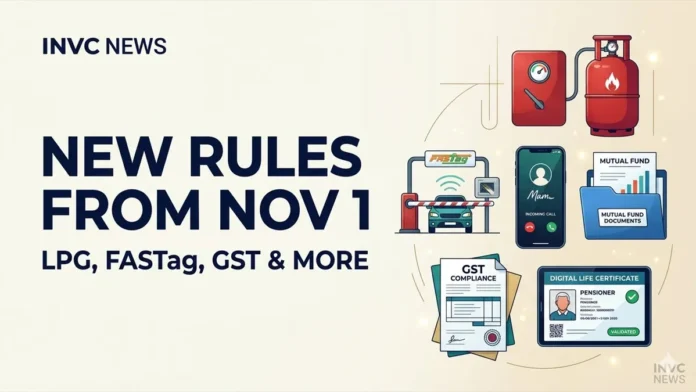
INVC NEWS | Personal Finance & Policy Update : November 1 brings several changes that could affect household budgets, pensioners, motorists, mutual fund investors and businesses. Commercial LPG prices have increased, eligible residents living near National Highway toll plazas can now opt for a concessional annual FASTag local pass, and direct mutual fund plans have become the default option on asset management companies’ digital platforms.
New GST procedures are also being introduced, while telecom operators are rolling out a system to display the registered name of callers on supported mobile networks. Aviation turbine fuel (ATF) prices have also risen.
Here is what has changed, who is affected and what people need to know.
1. Commercial LPG Cylinder Prices Increased
Oil marketing companies have raised the price of 19-kg commercial LPG cylinders from November 1, adding to operating costs for hotels, restaurants, roadside eateries and catering businesses.
In Delhi, a 19-kg commercial cylinder now costs ₹2,820, up ₹10 from ₹2,810 in October. The increase varies across major cities, with some markets recording rises of up to ₹11.50 or more.
The increase marks another monthly revision in commercial cooking gas prices. Businesses that rely heavily on LPG may face higher operating expenses, and some could eventually pass part of the additional cost on to customers.
There is relief for household consumers: The price of the 14.2-kg domestic LPG cylinder has remained unchanged for now. In Delhi, the domestic cylinder continues to cost ₹942.
The latest revision therefore directly affects commercial LPG users rather than households purchasing the standard domestic cylinder.
2. Pensioners: Digital Life Certificate Campaign Begins
Pensioners across India can now submit their Digital Life Certificates (DLCs) as the government’s fifth nationwide campaign begins on November 1.
The month-long campaign will run until November 30, 2026, with facilities planned across 2,000 cities and districts. The government is encouraging pensioners to use Aadhaar-based face authentication to complete the process through a compatible smartphone.
The system allows pensioners to generate a Digital Life Certificate without having to visit a bank or pension office in person, provided they have the required documents and access to the service.
Pensioners below 80 years of age can submit their annual life certificates from November 1. Those aged 80 and above were allowed to begin submitting theirs from October 1.
The campaign also includes support from banks, post offices, pensioners’ associations and government departments. Doorstep assistance is planned for pensioners who need help.
What pensioners should do: Complete the life certificate process within the prescribed period and retain the confirmation or acknowledgement. Those unable to use face authentication can explore other permitted submission methods through their pension-disbursing bank or the Jeevan Pramaan service.
3. Mutual Funds: Direct Plans Become the Default on AMC Digital Platforms
Mutual fund investors will notice an important change when using the digital platforms of asset management companies (AMCs).
From November 1, Direct Plans will be the default option on AMC digital platforms. Investors who choose a Regular Plan will be informed about its higher expense ratio before proceeding.
Direct and Regular Plans invest in the same mutual fund scheme and are managed by the same fund manager. The key difference is the cost structure.
- Direct Plan: Investors purchase the fund without going through a distributor. It generally carries a lower expense ratio.
- Regular Plan: Investors invest through a distributor or agent. The expense ratio is generally higher because distribution-related costs are included.
A lower expense ratio can help reduce the ongoing cost of an investment over time. However, a Direct Plan does not automatically guarantee better investment performance or higher returns in every situation.
Investors should consider whether they need distribution or advisory support before selecting a plan. The default option should not replace an informed investment decision.
4. FASTag: New Annual Local Pass for Residents Near Toll Plazas
A new concessional annual FASTag local pass has come into effect for eligible private vehicle owners who live within 20 kilometres of a National Highway toll plaza.
The annual fee depends on the location of the toll plaza:
- ₹1,500 per year: For eligible toll plazas outside municipal or local town limits.
- ₹3,000 per year: For eligible toll plazas located within municipal or local town limits.
The facility is intended to help residents who regularly use a particular toll plaza for commuting, work or other routine travel.
Who can apply?
The main conditions include:
- The vehicle must be a non-commercial vehicle.
- The owner must reside within 20 km of the designated toll plaza.
- The vehicle must have a valid and functional FASTag registered for non-commercial use.
- The pass will be valid only for the specific toll plaza for which it is issued.
The pass cannot be transferred to another toll plaza. It will also not be available on National Highways or expressways using a closed user-fee collection system, or at locations where a service road or alternative road is available for commuters.
Eligible motorists can obtain the pass at participating toll plazas from November 1. The facility is scheduled to become available through the Rajmargyatra app from December 1, 2026.
This is a local toll pass, not a nationwide FASTag annual pass. Vehicle owners should check the eligibility of their particular toll plaza before making a payment.
5. GST: Easier Registration and Faster Refunds for Businesses
Several procedural changes under the Goods and Services Tax (GST) framework are being introduced in phases from November 1.
The reforms approved by the 57th GST Council meeting are intended to simplify compliance, improve access to refunds and make it easier for eligible small businesses to operate through e-commerce platforms.
Key changes include:
Simplified GST registration: Small sellers operating through e-commerce platforms are expected to benefit from a more streamlined registration process, including clearer documentation requirements.
Faster refunds: Eligible refund claims, including those involving zero-rated supplies and inverted duty structures, will benefit from a more automated process. Under the revised mechanism, 90% of eligible claims may be released provisionally through a risk-based system, subject to prescribed conditions.
Post-sale discounts: Businesses will get greater flexibility in handling discounts offered after a sale. The revised provisions address the tax treatment of such discounts and the related credit-note process, while retaining safeguards concerning input tax credit adjustments.
Simplified compliance: Unified documentation and improvements to GST registration and processing are expected to reduce procedural difficulties for businesses.
Not every GST Council recommendation becomes effective immediately. Some changes requiring amendments to the GST law are scheduled for a later implementation date, including April 1, 2027, according to the reported rollout plan.
6. Caller Name Presentation: Your Phone May Show the Name Behind an Unknown Number
A new telecom feature called Calling Name Presentation (CNAP) is being rolled out from November 1.
Under the system, incoming calls on supported mobile networks can display the caller’s registered name along with the phone number. This is intended to help users identify unknown callers and make it easier to recognise potentially suspicious calls.
The system works differently from a contact list or a third-party caller identification app:
- If a number is already saved in your contacts, your phone will generally display the saved contact name.
- If the number is not saved, the network can display the subscriber name registered with the telecom operator.
- International calls may be identified separately as international calls.
- Users do not need to download a separate application or manually activate the service where it has been enabled by the operator.
The initial rollout is focused on supported 4G and newer mobile networks. The implementation for 2G, 3G and landline connections is being handled separately.
There are also privacy-related exceptions. For example, callers who have activated number-hiding services may not have their names displayed. Business and bulk-connection users may be allowed to display a verified business name under the prescribed process.
CNAP should not be treated as a complete protection against fraud. A displayed name does not guarantee that a call is genuine. Users should continue to avoid sharing OTPs, banking passwords or other sensitive information over unsolicited calls.
7. Aviation Turbine Fuel Becomes More Expensive
Airlines are also facing a rise in fuel costs from November 1, with aviation turbine fuel (ATF) prices increasing by approximately ₹1.37 per litre, according to reports on the latest monthly revision.
The reported rate in the supplied figures has moved from ₹137.12 to ₹138.50 per litre. Actual ATF prices can vary by airport and location.
Jet fuel is one of the largest operating expenses for airlines, accounting for a substantial share of their total costs. A sustained increase in ATF prices can put pressure on airline finances, particularly when fuel costs rise alongside other operating expenses.
However, a fuel-price increase does not automatically mean that airfares will rise immediately. Ticket prices also depend on demand, competition, route economics, capacity and airline pricing decisions.
What These November 1 Changes Mean for You
| Change | Who is affected? | What to know |
|---|---|---|
| Commercial LPG price increase | Hotels, restaurants and commercial users | Delhi’s 19-kg cylinder now costs ₹2,820 |
| Digital Life Certificate campaign | Pensioners | Campaign runs from November 1 to 30 |
| Direct mutual funds as default | Mutual fund investors using AMC platforms | Regular Plan costs must be disclosed |
| FASTag local pass | Eligible residents near toll plazas | Annual fee of ₹1,500 or ₹3,000 |
| GST process reforms | Businesses and e-commerce sellers | Easier registration and faster eligible refunds |
| Caller Name Presentation | Mobile subscribers on supported networks | Registered caller names can appear on screen |
| ATF price increase | Airlines and aviation businesses | Reported increase of about ₹1.37 per litre |
The Bottom Line: Which Changes Deserve Your Attention?
The November 1 changes affect different groups in different ways. Commercial LPG users face a higher fuel bill, while eligible motorists living near National Highway toll plazas get a new annual pass option.
Pensioners should pay attention to the November life certificate window. Mutual fund investors should understand the cost difference between Direct and Regular Plans before investing. Businesses should review the new GST procedures, while mobile users should remember that caller-name display does not eliminate the risk of phone fraud.
For ordinary households, the immediate relief is that domestic 14.2-kg LPG prices have not changed in this revision. The wider impact of the new rules will become clearer as the systems are implemented and consumers begin using them.