By Team INVC | INVC NEWS
MUMBAI, India | October 2, 2026 —
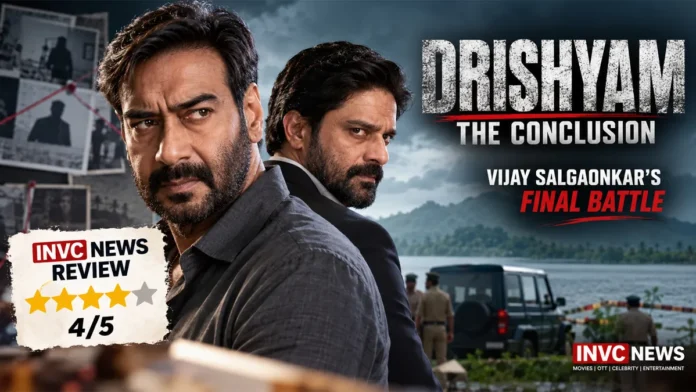
INVC NEWS Rating: ★★★★☆ (4/5)
Vijay Salgaonkar’s greatest strength was never that he was more powerful than the police. It was that he could think ahead of them — and, crucially, ahead of the audience.
But that advantage comes with a problem in the third film.
After two installments, viewers know Vijay too well. They know his silence can hide a plan. They question seemingly ordinary decisions. They have learned that what appears to be a coincidence in the world of “Drishyam” may be anything but accidental.
So the biggest question facing “Drishyam: The Conclusion” is not simply whether Vijay can escape again.
It is this:
Can the movie still stay one step ahead of an audience that has learned how Vijay Salgaonkar thinks?
For much of its runtime, the answer is yes.
Ajay Devgn returns as Vijay, but this time the shadow of the past is not his only problem. Jaideep Ahlawat enters the equation as a formidable new opponent — a man who realizes that catching Vijay may require something more sophisticated than finding another piece of evidence.
He needs to understand the man himself.
That changes the game.
This is no longer merely a battle between an investigation and a suspect.
It becomes a battle between two minds.
And when “Drishyam: The Conclusion” reaches its final stretch, the franchise reminds us why its greatest weapon was never the crime itself.
It was the story constructed around it.
THE 60-SECOND REVIEW
Is it worth watching? Yes, especially if you have followed the first two films.
Biggest strength: The psychological battle between Ajay Devgn and Jaideep Ahlawat.
Biggest weakness: The first half takes its time, while some familiar franchise mechanics begin to show.
How is Ajay Devgn? Controlled, understated, and commanding as Vijay Salgaonkar.
What does Jaideep Ahlawat add? A credible new threat and a much-needed fresh dynamic.
Does the climax work? It is one of the movie’s biggest talking points — and the less you know beforehand, the better.
Does the story really end here? The film is positioned as “The Conclusion,” and its narrative clearly moves toward bringing Vijay Salgaonkar’s long-running battle to a point of closure.
INVC NEWS Rating: ★★★★☆ — 4/5
The Story: The Past Never Disappeared — It Was Waiting
Vijay Salgaonkar may have protected his family, but the consequences of what happened years ago never truly disappeared.
His family wants to move forward.
The past has other plans.
Meera Deshmukh and her family continue to carry the pain and unanswered questions surrounding her son’s death. Vijay, meanwhile, knows that one mistake could destroy the protective wall he has spent years building around his family.
Then Rajveer Singh Tomar enters the picture.
Played by Jaideep Ahlawat, Rajveer understands something crucial.
Finding evidence may not be enough to defeat Vijay Salgaonkar.
He needs to think like him.
And that is where “Drishyam 3” finds its most compelling new weapon.
Vijay vs. Rajveer: This Time, the Real Battle Is Psychological
Vijay’s biggest advantage in the previous films was his ability to control the narrative.
Investigators searched for evidence.
Vijay understood that memory, perception, timing, and human behavior could sometimes matter just as much.
Rajveer is different.
He does not approach Vijay merely as a suspect. He studies his behavior, his instincts, and the architecture of his thinking.
Jaideep Ahlawat does not need excessive theatrics to establish danger.
His presence does the work.
On one side is Vijay’s carefully controlled silence.
On the other is Rajveer’s mounting pressure.
When the two occupy the same dramatic space, the film does not require a massive action sequence. A conversation, a glance, or a strategically incomplete piece of information can generate tension.
That psychological duel becomes the third film’s most effective addition.
Ajay Devgn: Vijay Salgaonkar No Longer Needs Big Speeches
Ajay Devgn has reached a point with this character where Vijay Salgaonkar barely needs dialogue to communicate danger.
A glance can do it.
A few seconds of silence can do it.
Even the slightest change in expression can make the audience wonder whether another plan is already underway.
Vijay is no longer exactly the ordinary cable operator audiences first met.
Time and circumstances have changed him.
Yet the foundation of the character remains intact:
Family comes first.
Devgn handles that evolution with impressive restraint. Instead of turning Vijay into a larger-than-life mastermind, he continues to play him as a father whose intelligence is driven primarily by the need to protect his family.
That restraint remains one of the performance’s greatest strengths.
Jaideep Ahlawat: Has Vijay Finally Met His Match?
Jaideep Ahlawat arrives carrying perhaps the movie’s biggest burden.
Adding another investigating officer to “Drishyam” is easy.
Creating someone audiences can genuinely believe might outthink Vijay Salgaonkar is considerably harder.
Ahlawat makes that threat credible.
His Rajveer does not enter Vijay’s world as merely another cop pursuing an old case. His arrival changes the established equation.
Aggression is available to him, but it is not his most dangerous weapon.
Observation is.
That makes the conflict between Vijay and Rajveer the movie’s intellectual and dramatic engine.
Ahlawat does not try to overpower the film.
Instead, he steadily reduces Vijay’s room to maneuver.
In a thriller like this, that is far more effective.
Tabu: Meera Deshmukh’s Battle Was Never Just About the Law
Tabu’s Meera Deshmukh has always been one of the franchise’s most important characters.
For her, this was never simply a police investigation.
It was also the fight of a mother.
That emotional history gives her presence in the concluding chapter considerable weight.
Vijay wants to protect his family.
Meera wants answers for hers.
That is one reason the moral world of “Drishyam” has never been entirely black and white. Audiences can admire Vijay’s intelligence while the story continues to remind them that another family has lived with devastating consequences.
Tabu brings that unresolved pain back into the story without allowing it to become merely another procedural device.
Shriya Saran and the Cost of Protecting the Salgaonkar Family
As Nandini, Shriya Saran represents the emotional vulnerability inside the family Vijay has spent years protecting.
Vijay can build a plan.
His family cannot become machines.
Fear, guilt, trauma, and uncertainty create human reactions.
And human reactions can undermine even the smartest strategy.
Whenever the film returns to the Salgaonkar household, it exposes the emotional cost hiding beneath Vijay’s carefully constructed defenses.
That human element remains essential because without it, “Drishyam” would risk becoming nothing more than an elaborate puzzle.
The First Half Demands Patience
The film does have a noticeable weakness.
Its opening stretch does not consistently maintain the level of intensity audiences now expect from the franchise.
The story needs time to reestablish old conflicts, revisit familiar characters, and introduce the mechanics of the new investigation.
At certain points, the movie appears to be walking across territory the previous two installments already explored extensively.
That familiarity occasionally slows the momentum.
Fortunately, the patience eventually pays off.
Once the Vijay-Rajveer battle moves to the center of the narrative, the screenplay begins tightening its grip.
By the time the film approaches its midpoint, the game has changed.
The Second Half: Question Everything You Think You Know
The second half is where “Drishyam: The Conclusion” fully reconnects with the franchise’s identity.
The question is no longer simply:
What evidence do the investigators have?
It becomes:
Can you trust what you think you know?
The movie feeds the audience information.
Then it creates reasons to question that information.
And eventually, it forces viewers to reconsider theories they may have confidently built only minutes earlier.
That is classic “Drishyam.”
And when the screenplay executes that formula properly, it remains remarkably effective.
The Climax: The Less You Know, the Better
The easiest way to ruin a review of a “Drishyam” movie is to explain its climax.
We will not do that.
What matters is that the final stretch is not built solely around shock value.
Narrative pieces placed earlier in the film begin acquiring new significance as the story moves toward its conclusion.
Some viewers may anticipate certain developments. After two movies, audiences have effectively received their own education in the Vijay Salgaonkar school of observation.
Still, the final stretch generates enough tension and payoff to justify the buildup.
Avoid spoilers before watching this movie.
The uncertainty is a major part of the experience.
Is Drishyam 3 as Strong as the Earlier Films?
The third movie faces an almost impossible challenge.
The first “Drishyam” had the advantage of discovery.
The second demonstrated that just when everyone believed Vijay’s story had ended, he had already prepared for what might happen next.
Repeating exactly the same trick a third time would have been dangerous.
“The Conclusion” therefore makes an important adjustment.
Instead of depending entirely on another variation of “What has Vijay hidden this time?” it introduces a more interesting question:
What happens when Vijay faces someone patient and intelligent enough to challenge him at his own game?
Jaideep Ahlawat’s presence makes that question believable.
And that is crucial to keeping the third chapter alive.
Is the Drishyam Franchise Really Over?
The title makes the intention clear:
“Drishyam: The Conclusion.”
The film makes a deliberate effort to bring Vijay Salgaonkar’s long-running struggle toward closure.
But the end of a successful franchise is not determined simply by what appears on screen after the final scene.
The more important question is whether the audience feels that the character’s journey has reached a meaningful destination.
On that front, the movie largely succeeds.
Instead of endlessly explaining every question, it pushes its central conflict toward a decisive endpoint.
For Vijay Salgaonkar, that may be the most appropriate farewell possible.
INVC NEWS VERDICT
“Drishyam: The Conclusion” understands that simply repeating Vijay Salgaonkar’s old tricks would no longer be enough. Instead, it puts the franchise’s greatest weapon — the battle of minds — under maximum pressure one final time.
The opening portion requires patience. Certain narrative patterns feel familiar, and after two successful installments, the franchise can no longer hide its basic machinery from the audience.
But once Vijay Salgaonkar and Rajveer Singh Tomar’s psychological battle takes control, the movie moves into a different gear.
Ajay Devgn once again plays Vijay with the controlled intensity that made the character memorable.
Tabu keeps the emotional wound at the center of the original conflict alive.
And Jaideep Ahlawat gives the concluding chapter exactly what it needed most:
A new and credible threat.
Most importantly, the film does not run away from the enormous expectations surrounding its climax.
It plays with them.
★★★★☆ — 4/5
INVC NEWS Bottom Line:
Vijay Salgaonkar has always written the story before the police could solve it. In “Drishyam: The Conclusion,” for the first time, it feels as though his opponent may have already read the script — and that makes this final battle worth watching.