

By Team INVC | INVC NEWS
Published: October 9, 2026 | 12 : 18 PM IST
Update : October 9, 2026 | 05:38 PM IST
NEW DELHI, India | October 9, 2026 — Delhi Metro passengers face one of the capital’s biggest transport disruptions this week as entry and exit gates at 57 stations close from 9 PM Friday, October 9, ahead of a planned protest in New Delhi on Saturday.
The restrictions span some of the network’s busiest corridors, including the Yellow, Blue, Violet, Red, Pink and Magenta lines, as well as the Airport Express.
The measures will continue on October 10 until the security situation normalizes, according to the operational advisory.
For commuters, one distinction is crucial: this does not mean all 57 stations have stopped handling Metro trains.
Entry and exit will remain restricted at the identified stations, while interchange facilities are expected to remain available at affected interchange stations except New Delhi Metro station.
That means passengers may still be able to travel through parts of the network without leaving the station, depending on the route and operational conditions.
Why Has Delhi Metro Restricted 57 Stations?
The restrictions follow a request from Delhi Police ahead of the Cockroach Janata Party’s proposed October 10 demonstration at Jantar Mantar and other locations in the New Delhi district.
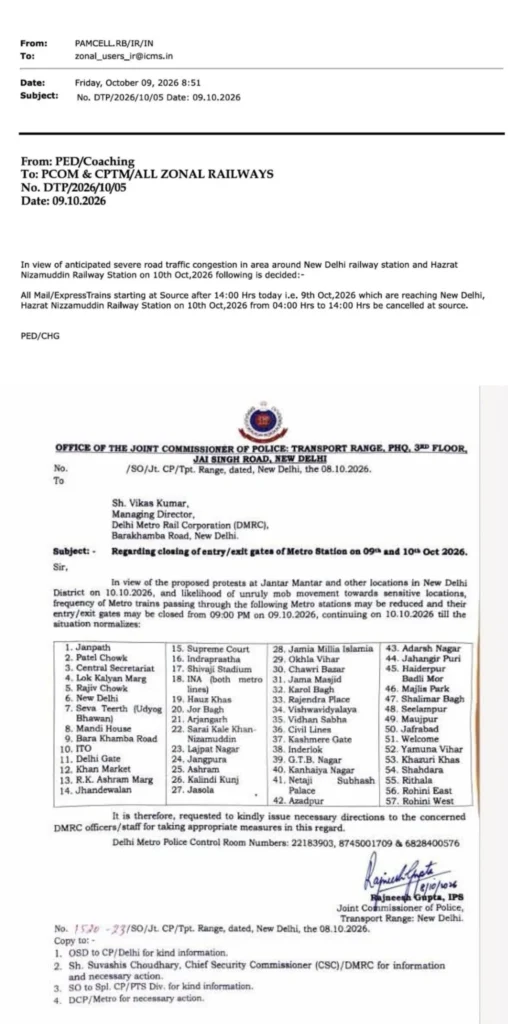
In a communication dated October 8, the Office of the Joint Commissioner of Police, Transport Range, asked Delhi Metro Rail Corporation to consider reducing train frequency at the identified stations and shutting their entry and exit gates.
The police communication cited concerns about large crowd movement toward sensitive locations.
DMRC subsequently announced restrictions beginning at 9 PM on October 9.
Passengers should expect security conditions to determine how long the measures remain in force on Saturday.
The Most Important Rule for Saturday Travelers
Do not simply check whether your Metro line is running.
Check your individual station.
A line may continue operating even when passengers cannot enter or leave through a particular station.
This distinction will matter especially at interchange hubs such as Rajiv Chowk, Central Secretariat, Mandi House, INA, Hauz Khas, Lajpat Nagar, Kashmere Gate, Azadpur and Netaji Subhash Place.
Yellow Line: Major Central and North Delhi Stations Affected
The Yellow Line faces some of the widest disruption.
Stations named in the restriction list include:
Patel Chowk, Central Secretariat, Lok Kalyan Marg, Rajiv Chowk, New Delhi, Seva Teerth (Udyog Bhawan), INA, Hauz Khas, Jor Bagh, Arjangarh, Chawri Bazar, Vishwavidyalaya, Vidhan Sabha, Civil Lines, Kashmere Gate, GTB Nagar, Azadpur, Adarsh Nagar, Jahangirpuri and Haiderpur Badli Mor.
Passengers traveling through Central Delhi should pay particular attention to Rajiv Chowk, Central Secretariat and New Delhi because these stations connect major business, government and railway areas.
Blue Line: Rajiv Chowk and Central Delhi Access Hit
Affected Blue Line stations include:
Rajiv Chowk, Mandi House, Barakhamba Road, R.K. Ashram Marg, Jhandewalan, Supreme Court, Indraprastha, Karol Bagh and Rajendra Place.
Rajiv Chowk is one of Delhi Metro’s busiest interchange stations, so entry and exit restrictions there could affect a large number of evening and Saturday travelers.
Violet Line: Janpath to South Delhi Stations Face Restrictions
The Violet Line list includes several stations serving central and south Delhi:
Janpath, Central Secretariat, Mandi House, ITO, Delhi Gate, Khan Market, Jama Masjid, Lajpat Nagar, Jangpura and Kashmere Gate.
Passengers heading toward areas around Jantar Mantar, government offices and central Delhi should plan their journeys carefully.
Red Line: North and East Delhi Stations Included
The Red Line is also heavily represented.
Affected stations include:
Kashmere Gate, Inderlok, Kanhaiya Nagar, Netaji Subhash Place, Seelampur, Welcome, Shahdara, Rithala, Rohini East and Rohini West.
This means the restrictions extend well beyond the immediate protest area and affect travelers in north, northwest and east Delhi.
Pink Line: South, North and Northeast Delhi Also Covered
Affected Pink Line stations include:
INA, Sarai Kale Khan–Nizamuddin, Lajpat Nagar, Ashram, Netaji Subhash Place, Azadpur, Majlis Park, Shalimar Bagh, Welcome, Jafrabad, Maujpur, Yamuna Vihar and Khazuri Khas.
Several of these stations serve major residential areas and interchange points.
The expanded Pink Line network means the restrictions could influence cross-city journeys even for passengers who have no plans to enter Central Delhi.
Magenta Line: Hauz Khas and Jamia Belt Affected
The restriction list also covers important Magenta Line stations:
Hauz Khas, Kalindi Kunj, Jasola Vihar Shaheen Bagh, Jamia Millia Islamia and Okhla Vihar.
Travelers from south Delhi, Jamia Nagar and adjoining areas should verify their route before starting their journey.
Airport Express: New Delhi and Shivaji Stadium
Two strategically important Airport Express stations are affected:
New Delhi
Shivaji Stadium
This could matter especially for airport passengers using the Airport Express to connect through central New Delhi.
Travelers carrying luggage or catching flights should allow extra time and consider alternate boarding points where practical.
Green Line
Inderlok appears on the affected list.
Because Inderlok also connects with the Red Line, passengers using it as an interchange should check the latest operating arrangements before travel.
What About Interchange Stations?
This is where passengers need to read the advisory carefully.
Closure of entry and exit gates does not automatically mean trains will bypass every affected station.
DMRC has indicated that interchange facilities will continue at affected interchange stations, except New Delhi Metro station.
For example, a passenger may be able to change lines inside an affected interchange station but may not be able to exit onto the street there.
Operational conditions can still change depending on security requirements.
Full 57-Station List
The stations identified for restrictions are:
Janpath, Patel Chowk, Central Secretariat, Lok Kalyan Marg, Rajiv Chowk, New Delhi, Seva Teerth (Udyog Bhawan), Mandi House, Barakhamba Road, ITO, Delhi Gate, Khan Market, R.K. Ashram Marg, Jhandewalan, Supreme Court, Indraprastha, Shivaji Stadium, INA, Hauz Khas, Jor Bagh, Arjangarh, Sarai Kale Khan–Nizamuddin, Lajpat Nagar, Jangpura, Ashram, Kalindi Kunj, Jasola Vihar Shaheen Bagh, Jamia Millia Islamia, Okhla Vihar, Chawri Bazar, Jama Masjid, Karol Bagh, Rajendra Place, Vishwavidyalaya, Vidhan Sabha, Civil Lines, Kashmere Gate, Inderlok, GTB Nagar, Kanhaiya Nagar, Netaji Subhash Place, Azadpur, Adarsh Nagar, Jahangirpuri, Haiderpur Badli Mor, Majlis Park, Shalimar Bagh, Seelampur, Maujpur, Jafrabad, Welcome, Yamuna Vihar, Khazuri Khas, Shahdara, Rithala, Rohini East and Rohini West.
Interchange stations appear on more than one Metro line, so line-wise counts should not be added together to calculate the 57-station total.
Could Metro Train Frequency Also Change?
Yes.
The Delhi Police communication also asked DMRC to consider reducing the frequency of Metro trains passing through the identified stations.
Passengers could therefore face longer waits even when trains continue to operate.
The exact frequency can depend on real-time security and crowd conditions.
Rail Passengers Face Disruption Too
The Metro restrictions are not the only transport challenge.
Rail services connected with New Delhi and Hazrat Nizamuddin have also faced widespread cancellations and schedule changes.
That makes October 10 particularly important for passengers who planned to combine Metro and railway travel.
Anyone heading toward a railway station should check both the train status and the accessibility of the Metro station they planned to use.
What Should You Do Before Leaving Home?
First, check the latest DMRC service update shortly before departure.
Second, confirm whether your destination station allows exit.
Third, identify the nearest alternative station in advance rather than trying to change plans after reaching an affected interchange.
Airport and railway passengers should leave additional time.
Most importantly, do not rely on screenshots or forwarded messages alone because security arrangements can change during the day.
Why Should You Read This Story?
Because “57 Metro stations closed” can easily create the wrong impression.
The key issue is entry and exit restrictions, not necessarily a complete shutdown of Metro movement at every listed station.
Understanding that difference can determine whether you need a completely different route or simply an alternative station for entering or leaving the network.
Why Is This Story Worth Sharing?
Delhi Metro carries millions of journeys, and the affected list includes major business districts, railway connections, universities and residential neighborhoods.
A friend or family member may not know their regular station is on the list until they reach the gate.
Sharing the station list before Friday night could help them plan a workable alternative.
The Bottom Line
From 9 PM on October 9, passengers will not be able to use normal entry and exit access at 57 identified Delhi Metro stations as security restrictions take effect ahead of Saturday’s protest.
The restrictions will continue on October 10 until authorities consider the situation normalized.
Metro passengers should remember the most important distinction:
Trains may still operate through affected parts of the network, but entering or leaving at your usual station may not be possible.