NEW DELHI, August 12, 2026 —
The Container Manufacturing Assistance Scheme could significantly reduce India’s dependence on imported shipping containers while creating more than 53,000 direct and indirect jobs, as the government moves to build a stronger domestic maritime manufacturing and logistics ecosystem.
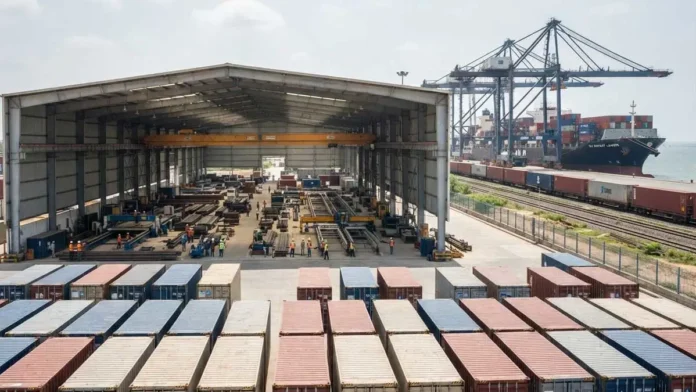
The proposed ₹10,000-crore scheme, announced in the Union Budget 2026-27, is designed to support new container-manufacturing plants, expansion of existing facilities, technology development, testing infrastructure and workforce skills over a five-year period. The government says the initiative could eventually increase annual domestic manufacturing capacity to as much as 750,000 twenty-foot equivalent units, or TEUs.
The program comes as India continues to import nearly 2 million empty containers every year to meet domestic demand and reposition equipment required for export-import trade. Policymakers see that dependence as a vulnerability at a time when geopolitical tensions, disrupted shipping routes and volatile freight rates have repeatedly tested global supply chains.
Container Manufacturing Assistance Scheme Could Create More Than 53,000 Jobs
Employment generation is expected to be one of the most important economic benefits of the Container Manufacturing Assistance Scheme, or CMAS.
Government estimates suggest that the program has the potential to create around 3,000 direct jobs and more than 50,000 indirect jobs, taking the combined employment impact above 53,000 positions.
The direct jobs would largely emerge in container manufacturing, assembly, testing, engineering and production operations.
However, a much broader employment impact could come from industries supplying materials and components used to manufacture internationally compliant freight containers.
These include manufacturers of corner castings, wooden flooring and frames, specialized steel such as Corten steel, paints and other industrial components. The government expects the development of a larger domestic container industry to stimulate many of these supporting businesses.
The employment impact could also extend into logistics, warehousing, maintenance, container depots, transport services and related segments as domestic production expands.
Why India Wants to Reduce Dependence on Imported Empty Containers
Containers are among the most basic but strategically important pieces of infrastructure in international trade.
They allow goods to move between ships, trains and trucks without being unloaded and repacked at every stage of their journey.
Yet India currently imports nearly 2 million empty containers annually, according to the government’s latest backgrounder on the proposed scheme.
That creates several risks.
When global container availability tightens, Indian exporters may face shortages, higher repositioning costs or delays in securing equipment.
Similarly, geopolitical conflicts or disruptions on major shipping routes can raise freight rates and alter the movement of containers between regions.
By creating a larger domestic manufacturing base, the government wants to reduce India’s exposure to those external shocks and ensure more reliable access to containers for exporters, manufacturers and logistics companies.
₹10,000-Crore CMAS to Run for Five Years
The Container Manufacturing Assistance Scheme carries an announced outlay of ₹10,000 crore over five years.
It is expected to provide both financial and institutional support for the domestic container industry.
The framework includes assistance for setting up new greenfield manufacturing facilities, expanding existing brownfield plants and improving the competitiveness of domestic producers. It also provides for support in testing infrastructure, skilling and capacity building.
The objective is not merely to manufacture more containers.
The larger ambition is to develop an Indian ecosystem capable of producing containers at globally competitive cost and quality while meeting internationally recognized technical and safety standards.
Domestic Capacity Could Rise to 750,000 TEUs Annually
The government says the proposed scheme could raise domestic container production capacity to as much as 7.5 lakh TEUs per year, roughly 10 times the existing manufacturing capability referenced in the latest official backgrounder.
A TEU, or twenty-foot equivalent unit, is the standard measurement used across the global container shipping industry.
A standard 20-foot container represents one TEU, while a 40-foot container generally represents two TEUs.
Building capacity at this scale could give Indian exporters and shipping companies a larger domestic source of standard dry containers and potentially other specialized container types as the industry develops.
Earlier government projections around the Budget had also highlighted the possibility of substantially scaling domestic container capacity over the coming decade.
₹99,149 Crore Investment Linked to 51-Vessel Container Shipping Plan
CMAS is being developed alongside a broader strategy to strengthen India’s domestic container-shipping ecosystem.
In February 2026, the Ministry of Ports, Shipping and Waterways moved to establish the proposed Bharat Container Shipping Line, or BCSL, involving organizations including the Shipping Corporation of India, Container Corporation of India and major port authorities.
The wider initiative envisages approximately ₹99,149 crore of investment in developing a fleet of 51 container vessels of different sizes and procuring containers domestically, according to the government’s August 11 backgrounder.
The approach is aimed at tackling two linked challenges: India’s dependence on foreign-made containers and its limited presence in container shipping.
A stronger domestic container fleet, combined with local manufacturing, could give Indian trade greater control over the equipment and shipping capacity required to move cargo internationally.
Make in India Push Extends to Maritime Manufacturing
The government has positioned CMAS as part of its wider Make in India and maritime self-reliance strategy.
The initiative is aligned with the Maritime Amrit Kaal Vision 2047, multimodal logistics development, PM Gati Shakti, the National Logistics Policy and the Sagarmala program.
Together, these programs seek to improve connectivity between ports, highways, rail networks, inland waterways and manufacturing centers.
The objective is to make Indian logistics more efficient while expanding the domestic industrial base serving shipping and international trade.
Container production is increasingly being treated as a strategic manufacturing segment because containers are essential to modern supply chains.
Maritime Trade Carries More Than 80% of Global Goods by Volume
The economic rationale behind stronger domestic container manufacturing is also linked to the central role of maritime shipping in global trade.
UN Trade and Development says more than 80% of international merchandise trade by volume is transported by sea.
That makes shipping containers, ports and vessels critical infrastructure for the global economy.
Container availability can influence how quickly exporters get goods to overseas customers, how efficiently supply chains operate and how much companies ultimately pay for transportation.
UNCTAD has also warned that maritime freight rates have remained elevated and volatile amid geopolitical tensions, changing trade patterns and supply-demand imbalances, adding uncertainty to global trade costs.
For India, building containers domestically could therefore serve not only an industrial objective but also a supply-chain resilience strategy.
India-Made Containers Begin Gaining Commercial Traction
India has already seen signs that domestic container manufacturing can attract major international customers.
In July 2026, the country rolled out an India-made export-import container for A.P. Moller-Maersk at the Maersk-CONCOR Inland Container Depot in Dadri, Uttar Pradesh.
The container was manufactured to recognized ISO specifications and standards under the International Convention for Safe Containers, making it suitable for international shipping networks.
The government also highlighted an additional order for 1,000 Made-in-India containers from DCM Shriram Group, describing it as an early sign of commercial confidence in India’s container-manufacturing capability.
These developments could become important as India attempts to move from limited domestic production toward industrial-scale manufacturing.
Ancillary Industries Could Benefit From CMAS
A container is far more than a steel box.
Its production requires multiple specialized materials and components, providing opportunities for a wide group of domestic suppliers.
The government expects CMAS to stimulate demand for industries producing corner castings, specialized steel and wooden flooring or framing components.
Testing agencies, engineering services, coating and paint companies, welding-equipment providers and logistics operators could also benefit as production capacity expands.
This multiplier effect explains why the government expects indirect employment to substantially exceed direct factory jobs.
A large container-manufacturing ecosystem could also support small and medium-sized enterprises that supply components to major producers.
CMAS Joins India’s Wider Shipbuilding and Maritime Push
The container program is part of a much larger effort to expand India’s maritime industrial capacity.
The government has also announced a shipbuilding support package broadly valued at around ₹70,000 crore.
The Union Cabinet had earlier approved a ₹69,725-crore comprehensive package for shipbuilding and maritime capacity, including a ₹24,736-crore Shipbuilding Financial Assistance Scheme, a ₹25,000-crore Maritime Development Fund and a ₹19,989-crore Shipbuilding Development Scheme.
That package is aimed at expanding shipyard capacity, improving financing, supporting technology development and attracting investment into domestic shipbuilding.
Combined with CMAS and the proposed Bharat Container Shipping Line, the government is seeking to create a more integrated maritime ecosystem spanning ships, containers, ports, shipping services and multimodal logistics.
Why Container Self-Reliance Matters for Indian Exporters
Domestic container availability can have a direct impact on exporters.
A shortage of empty containers can delay shipments even when manufacturing orders have been completed and port capacity is available.
Exporters can also face higher logistics expenses when empty containers must be repositioned over long distances.
Greater manufacturing capacity within India could improve availability, reduce exposure to overseas supply constraints and create more competition in the container market.
However, the ultimate impact on container prices and logistics costs will depend on production economics, steel prices, manufacturing efficiency, demand and shipping-market conditions.
The government’s immediate focus is therefore on building enough domestic scale to create a competitive industry.
Supply-Chain Resilience at the Center of the Plan
The pandemic-era logistics crisis and more recent geopolitical disruptions have demonstrated how quickly maritime supply chains can come under pressure.
UNCTAD has reported sharp fluctuations in freight costs when shipping routes are disrupted, including during periods of stress around major maritime corridors.
For a major trading economy such as India, dependence on imported logistics equipment creates an additional external vulnerability.
CMAS seeks to address part of that problem by increasing local availability of one of the most essential assets in global cargo movement.
The scheme could also help India develop production capacity that eventually serves overseas markets, provided domestic manufacturers can compete internationally on quality, price and delivery timelines.
Government Sees CMAS as a Long-Term Maritime Competitiveness Push
The Container Manufacturing Assistance Scheme represents a shift toward treating container manufacturing as part of India’s strategic industrial infrastructure rather than simply as a logistics support activity.
With a ₹10,000-crore outlay, projected employment of more than 53,000 people, targeted manufacturing capacity of up to 750,000 TEUs annually, and the wider ₹99,149-crore container-vessel and procurement initiative, the government is attempting to create an integrated domestic ecosystem.
If the planned investments translate into competitive manufacturing capacity, India could gradually lower its reliance on millions of imported empty containers while strengthening supply chains for its growing export and manufacturing sectors.
The initiative also fits into a much broader policy push involving shipbuilding, ports, coastal shipping and multimodal logistics.
For India, the longer-term goal is clear: produce more of the equipment required for its own trade at home, strengthen maritime resilience and build the industrial capacity needed to compete more effectively in global shipping and logistics.