BEIJING, CHINA | AUGUST 26, 2026 —
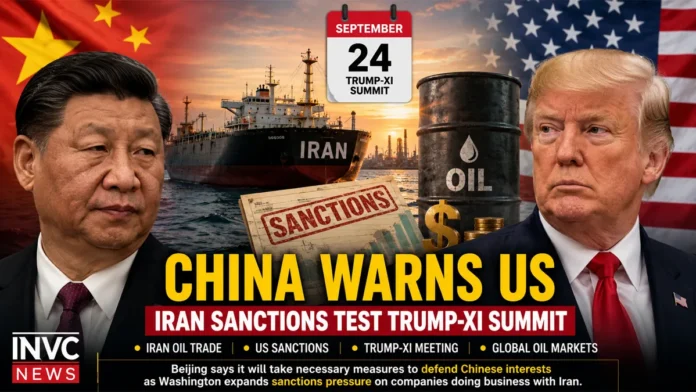
China US Iran sanctions tensions are escalating just weeks before a planned meeting between U.S. President Donald Trump and Chinese President Xi Jinping, after Beijing warned it would take “all necessary measures” to protect its interests if Washington’s expanding pressure campaign against Iran harms Chinese companies.
The warning follows a new U.S. sanctions push targeting dozens of individuals, companies and vessels linked to Iran, including some entities in China and Hong Kong.
Washington is threatening broader secondary sanctions against companies and financial institutions that continue doing business with Tehran.
China, however, has made clear that it does not accept U.S. demands to sever lawful economic ties with Iran.
The confrontation creates a major new test for the fragile U.S.-China relationship ahead of Xi’s expected September 24 visit to Washington.
What Did China Say About the US Sanctions?
Chinese Foreign Ministry spokesperson Lin Jian said Beijing firmly opposes unilateral sanctions that it says lack a basis in international law or authorization from the United Nations Security Council.
China also rejected what it described as economic warfare and maximum pressure against Iran.
Most significantly, Lin said:
China will do everything necessary to firmly safeguard its rights and interests.
The wording stops short of publicly announcing a specific retaliatory measure.
However, it signals that Beijing could respond if major Chinese companies, banks or energy interests become direct targets of U.S. secondary sanctions.
China’s official position can be reviewed through the Chinese Foreign Ministry.
What Is Washington Trying to Do?
The Trump administration is attempting to tighten Iran’s access to international trade, banking and energy revenue.
The latest U.S. action targeted approximately 60 individuals, entities and vessels connected with Iran.
Treasury Secretary Scott Bessent has also warned foreign companies and governments that Washington intends to widen enforcement against organizations helping Iran continue international commerce.
Secondary sanctions are particularly powerful because they can punish non-U.S. companies for dealing with sanctioned Iranian entities.
In extreme cases, companies can lose access to the U.S. financial system or dollar transactions.
That puts China at the center of the dispute.
Why China Matters to Iran’s Oil Industry
China is Iran’s most important oil customer.
A substantial majority of Iranian crude exports ultimately flow to Chinese buyers, particularly independent refiners often referred to as “teapot” refiners.
Iranian oil can be attractive to those buyers because sanctions often force Tehran to sell crude at discounted prices.
Large Chinese state-owned energy companies have generally been more cautious because they have greater exposure to the U.S. financial system.
Smaller refiners and trading networks, however, have continued purchasing Iranian crude through complex shipping and payment arrangements.
That makes tougher secondary sanctions potentially much more disruptive.
US Has So Far Avoided the Biggest Chinese Banks
Despite the strong rhetoric, Washington appears to be proceeding carefully.
The latest sanctions have hit some China- and Hong Kong-linked entities, but the United States has so far avoided imposing sweeping penalties on China’s largest banks and major state-owned companies.
That distinction matters.
Sanctioning a small trading company creates limited financial disruption.
Targeting a major Chinese bank could create a much larger confrontation between the world’s two biggest economies.
It could also disrupt global dollar transactions, trade financing and commodity markets.
Trump-Xi Summit Raises the Stakes
President Trump has said Xi Jinping is expected to visit the United States on September 24.
The two leaders are already expected to discuss trade, tariffs, artificial intelligence, technology controls and Taiwan.
Iran may now become another major issue.
Washington wants Beijing to reduce the economic lifeline available to Tehran.
China, meanwhile, has little incentive to accept unilateral U.S. sanctions without receiving something significant in return.
That creates the possibility of Iran becoming part of a broader U.S.-China bargaining process.
However, neither government has announced that Iranian oil will formally be on the summit agenda.
Could China Retaliate Against the United States?
China has several possible economic tools if tensions escalate.
These could theoretically include tighter restrictions on critical minerals, regulatory pressure on U.S. businesses operating in China or counter-sanctions against American entities.
China has previously demonstrated that controls over strategically important materials can create significant pressure on global industries.
But Beijing has not announced any specific retaliation over the latest Iran sanctions.
That is an important distinction.
For now, China’s message is a warning rather than a confirmed retaliatory action.
Strait of Hormuz Adds Another Layer
The sanctions dispute is unfolding while uncertainty continues around the Strait of Hormuz, one of the world’s most important energy routes.
Iran and Oman have recently discussed arrangements aimed at improving navigation through the waterway.
Those talks helped push global crude prices lower this week as traders assessed the possibility of improved tanker traffic.
Also Read:
Oil Prices Drop 2% on Hormuz Reopening Hopes: Will Petrol Get Cheaper in India?
The connection is important because sanctions on Iranian oil and restrictions in Hormuz can both influence global crude prices.
Why India Should Watch This Closely
A U.S.-China confrontation over Iranian oil would not remain confined to Washington, Beijing and Tehran.
India could feel the consequences through:
- Global crude oil prices
- Shipping costs
- The rupee-dollar exchange rate
- Inflation
- Petrol and diesel expectations
- Stock-market sentiment
India imports most of the crude oil it consumes.
If sanctions sharply reduce Iranian exports and global supply tightens, crude prices could rise again.
On the other hand, a compromise between the United States and China or improvement in Hormuz shipping conditions could reduce the geopolitical premium embedded in oil prices.
Could the Trump-Xi Meeting Defuse the Dispute?
Possibly—but there is no guarantee.
Both Washington and Beijing have reasons to prevent the Iran dispute from derailing their broader relationship.
Trump wants progress on trade and other economic issues.
Xi also has an interest in preventing another major escalation in tariffs, technology restrictions or financial sanctions.
That creates space for negotiation.
But Iran remains strategically important to China as both an energy supplier and geopolitical partner.
Beijing is therefore unlikely to simply abandon its Iran relationship without significant concessions.
What Happens Next?
Three developments will determine whether the dispute escalates.
First: whether Washington sanctions major Chinese banks or large state-owned companies.
Second: whether Beijing converts its warning into concrete retaliatory action.
Third: whether Iran becomes a central bargaining issue when Trump and Xi meet in Washington.
For now, the China US Iran sanctions dispute represents another pressure point in an already complicated relationship.
The most important signal may be what Washington has not done yet: it has avoided targeting China’s biggest financial institutions.
Whether that restraint survives until the Trump-Xi summit could determine whether the current warning remains diplomatic rhetoric—or develops into a much wider economic confrontation.