By Team INVC | INVC NEWS
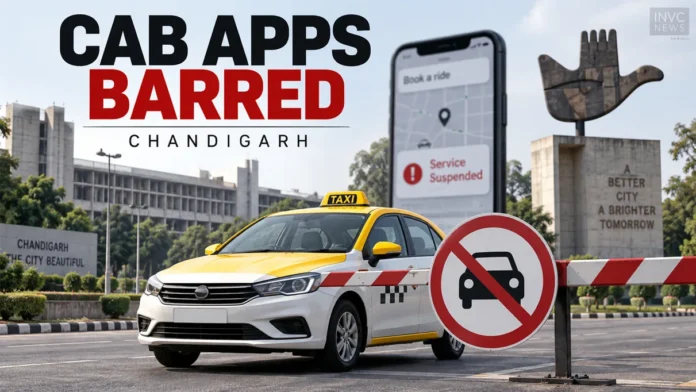
CHANDIGARH, India | September 19, 2026 — Chandigarh’s app-based cab market has undergone a dramatic shake-up after the Union Territory administration suspended the aggregator licences of Ola, InDrive, Uber and Rapido for six months over alleged violations of local motor vehicle aggregator rules.
All four major platforms are now barred from operating under their aggregator licences within Chandigarh.
However, the action did not come through one simultaneous order.
The State Transport Authority took action against the four companies in separate stages over the past three months, culminating in the suspension of Uber and Rapido on September 8.
The development has left commuters with far fewer major app-based transport choices and has pushed the newly launched Bharat Taxi into the spotlight.
Ola, InDrive, Uber and Rapido Suspended on Different Dates
The enforcement began with Ola.
The Chandigarh State Transport Authority suspended the aggregator licence of ANI Technologies, which operates Ola, on June 17, 2026.
InDrive followed on August 10.
Then, on September 8, the authority suspended the licences of Uber India Systems and Rapido operator Roppen Transportation Services for six months.
That means the suspension periods will also expire at different times.
Ola’s suspension runs until December 2026, while InDrive is expected to remain barred until February 2027.
Uber and Rapido face suspension until March 2027, unless the competent authority modifies the orders earlier.
Why Chandigarh Administration Took Action
The STA invoked Rule 17 of the Chandigarh Administration Motor Vehicles Aggregators Rules, 2025.
According to reports based on the suspension orders, the administration cited repeated non-compliance across several areas.
Officials alleged that companies failed to provide mandated health and term insurance to drivers.
Authorities also flagged violations involving the notified fare structure.
In the cases of Uber and Rapido, officials alleged that passengers were being charged above the prescribed fares.
The administration additionally raised concerns about subscription or prepaid recharge models imposed on drivers.
Offices Found Closed During Inspections
Regulators also questioned whether some aggregators maintained functioning local offices as required.
According to the orders reported in local media, Uber’s Sector 47-C office and Rapido’s Sector 32-D office were found closed during multiple inspections in May.
Authorities also cited cases involving the attachment of private, non-commercial vehicles to aggregator platforms.
The STA said companies had received notices, show-cause proceedings and opportunities to demonstrate compliance before the suspensions were imposed.
Driver Insurance and Training Became Major Issues
Driver welfare formed another major part of the regulatory dispute.
The Chandigarh rules require aggregators to comply with provisions covering insurance, training and other conditions intended to regulate app-based transport services.
Authorities alleged that some companies did not fully meet these requirements despite repeated directions.
The administration also questioned whether required compliance reports were submitted on time.
For passengers, the most immediate consequence is simple: fewer major ride-hailing platforms are legally permitted to operate within Chandigarh during the suspension periods.
Chandigarh Warns Against Booking Suspended Platforms
When Ola’s licence was suspended in June, the Chandigarh Transport Department advised residents not to book rides through the Ola application within the Union Territory.
Authorities warned that vehicles found operating in violation of the suspension could face fines and impounding.
Similar enforcement concerns now apply as the wider crackdown covers all four major aggregators.
This distinction is particularly important for commuters because an app may technically remain accessible on a smartphone even when the platform is not authorised to provide aggregator services within Chandigarh.
Does the Ban Cover the Entire Tricity?
No.
The orders concern Chandigarh Union Territory.
They should not automatically be described as a blanket prohibition across Chandigarh, Mohali and Panchkula.
Mohali falls in Punjab, while Panchkula is in Haryana, and transport regulation in those jurisdictions falls under different authorities.
Therefore, commuters travelling across the Tricity may encounter different regulatory conditions depending on where a trip begins or ends.
Bharat Taxi Emerges as Major Alternative
The disruption has opened the door for Bharat Taxi.
The cooperative-based ride-hailing service officially launched operations in Chandigarh this week and is positioning itself as an alternative to conventional aggregator platforms.
Bharat Taxi follows a driver-focused cooperative model designed to give participating drivers a greater role in the platform.
Its arrival comes at an unusually favourable moment because Ola, Uber, Rapido and InDrive are all under licence suspension in Chandigarh.
For passengers, however, the reduction in competing platforms could also raise concerns about availability, waiting times and fares.
Nearly One Lakh Daily Users Could Feel the Impact
Local reports estimate that close to one lakh people depend on app-based cab services in Chandigarh on a typical day.
That makes the regulatory action much more than a dispute between the administration and technology companies.
Students, office workers, visitors, older people and residents without private transport frequently depend on ride-hailing platforms for daily mobility.
Fewer available platforms could therefore place pressure on taxis, auto-rickshaws and other transport alternatives.
What Happens After Six Months?
A six-month suspension does not necessarily mean permanent removal from Chandigarh.
Each company could potentially return once its suspension period ends, subject to compliance with applicable rules and any further decision by the licensing authority.
The administration could also take additional action if it determines that violations continue.
For Ola, InDrive, Uber and Rapido, the coming months will therefore be crucial.
Compliance with fare rules, driver welfare requirements, insurance provisions and licensing conditions could determine how quickly major ride-hailing competition returns to Chandigarh.
For passengers, meanwhile, Chandigarh’s cab market has entered a very different phase.
Four of the city’s biggest ride-hailing names are currently barred under separate six-month licence suspensions, leaving Bharat Taxi with an unusually large opportunity to establish itself in one of North India’s most important urban transport markets.