JAKARTA, Indonesia | September 7, 2026 —
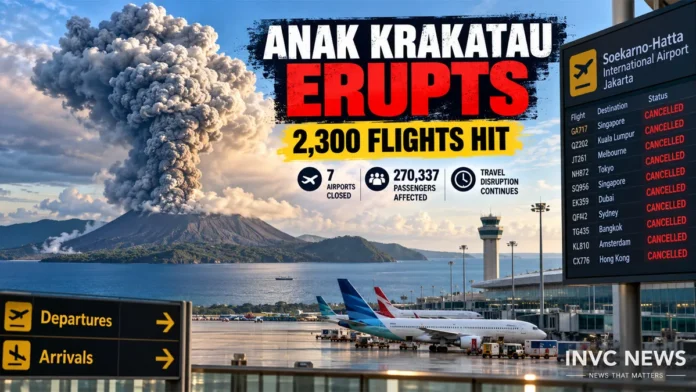
Anak Krakatau Eruption September 7 2026 continued to disrupt air travel across Indonesia on Monday as volcanic ash forced authorities to keep seven airports closed, including Jakarta’s main international gateway, while airlines dealt with thousands of cancelled, delayed and diverted flights.
Indonesia’s Transport Ministry said around 2,300 flights and 270,337 passengers had been affected since September 5 as ash from Anak Krakatau spread across parts of Java and Sumatra and entered critical aviation airspace.
Authorities extended temporary closures at seven airports until 6:00 PM local time on Monday, while continuing to monitor changing wind patterns and volcanic ash at different altitudes.
Jakarta Soekarno-Hatta Airport Remains Closed
Jakarta’s Soekarno-Hatta International Airport, Indonesia’s busiest international aviation hub, remains among the airports affected by the volcanic ash.
The closure has disrupted domestic and international services and forced airlines to cancel, delay or reroute flights.
Authorities said aircraft operations will resume only after officials determine that conditions meet aviation safety requirements.
Volcanic ash presents a serious hazard to aircraft because fine particles can damage engines, reduce visibility and affect other systems.
Seven Indonesia Airports Closed Until 6 PM
According to Indonesia’s latest Transport Ministry update, seven airports remained temporarily closed on Monday morning:
Soekarno-Hatta International Airport – Banten
Halim Perdanakusuma Airport – Jakarta
Radin Inten II Airport – Lampung
Budiarto Airport – Banten
Pondok Cabe Airport – Banten
Muhammad Taufiq Kiemas Airport – Lampung
Husein Sastranegara Airport – West Java
Authorities had previously closed Atung Bungsu Airport in South Sumatra, but the airport resumed normal operations at 9:00 AM on September 7.
The situation remains fluid and authorities may change airport operating status depending on ash movement.
2,300 Flights Affected by Volcanic Ash
The scale of the disruption has grown sharply.
Indonesia’s Transport Ministry said that by 9:00 AM Monday, about 2,300 flights had experienced cancellations, delays or diversions since September 5.
Approximately 270,337 passengers have been affected.
At airports that remained temporarily closed, officials recorded around 1,397 affected flights involving approximately 177,579 passengers.
Another 922 flights involving around 92,758 passengers faced disruption because airlines adjusted routes elsewhere.
The figures show how an eruption hundreds of kilometres from some airports can quickly create widespread aviation disruption when ash enters major flight corridors.
Anak Krakatau Ash Reaches Up to 50,000 Feet
Meteorological monitoring detected volcanic ash at two major altitude layers on Monday morning.
Officials tracked ash reaching approximately 15,000 feet and 50,000 feet.
Ash at these heights can interfere directly with airline routes.
Changing winds have made forecasting particularly difficult.
Indonesia’s transport minister said winds at different atmospheric levels have been moving in different directions, allowing ash to remain over areas near several affected airports.
Authorities therefore continue to update airport operations according to real-time conditions.
Indonesia Prepares Six Alternative Airports
Indonesia has prepared six alternative airports to maintain air connectivity while the closures continue.
The designated alternatives include:
Juanda Airport – East Java
Adi Soemarmo Airport – Central Java
Yogyakarta International Airport
Adisutjipto Airport – Yogyakarta
Jenderal Ahmad Yani Airport – Central Java
Kertajati International Airport – West Java
The Transport Ministry has encouraged domestic and international airlines to consider these airports where operationally possible.
Airlines will decide whether to use alternative airports based on aircraft routes, airport capacity and local operating conditions.
Passengers Told to Check Flight Status Before Leaving Home
Travelers with flights to or from Jakarta and other affected areas should contact their airline before travelling to the airport.
Flight status can change rapidly.
An aircraft scheduled to operate later in the day could face cancellation, delay or diversion if ash continues to affect the route.
Passengers should check:
Flight departure status
Arrival airport
Rebooking arrangements
Refund policies
Alternative airport information
Airline notifications
Travelers with connecting international flights should pay particular attention because a domestic cancellation can also affect onward travel.
Airlines Must Inspect Aircraft Before Operations Resume
Reopening an airport does not mean flights can restart immediately.
Authorities plan to inspect and clean runways, taxiways and aprons before normal operations resume.
Airlines must also inspect aircraft that remained at affected airports.
Volcanic ash can enter aircraft engines and other components even when planes are parked.
Safety inspections could therefore create additional delays even after airport authorities lift closures.
Schools Move Online as Ash Affects Daily Life
The Anak Krakatau eruption has also affected life outside airports.
Authorities have advised residents in affected areas to limit exposure to volcanic ash and use masks when outdoors.
Schools in some affected areas have moved lessons online because ash can irritate the eyes, skin and respiratory system.
The eruption has spread ash across Jakarta and surrounding regions as changing weather conditions carry particles away from the volcano.
No Immediate Tsunami Threat Reported
Anak Krakatau has a history that makes any major eruption closely watched.
The volcano sits in the Sunda Strait between Java and Sumatra.
A major collapse at Anak Krakatau in 2018 triggered a tsunami that killed more than 400 people along nearby coastlines.
However, Indonesian authorities have not reported an immediate tsunami threat from the current eruption.
Officials continue to monitor volcanic activity closely.
Residents and tourists near the volcano should follow official exclusion-zone instructions.
Why Volcanic Ash Is Dangerous for Aircraft
Volcanic ash differs from ordinary smoke or dust.
It contains tiny particles of rock and volcanic material.
When aircraft engines ingest ash, high temperatures can melt the particles and damage internal components.
Ash can also scratch cockpit windows, interfere with instruments and reduce visibility.
For that reason, aviation authorities often close airspace even when an airport itself has not suffered physical damage.
Safety considerations take priority over maintaining schedules.
Jakarta Flight Disruption Could Affect Regional Travel
Jakarta serves as one of Southeast Asia’s major aviation hubs.
Flight disruption there can affect passengers travelling between Indonesia and cities across Asia, Australia and the Middle East.
International travelers may experience schedule changes even if their final destination lies far from Anak Krakatau.
Airlines could also reposition aircraft or crews as the disruption continues.
That makes today’s eruption a significant regional travel story rather than only a domestic Indonesian event.
When Will Jakarta Airport Reopen?
Authorities have not guaranteed a final reopening time.
The current closure period extends until 6:00 PM local time on September 7, but officials will reassess conditions before allowing operations to resume.
The Transport Ministry has made clear that aviation safety will determine the decision.
Wind direction, ash concentration and additional volcanic activity could all change the schedule.
Therefore, passengers should treat any reopening time as provisional until their airline confirms their individual flight.
Anak Krakatau Eruption: Key Numbers
Airports currently affected: 7
Flights affected since September 5: About 2,300
Passengers affected: 270,337
Ash detected as high as: 50,000 feet
Current airport closure extension: Until 6:00 PM local time
Alternative airports prepared: 6
Atung Bungsu Airport: Reopened Monday morning
Travelers Face More Uncertainty
Indonesia’s aviation authorities continue to monitor Anak Krakatau and the movement of its ash cloud.
Another eruption or shift in wind direction could extend flight disruption.
Conversely, improving conditions could allow authorities to reopen airports progressively.
For passengers, the safest approach remains checking directly with airlines before heading to an airport.
With Jakarta acting as one of Asia’s busiest aviation gateways, the next official update could have consequences for hundreds of domestic and international flights.