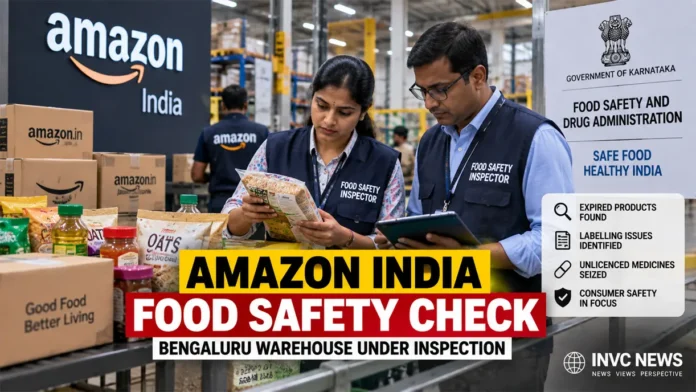
BENGALURU, India | September 10, 2026 —
Amazon India Food Safety Raid has put online food storage and consumer safety back under scrutiny after Amazon said it was reviewing findings from Karnataka food inspectors who identified expired or inadequately labelled food products at two of its Bengaluru facilities.
Karnataka’s Food Safety and Drug Administration said checks at two Amazon food storage and supply units found products worth a combined $59,000 that had incorrect or inadequate labels or had passed their expiry dates. Inspectors also seized medicines valued at about $4,232 because authorities said they were stored without a valid licence.
Amazon has not accepted allegations of systemic wrongdoing. The company said it is reviewing the inspection observations and will take necessary steps where required.
That distinction is important for consumers: inspectors have reported compliance lapses, while Amazon says it maintains systems designed to stop non-compliant products from entering its fulfilment network.
What did inspectors find at Amazon facilities?
The inspections formed part of a wider enforcement drive across Bengaluru involving online delivery and storage facilities.
At Amazon-linked facilities, authorities identified food products with labelling problems as well as products that had crossed their expiry dates.
Medicines stored without a valid licence also attracted regulatory action.
The broader Bengaluru operation extended beyond Amazon. Karnataka authorities inspected other storage facilities and quick-commerce operations as they intensified checks on how food and health-related products move through rapidly expanding online delivery networks.
For Amazon, however, the key issue now is whether the lapses identified by inspectors resulted from isolated operational failures or expose weaknesses that require stronger controls.
Amazon says it is reviewing the findings
Amazon responded by stressing its compliance systems.
The company said it has controls designed to prevent products that fail applicable regulatory requirements from being listed on its Indian marketplace or entering its fulfilment centres.
It is now reviewing the observations and says it will take the necessary steps.
An industry source also said Amazon was strengthening internal controls to prevent similar lapses from recurring.
That response makes today’s development more significant than simply repeating news of the earlier inspections.
The next question is what corrective measures follow.
Should Amazon customers be worried?
Consumers should pay attention, but the findings do not mean every food product sold through Amazon is unsafe.
The inspections involved specific facilities and products.
There has been no announcement requiring consumers to stop buying food from Amazon generally.
However, the case provides a useful reminder that online delivery does not remove the basic checks consumers should make when buying packaged food.
Buyers should examine the expiry or best-before date when an order arrives. They should also check whether packaging remains sealed, whether the label appears altered and whether storage-sensitive products arrive in appropriate condition.
Any suspicious product should be documented before it is consumed.
Why expiry dates and labels matter
Food labels do far more than display a brand name.
They can tell consumers when a product should be used, what ingredients it contains, its nutritional composition, allergens, manufacturer details and storage requirements.
Incorrect or inadequate labelling can therefore prevent consumers from making an informed decision.
Expiry-related problems carry an even more obvious concern.
Products that have passed applicable safety dates should not continue moving through normal retail channels as though they were fresh stock.
That principle applies whether consumers buy from a neighbourhood store, supermarket, dark store or online marketplace.
Bengaluru checks expose a bigger e-commerce challenge
India’s online grocery and quick-commerce market has expanded at extraordinary speed.
That growth has made food delivery more convenient, but it has also created an enormous logistics network involving warehouses, dark stores, fulfilment centres and thousands of individual products.
Regulators now have to monitor a supply chain that moves much faster than conventional retail.
India’s quick-commerce industry processes roughly nine million orders a day, according to Reuters’ recent examination of the country’s food-safety enforcement push. Regulators have stepped up checks after finding hygiene, labelling and storage problems across parts of the food industry.
That makes warehouse compliance increasingly important.
Consumers rarely see where an online order was stored before it reached their home.
They depend on platforms and sellers to maintain proper inventory controls behind the screen.
Amazon case comes amid nationwide food-safety crackdown
The Bengaluru action is not happening in isolation.
Federal and state authorities have intensified food-safety inspections across restaurants, warehouses, clubs and major brands.
Reuters reports that inspectors have tested more than 100,000 food samples annually since 2020, with roughly one-fifth found unsafe, substandard or inadequately labelled.
Regulators have also increased attention on expiry-date manipulation, misleading labels, warehouse hygiene and the rapidly growing quick-commerce sector.
Separately, India is debating a major change to front-of-pack food labels.
The Food Safety and Standards Authority of India has proposed prominent warning labels for products crossing specified thresholds for added sugar, salt or saturated fat. Food-industry representatives have challenged aspects of that framework, arguing that the thresholds need further scientific review.
Together, these developments point to a much larger shift in India’s food market.
Online marketplaces face a trust test
For e-commerce companies, food is fundamentally different from many other product categories.
A delayed phone charger is inconvenient.
A poorly stored or expired food product can become a consumer-safety issue.
That means platforms need strong inventory rotation, seller verification, temperature controls where necessary and systems capable of identifying products approaching expiry.
The scale makes this difficult.
Amazon handles enormous product volumes across India. Quick-commerce companies promise deliveries within minutes. Consumers simultaneously expect low prices, huge selection and immediate availability.
Those expectations cannot come at the expense of food-safety compliance.
What happens next?
Amazon’s response will now be important.
The company is reviewing the observations and says it will take steps as required. Authorities could also continue enforcement action depending on their findings and applicable regulations.
Consumers should watch for any product-specific recall, regulatory notice or additional official action rather than assuming the inspection applies to every Amazon food order.
For the wider industry, the message is clearer.
India’s regulators are increasingly looking beyond restaurants and traditional retailers and into the warehouses that power e-commerce.
As online grocery shopping expands, food safety inside a fulfilment centre is becoming just as important as food safety on a supermarket shelf.