JAIPUR, Rajasthan | August 24, 2026 —
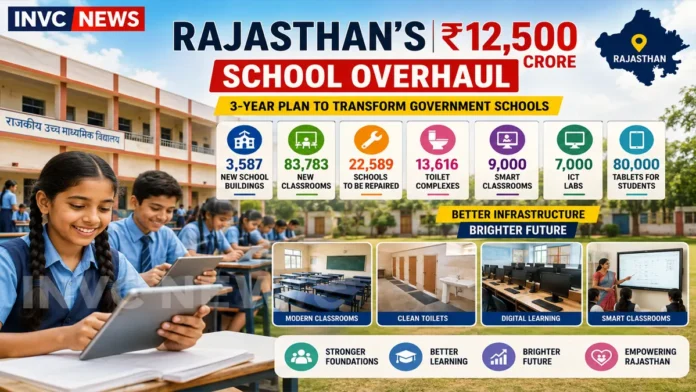
The rajasthan has unveiled an ambitious ₹12,500 crore school infrastructure plan that aims to transform government schools across the state over the next three years, with massive spending proposed for new buildings, additional classrooms, repairs, toilets, smart classrooms, ICT laboratories and student tablets.
The roadmap, covering 2026-27 to 2028-29, is designed to address long-standing infrastructure gaps while pushing government schools toward safer, better-equipped and more technology-enabled learning environments.
The scale is substantial.
The state plans to build 3,587 new school buildings, add 83,783 classrooms, carry out major repairs at 22,589 schools and construct 13,616 toilet complexes.
Alongside physical infrastructure, Rajasthan is also planning a major digital-learning expansion involving 9,000 smart classrooms, 7,000 ICT laboratories and around 80,000 tablets.
For students and parents, however, the real value of the plan will depend on how quickly these numbers translate into functioning classrooms, safe buildings, usable toilets and meaningful digital-learning facilities.
₹12,500 Crore Rajasthan School Infrastructure Plan: What Will Change?
The biggest share of the proposed spending is expected to go toward additional classrooms.
Approximately ₹8,378.30 crore has been earmarked for the construction of 83,783 new classrooms.
Another ₹2,487.75 crore is proposed for 3,587 new school buildings, while approximately ₹1,129.45 crore is planned for major repair work across 22,589 schools.
The government also proposes spending around ₹340.40 crore on 13,616 toilet complexes.
These investments are intended to tackle some of the most basic problems faced by government schools: overcrowding, aging buildings, damaged classrooms, inadequate sanitation and limited learning infrastructure.
83,783 New Classrooms Could Be the Biggest Immediate Change
The planned 83,783 classrooms are the most striking component of the scheme.
Additional classrooms could help reduce overcrowding, improve class scheduling and allow unsafe or damaged rooms to be taken out of use.
In many government schools, infrastructure shortages can directly affect the teaching environment.
When too many students share limited classroom space, teachers face more difficulty maintaining attention, organizing lessons and creating an effective learning environment.
That is why classroom expansion can have an impact beyond construction alone.
It can influence daily teaching conditions.
3,587 New School Buildings Planned Across Rajasthan
Rajasthan also plans to construct 3,587 new school buildings.
This could be particularly important for institutions operating from old, damaged or inadequate premises.
Modern school buildings increasingly require more than standard classrooms.
They may include:
- Science laboratories
- Computer laboratories
- Libraries
- Staff rooms
- Accessible toilets
- Drinking-water facilities
- Electricity
- Digital classrooms
- Administrative spaces
- Facilities for children with disabilities
A new school building therefore gives the government an opportunity to design campuses around current educational needs rather than repeatedly repairing outdated infrastructure.
Repairs Planned at 22,589 Government Schools
New construction alone will not solve Rajasthan’s infrastructure challenge.
Major repairs are proposed at 22,589 schools.
This part of the program could produce faster visible results because many existing schools may need structural repairs rather than complete rebuilding.
Damaged roofs, walls, floors, classrooms and sanitation facilities can directly affect student safety.
Regular maintenance can also prevent smaller problems from becoming larger and more expensive.
For parents, repair work may matter as much as a newly announced school building.
The immediate concern is simple: Is the place where children study safe?
13,616 Toilet Complexes Could Improve Attendance and Dignity
Sanitation is another major component of the roadmap.
The government plans to construct 13,616 toilet complexes.
Functional toilets are basic infrastructure, but their impact can extend well beyond hygiene.
For adolescent girls in particular, reliable and clean sanitation facilities can affect attendance and school retention.
The challenge will be maintenance.
A newly constructed toilet does not automatically remain useful unless schools also receive regular water supply, cleaning support and accountability for upkeep.
That makes maintenance almost as important as construction itself.
Rajasthan’s Digital Learning Push Is Equally Significant
The physical school revamp is being accompanied by a large digital transformation plan.
Rajasthan plans to introduce around:
9,000 smart classrooms
7,000 ICT laboratories
80,000 tablets
Around ₹1,087 crore is being directed toward digital education initiatives targeted for rollout by December 2026.
This could significantly expand access to digital learning across government schools.
Smart classrooms can give teachers access to multimedia learning tools, while ICT laboratories can help students develop practical computer skills.
Tablets can support educational content, online assessments and personalized learning.
However, digital hardware works only when the surrounding ecosystem works.
Schools also need electricity, internet connectivity, teacher training, device maintenance and quality educational content.
Digital Education Is Becoming Core School Infrastructure
Digital learning is increasingly becoming part of basic education rather than an optional extra.
Students entering universities and the job market are expected to work with digital tools across almost every sector.
That means computer literacy, online research and familiarity with digital systems are becoming fundamental skills.
India’s broader education system is already adapting to this shift.
INVC has previously covered how IGNOU expanded flexible higher-education pathways under NEP-linked reforms, reflecting the wider movement toward more technology-enabled and flexible education models.
The same transition is now increasingly relevant at the school level.
For Rajasthan, the opportunity is not simply to distribute devices.
It is to create an environment where those devices improve learning.
Smart Classrooms Need Trained Teachers
Technology cannot improve education by itself.
Teachers remain central.
A smart board or tablet has limited value if teachers are not trained to use digital tools effectively.
That means the state will need to invest in:
Teacher training
Technical support
Digital content
Internet connectivity
Device maintenance
Cyber safety
Assessment tools
The success of Rajasthan’s digital-learning push will therefore depend on how well hardware spending is matched by teacher capacity and technical support.
Rural Schools Could Benefit the Most
The infrastructure plan could have its biggest impact in rural Rajasthan.
Schools in remote areas often face greater challenges related to transport, construction, maintenance and digital connectivity.
New classrooms and repairs could significantly improve basic learning conditions.
At the same time, digital classrooms and ICT labs could give rural students access to educational resources that may otherwise be difficult to obtain locally.
However, rural rollout will also be the toughest test.
A digital classroom without reliable electricity or internet connectivity cannot deliver its intended benefit.
That is why the strongest version of the plan would combine physical infrastructure with digital access.
Over ₹3,006 Crore of School Work Already in the Pipeline
The government says more than ₹3,006 crore worth of school development work has already been sanctioned or is at various stages of tendering and implementation.
This suggests the broader ₹12,500 crore plan is not starting from zero.
Earlier school-development projects have included new buildings, additional classrooms, repair work and safety-related improvements.
This existing pipeline could allow some visible changes to appear sooner than the full three-year timeline.
For residents, the key next step will be district-level project details.
Parents Should Watch for District-Wise Rollout
The statewide announcement is only the first stage.
Parents and students should now watch for district-wise and school-wise implementation.
Useful information will include:
- Which schools are selected
- Which buildings will be repaired
- Which schools will receive new classrooms
- Which campuses will get smart classrooms
- Where ICT labs will be installed
- When tablets will be distributed
- When construction will begin
- When projects are expected to finish
District-level transparency could significantly improve accountability.
A ₹12,500 crore plan is easier to evaluate when families can see exactly what is being built in their own schools.
Rampura School Case Put Infrastructure Under the Spotlight
The wider school infrastructure debate intensified after attention focused on the Government Primary School at Rampura Kanwarpura in Jaipur district.
The school building had reportedly been declared dilapidated and students were forced into alternative learning arrangements.
The government later moved ahead with funding for a new building, with construction scheduled to begin in September 2026.
The case became symbolic because it highlighted the gap that can exist between statewide education spending and conditions at an individual school.
For parents, statewide budget numbers matter less than whether their children have a safe classroom.
Why School Infrastructure Matters for Learning
Infrastructure is not the only factor affecting educational outcomes.
Teacher quality, curriculum, attendance and family support also matter.
But infrastructure shapes the environment in which all of those factors operate.
A school without safe classrooms, toilets or drinking water creates obstacles before learning even begins.
Similarly, a well-maintained classroom, functional laboratory and reliable digital infrastructure can help teachers deliver lessons more effectively.
That is why the Rajasthan plan could influence both access and learning quality if implemented properly.
Better Facilities Could Help Student Retention
Improved infrastructure can also affect enrollment and student retention.
Parents are generally more confident sending children to schools that are safe, clean and properly equipped.
Sanitation can be particularly important for older students.
Digital-learning facilities may also make government schools more attractive to families seeking better technology exposure for their children.
In the long term, better facilities could help narrow the perceived gap between public and private education.
Rajasthan’s Education Push Fits a Wider National Trend
Across India, governments are placing increasing emphasis on school modernization, digital learning and technology-enabled education.
At the same time, students are becoming more dependent on online admission systems, digital examinations and technology-based learning platforms.
INVC regularly tracks major education and student admission developments, including university admissions, digital learning and education-policy changes.
That broader shift helps explain why Rajasthan’s plan combines traditional infrastructure spending with technology.
Classrooms remain essential.
But the modern classroom increasingly includes computers, internet access and digital content.
The Big Question Is Execution
The scale of the roadmap is impressive.
Execution will determine whether it becomes transformational.
Managing thousands of construction and repair projects across Rajasthan will require coordination between state departments, district administrations, engineers, contractors and schools.
Important questions remain:
Will funding be released on time?
Will rural schools receive equal priority?
Will construction quality be monitored?
Will projects meet deadlines?
Will smart-classroom equipment remain functional?
Will toilets receive regular maintenance?
Will teachers receive digital training?
These questions will determine the real impact of the program.
What Students and Parents Could Ultimately Gain
If implemented effectively, the plan could deliver several direct benefits:
Safer classrooms
Less overcrowding
Improved sanitation
Better school buildings
Modern digital-learning environments
More technology access
Improved rural-school facilities
Potentially stronger attendance and retention
That combination could improve the overall learning environment for thousands of students.
Rajasthan’s ₹12,500 Crore School Plan Is Now an Execution Test
Rajasthan’s ₹12,500 crore school infrastructure plan is one of the most ambitious education investment announcements in the state in recent years.
The headline numbers are huge.
But the real measure of success will not be the amount allocated.
It will be the number of schools actually repaired.
The number of classrooms actually completed.
The number of toilets that remain functional.
The number of smart classrooms teachers are able to use.
And ultimately, whether students experience a safer and better learning environment.
For Rajasthan, the next three years could therefore become a major test of whether large-scale education spending can produce visible improvements at the classroom level.
Rajasthan School Education Department
https://education.rajasthan.gov.in/
Shala Darpan Rajasthan
https://rajshaladarpan.nic.in/