GENEVA, Switzerland | September 28, 2026 —
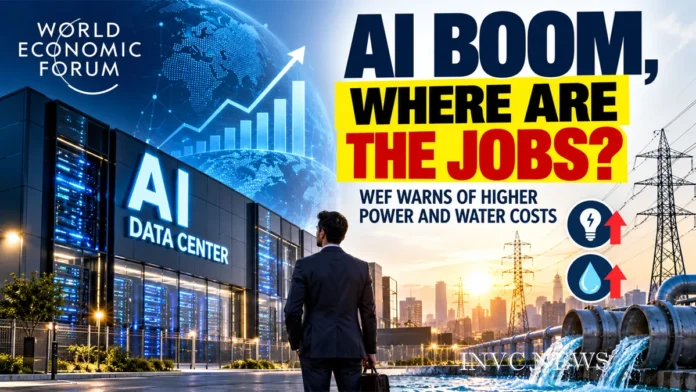
The AI data center boom could become one of the biggest engines of global economic growth over the next year. However, the billions pouring into servers, chips and computing infrastructure may not produce anything close to the same boom in jobs.
And communities hosting those massive facilities could face another surprise: higher electricity and water costs.
The World Economic Forum’s latest Chief Economists’ Outlook reveals a striking divide between the economic promise of artificial intelligence and the local costs of building the infrastructure behind it.
Around 78% of chief economists surveyed expect data-center investment to drive a significant share of global growth. Yet 61% do not expect it to generate a significant share of global job creation.
Even more striking, 79% expect significant local resistance to data-center expansion.
That raises a question that could define the next phase of the AI revolution:
If AI brings billions in investment but relatively few permanent jobs, will communities still want the data centers?
THE 60-SECOND BRIEF
The World Economic Forum surveyed chief economists from the public and private sectors.
97% expect AI adoption to increase over the next 12 months.
69% expect AI to deliver meaningful productivity gains.
78% expect data-center investment to contribute significantly to global growth.
However, 61% do not expect data-center investment to become a significant driver of global job creation.
Meanwhile, 79% expect meaningful local opposition to data-center expansion.
And the biggest household concern may be utilities: 78% expect expansion to increase electricity prices, while 58% expect higher water prices.
AI Lives in the Cloud. Its Infrastructure Does Not.
For consumers, artificial intelligence often feels almost invisible.
Open an app. Type a question. Generate an image. Summarize a document.
Seconds later, an answer appears.
Behind that apparently effortless experience, however, sits an enormous physical system.
AI requires servers.
Those servers require advanced chips.
The chips require electricity.
The machines generate heat.
That heat requires cooling.
And the entire operation needs buildings, land, power infrastructure, network connections and, in many cases, significant amounts of water.
So while AI products may appear digital, the race to build them is increasingly becoming an infrastructure race.
Billions Are Coming. But Are the Jobs?
This is where the WEF findings become especially important.
Traditionally, communities have welcomed large industrial projects because major investment often meant major employment.
A new factory could create thousands of long-term jobs.
An industrial plant could support an entire local economy.
A huge AI data center works differently.
Construction can create significant temporary employment. Data centers also need engineers, electricians, technicians, security staff and other workers.
However, once a modern hyperscale facility is running, automation allows enormous amounts of computing power to operate with a workforce far smaller than many traditional industrial projects.
That creates a new economic equation:
Huge capital investment. Huge economic output. Not necessarily huge employment.
The Number That Could Make Local Governments Nervous: 79%
The jobs question becomes even more important when communities start looking at what data centers consume.
The WEF survey found that 79% of respondents expect significant local pushback against data-center expansion.
That resistance is unlikely to be driven by opposition to AI itself.
Instead, residents may ask a much more practical question:
What does our community get in return?
If a facility creates relatively few permanent jobs while consuming substantial amounts of electricity and water, the political equation can change quickly.
The promised investment may suddenly look very different to people living next door.
Your Electricity Bill Could Become Part of the AI Debate
One of the most important findings in the WEF report concerns energy.
About 78% of surveyed chief economists expect data-center expansion to increase electricity prices.
That turns AI infrastructure from a Silicon Valley story into a household-cost story.
Data centers require enormous and continuous electricity supplies.
AI workloads can be particularly energy-intensive because advanced models require huge amounts of computing power during both training and operation.
As more facilities connect to electricity grids, utilities may need to build new generation capacity, transmission lines and other infrastructure.
The key question then becomes:
Who ultimately pays for that expansion?
Technology companies?
Governments?
Or ordinary electricity customers?
That debate is already becoming harder to ignore.
Then There Is Water
Electricity is only part of the challenge.
Cooling thousands of high-performance servers can also require substantial amounts of water, depending on the facility and cooling technology.
According to the WEF survey, 58% of chief economists expect data-center expansion to increase water prices.
In places where water is already scarce, that could become highly sensitive.
Residents may support AI investment in principle.
However, support can change if households believe a new facility is competing with communities, farms or businesses for a limited resource.
That is where an AI infrastructure boom can turn into a local political fight.
The Big Paradox: AI Could Still Be Great for the Economy
None of this means the WEF report sees artificial intelligence as an economic failure.
In fact, the opposite is true.
An overwhelming 97% of respondents expect AI adoption to increase, while 69% expect meaningful productivity gains.
AI could help businesses automate repetitive tasks, analyze information faster, improve research and reduce operating costs.
Higher productivity can eventually raise economic output and create entirely new industries.
Therefore, the central issue is not whether AI can create value.
It can.
The more difficult question is how that value gets distributed.
A company may become more productive.
Investors may receive higher returns.
The economy may grow.
But workers and communities will inevitably ask whether they are receiving a meaningful share of those gains.
Growth Without Jobs Could Change the AI Conversation
For years, much of the public debate around artificial intelligence has focused on one question:
Will AI take people’s jobs?
The WEF findings add another one.
Will the infrastructure required to power AI create enough new jobs to compensate?
Those are not the same question.
A technology can increase economic output dramatically while employing relatively few people.
If AI pushes economies toward that model, governments could face pressure to rethink how growth translates into wages, employment, taxation and public investment.
That conversation may become especially important if electricity and water costs rise at the same time.
Why India Should Pay Attention
India has major ambitions in artificial intelligence, cloud computing and digital infrastructure.
The opportunity is enormous.
A growing digital economy, a large technology workforce and increasing demand for computing could make India an important destination for data-center investment.
Moreover, the same WEF outlook gives India one of the strongest regional growth assessments.
However, rapid data-center expansion also requires reliable electricity, adequate grid capacity, land and sustainable water management.
Therefore, India’s opportunity may depend not simply on attracting more data centers.
It may depend on where they are built, how efficiently they use resources and whether local communities see tangible benefits.
That could become a crucial test for policymakers.
The AI Race Is Becoming an Energy Race
The first stage of the AI boom focused on models.
Which company had the smartest chatbot?
Who had the most advanced chips?
Who could build the largest language model?
The next stage could look very different.
The winners may increasingly depend on who can secure enough electricity, computing infrastructure, water and grid capacity.
In other words, the AI race is rapidly turning into an infrastructure race.
And infrastructure creates consequences far beyond the technology industry.
THE BIGGER PICTURE
The WEF surveyed its Chief Economists’ Community between August 4 and August 20, 2026.
Its findings point to an AI economy filled with opportunity — but also contradictions.
AI adoption could accelerate.
Productivity could rise.
Data-center investment could boost global growth.
Yet the same boom may fail to produce a matching employment surge.
Meanwhile, communities could face growing pressure on electricity and water.
That combination explains why local resistance could become one of the biggest obstacles to future AI infrastructure.
INVC NEWS Bottom Line
The next chapter of the AI revolution may not be decided only by better algorithms.
It could be decided by something much more basic:
jobs, electricity and water.
The World Economic Forum’s latest survey suggests data centers could become a powerful engine of global growth.
But if communities see huge investment arriving without a comparable jobs boom — while their power and water costs rise — enthusiasm could quickly turn into resistance.
And that leaves the AI industry with a question no algorithm can easily solve:
If billions are being invested in the AI boom, who actually gets the benefits — and who pays the bill?
What happened. Why it matters. What comes next.