
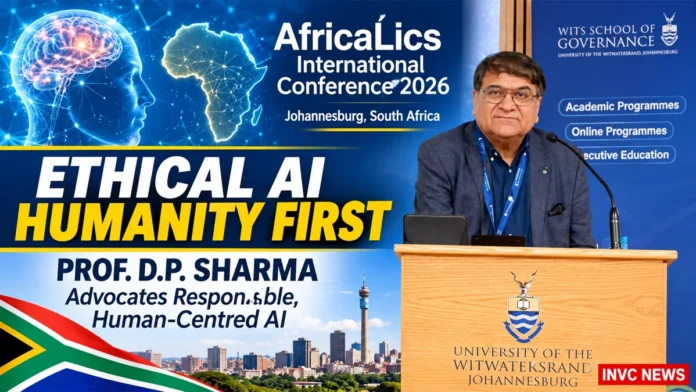
Johannesburg, South Africa | November 16, 2026 : Prof DP Sharma, an international expert in digital diplomacy, cloud computing, internet governance, artificial intelligence, digital accessibility and science, technology and innovation policy, participated in the AfricaLics International Conference 2026, held in Johannesburg, South Africa, from 10 to 12 November 2026.
Professor Sharma was invited to contribute in two important capacities: first, to provide scientific and academic support to the conference and share his perspectives as a Chair and Discussent on AI and Innovations tracks; and second, to participate in bilateral and trilateral discussions associated with the AfricaLics Fellowship Programme, scheduled around 9 and 13 November 2026. His participation aimed to strengthen international academic engagement, research collaboration and dialogue on emerging technological challenges and opportunities.
AI Must Be More Than a Buzzword: Prof Sharma Calls for Responsible and Human-Centred Innovation
During the Chair and Discussent dialogue, Prof Sharma emphasised that Artificial Intelligence must not become merely a fashionable buzzword used across almost every academic discipline and professional sector. Instead, AI should be understood, developed and applied as a transformative instrument for human progress, guided by responsibility, humanitarian values and ethical principles.
Using a powerful analogy, he explained that “artificial intelligence is like a knife: it can be used to cut fruit and serve a useful purpose, but the same instrument can also cause serious harm if misused.” Similarly, AI offers extraordinary opportunities for scientific discovery, economic development, social transformation and innovation, but its irresponsible application can create significant risks and disruptions.
He stressed that the future of AI must be guided by human dignity, accountability, inclusiveness, justice and ethical responsibility.
From Human Intelligence to Artificial Intelligence: The 86-Billion-Neuron Perspective
During formal and informal symptoms and, Prof Sharma offered an evolutionary perspective on human intelligence and technological advancement, highlighting Africa’s historical significance as the birthplace of modern humans.
During the keynote speech session, Prof Sharma Questioned and recalled that Homo sapiens emerged in Africa approximately 200,000–300,000 years ago, marking a remarkable stage in human evolution when innovation, adaptation and the development of ideas became essential to human survival.
Drawing a connection between biological and artificial intelligence, he observed that the human brain contains approximately 86 billion neurons, representing an extraordinary biological foundation for human intelligence, creativity, reasoning and innovation.
He highlighted an important contemporary distinction: while the fundamental neuronal architecture of the adult human brain remains relatively stable, artificial neural networks, computational infrastructure, AI models and robotic capabilities are expanding rapidly.
“Human intelligence is creating artificial intelligence, and human knowledge is continuously contributing to the advancement of artificial neural networks, intelligent machines, robotics and technological ecosystems. However, we must never confuse the expansion of artificial intelligence with the expansion of human biological intelligence. Technology should enhance human capabilities, not diminish the centrality of human intelligence, creativity and judgement.”
He further emphasised that AI systems, robotic intelligence and emerging technological tool stacks must remain accountable to human values and serve humanity rather than operate as substitutes for human responsibility.
International Conferences as Platforms for Global Collaboration
As a Chair of the session, Prof Sharma also highlighted the broader purpose of international academic conferences, describing them through five essential principles:
Connect, Communicate, Create, Collaborate and Celebrate.
He explained that international conferences should not remain limited to the presentation of research papers or academic discussions. They should serve as platforms for connecting researchers, communicating knowledge, creating innovative solutions, collaborating across institutional and national boundaries, and celebrating the achievements of research and innovation.
He observed that the world’s increasingly complex and interconnected challenges require multilateral thinking, interdisciplinary research and collective action. Artificial Intelligence is opening new horizons for innovation and providing fresh perspectives on addressing global challenges. However, its potential must be balanced against the risks of technological disruption, inequalities, ethical concerns and unintended consequences.
He particularly emphasised the importance of ensuring that African researchers, universities, innovators and policymakers actively participate in shaping the global AI ecosystem rather than remaining only consumers of technologies developed elsewhere.
Strengthening International Research and Fellowship Cooperation
Alongside his scientific contribution to the conference, Prof Sharma participated in bilateral and trilateral engagements associated with the AfricaLics Fellowship Programme. These interactions provided opportunities to explore academic networking, institutional cooperation, international research partnerships and potential collaborative initiatives.
His participation reflected the importance of strengthening connections between African and international academic institutions, particularly in areas where digital transformation, AI governance, inclusive innovation and sustainable development intersect.
Prof Sharma reiterated that technological progress should ultimately be measured not merely by computational power, the sophistication of AI models or the capabilities of intelligent machines, but by the positive difference these technologies make in human lives.
He advocated an innovation ecosystem in which Artificial Intelligence becomes a catalyst for humanitarian development, scientific advancement, social inclusion and international cooperation.
He emphasized that ‘Artificial Intelligence should empower human intelligence, strengthen human dignity and advance humanity. Innovation without ethics can become a disruption, whereas innovation guided by responsibility can become a powerful instrument for global progress.’
Prof Sharma is an international academic, digital diplomacy expert and science, technology and innovation policy contributor. He serves as a Professor at Arba Minch University, and contributes to doctoral research supervision and academic initiatives across global universities. He is a Lead Author of the UNESCO Science Report, an IGF-DCAD Fellow 2026 associated with the United Nations Internet Governance Forum, and has contributed to international academic, research and policy initiatives involving digital transformation, internet governance, accessibility, artificial intelligence and inclusive innovation.