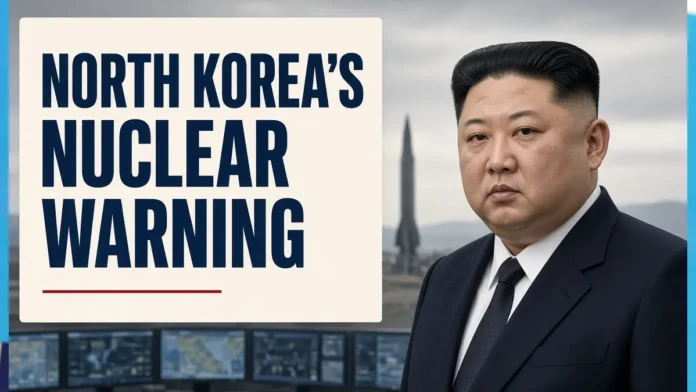
Pyongyang | November 2, 2026 : North Korea has renewed its commitment to expanding its nuclear deterrent, sharply criticising recent military exercises conducted by South Korea and the United States. Pyongyang has described the joint drills as preparations for a possible nuclear attack against the North, arguing that the activities demonstrate the need to further strengthen its military capabilities.
The latest warning came after the United States and South Korea conducted a joint tabletop exercise, known as Iron Mace, focused on integrating American nuclear capabilities with South Korean conventional military forces. North Korea claims the exercise reflects Washington’s continuing intention to use nuclear weapons against it.
In a statement carried by the state-run Korean Central News Agency (KCNA) on Monday, Kim Jong-sik, first vice department director of the Workers’ Party of Korea’s Central Committee, said the North would continue strengthening its nuclear forces to counter existing and potential threats.
Pyongyang maintained that developing a stronger nuclear deterrent remains an unchanging element of its national defence policy.
North Korea calls Iron Mace a nuclear war rehearsal
Kim Jong-sik strongly criticised the Iron Mace exercise, describing it as a dangerous rehearsal for a nuclear war aimed at North Korea.
He argued that the drill demonstrated how the United States could combine its nuclear capabilities with South Korea’s conventional military strength in a potential conflict involving the Korean Peninsula.
According to North Korea’s statement, the exercise exposed what Pyongyang considers Washington’s continuing ambition to threaten the country with nuclear weapons.
The North Korean official insisted that his country needed more powerful nuclear capabilities to deter what it described as hostile military activities by the United States and its regional allies.
These statements reflect Pyongyang’s long-standing position that joint military exercises involving Washington and Seoul are directed against its security.
What was the Iron Mace military exercise?
South Korea and the United States conducted the Iron Mace tabletop exercise at the Joint Chiefs of Staff headquarters in Seoul from September 29 to October 2, 2026.
Unlike a conventional field exercise involving troops and military equipment manoeuvring on the ground, Iron Mace is a discussion-based exercise designed to examine how the two allies would coordinate their military capabilities in a potential crisis.
Its central objective was to strengthen deterrence against North Korea’s nuclear and missile threats by integrating American nuclear capabilities with South Korea’s conventional military forces.
The exercise also focused on joint planning, including procedures through which South Korean conventional forces could support US strategic operations in a contingency.
Iron Mace was first conducted in August 2024 under the framework of the South Korea-US Nuclear Consultative Group. The framework was established following the Washington Declaration issued by the two countries in April 2023.
The latest round was conducted without a public announcement, amid efforts by South Korea’s government to avoid unnecessarily escalating tensions with Pyongyang.
North Korea also criticises Hoguk and Freedom Flag drills
Pyongyang’s criticism was not limited to Iron Mace. Kim Jong-sik also objected to other military activities involving South Korea, the United States and Japan.
These included South Korea’s Hoguk military exercise, the South Korea-US Freedom Flag air exercise and the US-Japan Keen Sword military exercise.
North Korea argued that these activities, whether conducted publicly or behind closed doors, demonstrated an intensification of military pressure against the country.
Kim said such developments reinforced Pyongyang’s determination to build stronger nuclear capabilities to counter what it regards as threats from opposing forces.
His remarks indicate that North Korea views the wider pattern of military cooperation among the United States, South Korea and Japan as a security challenge, rather than treating the Iron Mace exercise as an isolated event.
Seoul and Washington describe drills as defensive
South Korea and the United States have consistently maintained that their joint military exercises are intended to strengthen defensive readiness and deter potential aggression from North Korea.
The allies argue that coordination between American nuclear capabilities and South Korean conventional forces is necessary because of the threats posed by Pyongyang’s expanding nuclear and missile programmes.
Washington’s extended deterrence commitment is a central part of this security arrangement. It is intended to assure South Korea that the United States would use its full range of capabilities, including nuclear forces, to respond to a major threat against its ally.
The Nuclear Consultative Group provides a framework for discussions and coordination on nuclear deterrence, strategic planning and crisis response.
The two governments therefore present exercises such as Iron Mace as measures designed to prevent conflict, while North Korea portrays them as preparations for an attack.
Nuclear deterrence remains central to Pyongyang’s policy
In his statement, Kim Jong-sik reiterated that North Korea would accelerate efforts to strengthen its nuclear deterrent against both current and potential threats.
He maintained that the country’s nuclear capabilities would protect its sovereignty and national security while contributing to regional peace.
North Korea has repeatedly used similar arguments to justify its nuclear weapons programme, describing its arsenal as a necessary response to military pressure from the United States and its allies.
However, the continued expansion of nuclear and missile capabilities on the Korean Peninsula remains a major concern for regional security.
A familiar cycle of military pressure and retaliation
The latest exchange highlights the continuing security dilemma in Northeast Asia. South Korea and the United States conduct military exercises to improve coordination and deter North Korean threats. Pyongyang responds by condemning those activities and using them to justify further investment in its nuclear and missile capabilities.
This cycle makes it difficult to reduce tensions, even when the military activities are described by one side as defensive.
The involvement of Japan in regional security cooperation adds another dimension to the situation, as North Korea also views US-Japan military coordination with suspicion.
For now, Pyongyang’s latest statement signals that it has no intention of changing its nuclear policy in response to criticism of its weapons programme. Instead, it is once again presenting stronger nuclear deterrence as essential to its national security strategy.
The key question for the region is whether Washington, Seoul and Pyongyang can find a way to prevent military preparedness from turning into a further escalation of tensions on the Korean Peninsula.