London and Washington | October 16, 2026
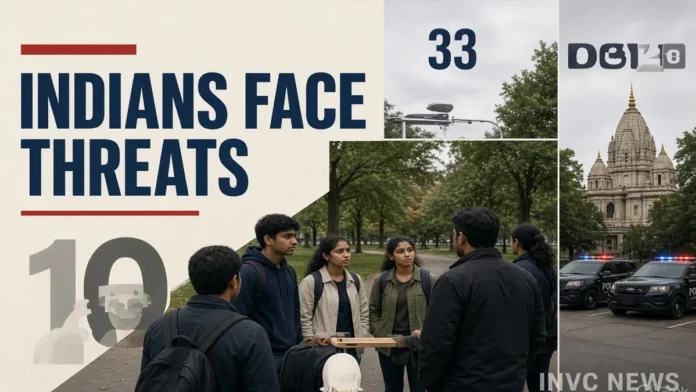
A confrontation involving Indian students at a public park in England and a separate alleged mass-shooting plot targeting a Hindu place of worship in the United States have drawn attention to concerns about racial intimidation and extremist violence. In the UK, a self-described patrol group filmed itself questioning Indian students and ordering them to leave a park. In the US, a 19-year-old man has been arrested after investigators uncovered alleged threats, extremist writings and weapons.
The incidents are separate, and investigations are continuing in both countries.
UK: Indian Students Ordered to Leave Meriden Park
A video showing Indian students being confronted by members of a self-described vigilante group at Meriden Park in the West Midlands has sparked criticism and renewed questions about who has the authority to police public spaces.
The group, known as the Chelmsley Wood Patriots, reportedly approached three Indian students during a late-night patrol. Members questioned why the students were in England and told them to leave the park. One student reportedly explained that he had come to the country to pursue a master’s degree and had been living there for approximately two years.
A member of the group then warned the students not to return, describing the message as their “final warning.”
The group has said its patrols aim to protect women and children. It reportedly argued that parks should be reserved for children and families, while the confrontation prompted criticism from people who viewed the students’ treatment as intimidation based on their background.
The central question is whether claims of public safety are being used to justify confrontations with people who are simply using a public space. Concerns about crime and personal safety are legitimate, but members of self-appointed groups do not acquire police powers merely by organising patrols.
Reports on the incident said West Midlands Police were aware of the matter and that an appropriate policing response was underway. Police powers to stop and search people belong to authorised law-enforcement officers under the relevant legal conditions, not to informal patrol groups.
The circulating video has intensified scrutiny of the group’s conduct. However, the circumstances surrounding the encounter, including any further police action, should be established through official statements and investigation rather than assumptions based solely on social media footage.
US: Police Investigate Alleged Plot Against Hindu Temple
In a separate case in Illinois, authorities have arrested 19-year-old Alexandros Paporakis of Palatine over an alleged plan for a mass shooting that may have targeted a Hindu temple in Aurora, a suburb in the Chicago area.
According to prosecutors and police accounts reported by US media, investigators received information from the suspect’s co-workers about threatening communications and alleged plans for violence. Authorities subsequently examined electronic communications and a document described as a manifesto.
Investigators allege that the document contained white supremacist and neo-Nazi views and dehumanising language directed at Indian, Jewish and African American people. It also reportedly described an intention to kill large numbers of people.
The investigation has raised particular concern because the alleged threats included people of Indian heritage and a possible target associated with the Hindu community.
Alleged weapon malfunction and police investigation
Prosecutors reportedly said Paporakis had gone to a Hindu temple in Aurora with a rifle but left after the weapon malfunctioned. He allegedly contacted a co-worker afterward and discussed the failed attempt.
Police searching his residence reported finding an AR-style rifle, ammunition, loaded magazines, body armour and other tactical equipment. Investigators also examined materials associated with extremist ideology.
Authorities have not publicly established every detail of the alleged plan, and reports have noted that the precise intended target remains a matter for investigators to confirm. The case is proceeding through the criminal justice system, and the allegations against the accused have not yet been proven in court.
The incident has also prompted concern about the safety of Hindu places of worship and the threat posed by individuals who allegedly express violent hatred toward particular racial or religious communities.
Why the Two Incidents Matter
The UK confrontation and the US investigation involve different circumstances and different legal processes. There is no established evidence that the incidents are connected.
Yet both highlight the importance of distinguishing legitimate public-safety concerns from intimidation or threats directed at people because of their ethnicity, nationality or religion.
In the UK, the immediate issue is whether members of an informal patrol group acted appropriately when confronting students in a public park. In the US, investigators are examining an alleged plan for mass violence and the evidence that may support criminal charges.
Both cases require careful investigation, clear communication from authorities and accountability where wrongdoing is established.
What Happens Next?
In the UK, further clarity is expected from police regarding their response to the park confrontation and whether any formal action follows. The video may form part of public scrutiny of the group’s behaviour, but official findings will be important in establishing the full circumstances.
In the US, investigators and prosecutors will continue to examine the evidence in the alleged temple attack plot. Court proceedings will determine how the charges are addressed and whether the allegations can be proved.
Bottom line: The confrontation of Indian students in England and the alleged plot against a Hindu temple in Illinois are separate cases, but both have drawn attention to the risks of racial intimidation and extremist violence. The facts established by investigators—not online speculation—will be essential to determining responsibility in each case.