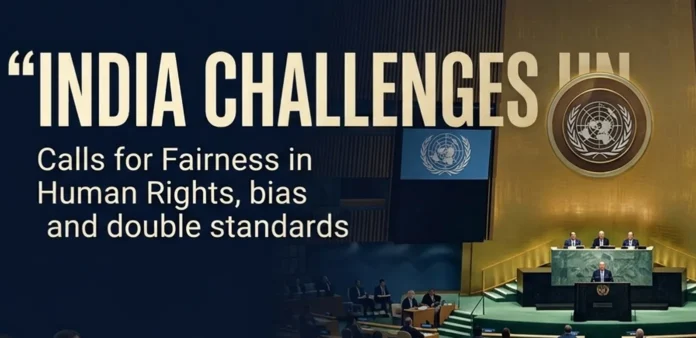
NEW DELHI, October 14, 2026: India has urged United Nations human rights institutions to remain free from political influence, avoid double standards and assess human rights issues in their cultural and historical contexts. The statement comes amid a dispute over the UN human rights office’s comments on detentions linked to protests in New Delhi and a separate report examining Indigenous peoples’ rights to land and natural resources.
Speaking during the 81st session of the United Nations General Assembly’s Third Committee, Anuj Swarup, First Secretary at India’s Permanent Mission to the UN, emphasized the need for impartiality and consistent standards in the international human rights system.
India said it remained committed to promoting and protecting human rights without discrimination. It also reiterated its willingness to work with the UN High Commissioner for Human Rights and the Office of the High Commissioner for Human Rights (OHCHR), while calling on international institutions to avoid selective scrutiny and political polarization.
The remarks reflect India’s broader position that international human rights mechanisms should account for national circumstances while applying consistent principles across countries. They also highlight tensions between India’s emphasis on sovereignty and the UN’s role in raising concerns about reported human rights violations.
India Questions Political Bias and Double Standards at the UN
Addressing the General Assembly’s Third Committee, Swarup said human rights institutions should function as impartial and credible bodies rather than become affected by political considerations.
He emphasized that human rights assessments should take into account the historical, cultural and social circumstances of individual countries. India also highlighted dialogue, cooperation and engagement as important elements of international human rights work.
According to the Indian position, the credibility of the international human rights system depends on consistent treatment of countries and the avoidance of selective attention to particular cases.
Swarup reiterated India’s commitment to working with the UN human rights system in a spirit of trust and partnership. He also pointed to India’s experience as a diverse democracy and its stated commitment to protecting the dignity of its citizens.
The remarks were delivered during discussions related to the work of the UN Human Rights Council and its reporting to the General Assembly. The Third Committee addresses a range of social, humanitarian and human rights issues as part of the General Assembly’s work.
Delhi Protest Detentions Trigger Dispute With UN Human Rights Office
India’s statement followed a disagreement over comments by the UN human rights office concerning protests in New Delhi.
The OHCHR expressed concern over reports that protesters, movement leaders, civil society representatives, lawyers and journalists had been detained before and during demonstrations in the Indian capital.
India rejected the comments, describing them as unwarranted and unacceptable interference in its internal affairs. The government emphasized national sovereignty and objected to what it viewed as external commentary on domestic law enforcement and public order.
The dispute illustrates a recurring disagreement in international affairs: governments often emphasize their sovereign authority to maintain public order, while UN human rights bodies monitor developments and raise concerns about the protection of fundamental freedoms.
The UN office’s comments were based on reports of detentions surrounding the demonstrations. India’s response challenged the appropriateness of the intervention rather than accepting the concerns as presented.
Neither position, by itself, resolves the factual questions surrounding individual detentions or the circumstances in which they occurred. Those questions require assessment of the available evidence, applicable law and the specific circumstances of each case.
India Highlights Poverty Reduction and Social Welfare Programs
During the statement, India also cited its social development record as part of its broader account of human rights progress.
Swarup said more than 250 million people had moved out of multidimensional poverty over the preceding decade. He also highlighted the reach of social protection programs, including subsidized or free food assistance, health coverage and financial inclusion initiatives.
According to the figures presented by the Indian delegation, social security programs reach more than one billion people, around 800 million people receive free food grains, and approximately 600 million people have access to free health protection. The delegation also cited 320 million bank accounts opened in women’s names.
India presented these initiatives as evidence of a development model focused on people’s welfare, access to essential services and economic inclusion.
The figures are claims cited by the Indian delegation and should be understood in that context. Poverty reduction, access to health care and food security are important indicators of social development, but a comprehensive human rights assessment also considers civil and political rights, access to justice, equality and the implementation of legal protections.
India said it would continue working with other countries to make the Human Rights Council effective, impartial and credible.
India Challenges UN Report on Indigenous and Tribal Rights
India also questioned findings in a separate UN report concerning the rights of Indigenous peoples to their lands, territories and natural resources.
The report, prepared by UN Special Rapporteur on the rights of Indigenous Peoples Albert Barume, examined issues including the demarcation, registration and legal recognition of Indigenous peoples’ land and resource rights.
The report discussed India’s Forest Rights Act, 2006, under which eligible Scheduled Tribes and other traditional forest dwellers can seek recognition of individual and community forest rights. It noted that large numbers of claims had been filed and that some remained pending, with particular attention to community rights.
India has challenged the way its record was presented, pointing to government data on claims processed under the law.
The distinction between individual and community claims is significant. Individual claims may concern rights over land used or occupied by eligible forest dwellers, while community claims can involve access to and management of forest resources by a village or community.
The Indian government’s own figures confirm that the Forest Rights Act involves a substantial administrative process. In a parliamentary response published in February 2026, the Ministry of Tribal Affairs reported that 4,433,940 claims—approximately 85.4% of the total reported at the time—had been settled as of December 31, 2025. Settlement in this context means that a decision had been taken; it does not mean every claim was approved. The government also reported that the total included both individual and community claims.
In a further update in August 2026, the ministry published claim-status information based on reports from states and union territories as of June 30, 2026. The ministry said implementation of the law is primarily the responsibility of state governments and union territory administrations.
These figures provide important context for evaluating the report. However, the total number of claims decided does not, on its own, establish how many were approved, rejected or still pending in each category. A complete comparison would require examining the relevant reporting dates, definitions and breakdowns of individual and community claims.
The wider issue is whether legal recognition translates into effective protection of land and resource rights, including timely decisions and implementation on the ground.
UN General Assembly Elects 15 Countries to Human Rights Council
The dispute unfolded as the UN General Assembly elected 15 countries to serve on the Human Rights Council for the 2027–2029 term.
The elected countries were Brazil, Burundi, the Dominican Republic, Germany, Ghana, Ireland, Japan, Jordan, Kuwait, Nepal, Nigeria, the Republic of Moldova, Ukraine, Uruguay and Zambia.
The 47-member Human Rights Council is responsible for promoting and protecting human rights worldwide. Its work includes reviewing country situations, examining alleged violations and appointing independent experts to investigate particular issues.
The election also renewed discussion about the council’s credibility and the human rights records of its members. An election to the council does not itself constitute an endorsement of every aspect of a country’s human rights record.
India’s intervention placed renewed emphasis on the need for the body to apply its principles consistently and maintain the confidence of member states.
What the Dispute Means for India and the UN
India’s comments highlight a continuing debate about the balance between national sovereignty and international human rights oversight.
India argues that international institutions should avoid political bias and account for national circumstances. The UN human rights system, meanwhile, has a mandate to raise concerns about reported violations and encourage states to meet their international obligations.
The disagreement over Delhi’s protests and the debate over tribal and forest rights involve distinct issues, but both concern how human rights standards are interpreted, assessed and implemented.
For India, the central message is that international scrutiny should be impartial and based on consistent standards. For those evaluating human rights outcomes, the key questions include the quality of available evidence, the transparency of official data, the handling of reported violations and whether legal protections are effective in practice.
The exchange is likely to keep India’s relationship with UN human rights mechanisms in focus as the General Assembly continues its work. The broader challenge for both governments and international institutions remains finding ways to combine credible oversight, constructive engagement and respect for the rights and dignity of individuals.