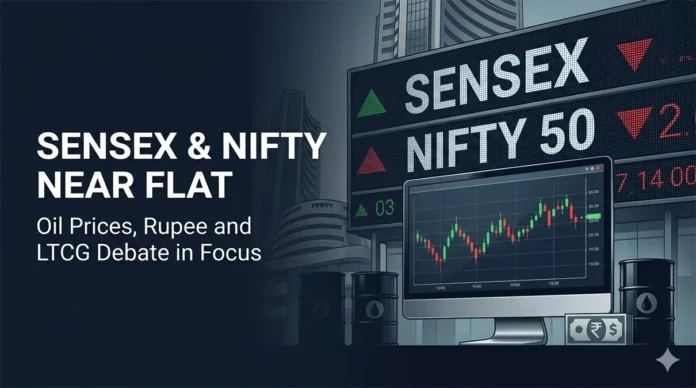
NEW DELHI, October 14, 2026: Indian equity markets traded with limited movement on Wednesday morning as investors weighed rising crude oil prices, persistent foreign investor outflows and developments surrounding the government’s position on long-term capital gains (LTCG) taxation. The Sensex and Nifty moved close to their previous levels after a strong rally in the preceding session.
At 9:35 a.m. IST, the BSE Sensex stood at 73,051.82, up 18.04 points, or 0.02%. The NSE Nifty 50 was at 22,719.30, down 2.66 points, or 0.01%, according to the market figures provided for this report. The near-flat readings reflected a cautious start as traders assessed global developments, currency movements and corporate earnings.
Among individual stocks, Tata Consultancy Services (TCS) gained around 2%, while BSE Ltd. declined approximately 1%, according to the supplied market update. These early-session moves indicated that performance varied across stocks even as the benchmark indices remained largely unchanged.
Sensex and Nifty Opening Bell: Markets Struggle for Direction
The Indian stock market began Wednesday’s session with a mixed trend following gains in the previous trading session. Investors were balancing the possibility of continued recovery against risks from elevated oil prices, overseas fund withdrawals and uncertainty in the global economic environment.
The Sensex and Nifty are influenced by developments across major sectors, including information technology, banking, energy and consumer businesses. As a result, gains in selected heavyweight stocks may support one index while declines in other shares limit the overall advance.
Market participants were also monitoring quarterly earnings announcements for clues about corporate profitability, revenue growth and management expectations. Earnings performance can influence individual stocks and sector valuations, particularly when investors are looking for evidence that companies can maintain growth amid higher input costs and uncertain demand.
The early-session index figures should not be interpreted as closing levels. Both benchmarks can move significantly during the trading day in response to fresh economic data, global market movements, institutional trading and company-specific announcements.
Rising Crude Oil Prices Put Pressure on Market Sentiment
Crude oil remained a key concern for Indian equities. India relies heavily on imported crude, making the economy sensitive to increases in international energy prices.
Higher oil prices can raise fuel and transportation costs, increase pressure on businesses and households, and contribute to inflation. They can also increase the country’s import bill and affect the external balance, particularly if elevated prices persist.
For listed companies, the impact depends on the sector and business model. Oil marketing companies, airlines, transport businesses and other energy-intensive industries may face cost pressures, while the effects on upstream energy producers can differ.
Investors were therefore watching developments in the global oil market alongside domestic economic indicators. A sustained increase in crude prices could complicate the inflation outlook and influence expectations for interest rates, corporate margins and economic growth.
The effect is not uniform across the stock market. Companies with stronger pricing power, lower energy exposure or robust earnings may perform differently from businesses that are more vulnerable to rising fuel and freight expenses.
Foreign Investor Outflows Remain a Concern
Continued selling by foreign portfolio investors has been another source of pressure on Indian equities. Overseas investors can influence market liquidity and stock prices through their buying and selling activity, particularly in large-cap shares.
Foreign outflows can reflect several factors, including global risk appetite, currency movements, relative valuations, international interest-rate expectations and investment opportunities in other markets.
However, foreign selling does not automatically mean that domestic equities will decline every day. Domestic institutional investors and retail participants can provide buying support, while corporate earnings and economic fundamentals may influence market direction over a longer period.
For investors, the key indicators to monitor include daily institutional flows, the rupee’s performance, global market trends and the earnings outlook for Indian companies.
Rupee Strengthens Against the US Dollar
The Indian rupee strengthened during early trading on Wednesday, reportedly gaining 44 paise to reach 94.92 against the US dollar.
The move followed Reserve Bank of India measures aimed at reducing immediate dollar demand and limiting excessive speculative positions in the foreign-exchange market. Currency movements are important for equity investors because they affect import costs, foreign investment returns and the financial performance of businesses with overseas revenue or dollar-linked expenses.
A stronger rupee can ease the cost of imported commodities, including crude oil, if international prices remain unchanged. It may also reduce some imported inflationary pressure. However, the benefits depend on the duration and scale of the currency movement.
A stronger rupee can have mixed effects on companies. Businesses that depend on imported inputs may benefit from lower currency-related costs, while exporters earning substantial revenue in dollars may face translation pressure when overseas earnings are converted into rupees.
The currency’s early-session level should be treated as a time-specific market reading rather than a closing rate.
LTCG Tax Debate: What Did Finance Minister Nirmala Sitharaman Say?
Investor attention also remained on comments by Finance Minister Nirmala Sitharaman regarding long-term capital gains tax and the securities transaction tax.
Speaking at the Bloomberg New Economy Forum in New Delhi on Tuesday, October 13, Sitharaman said the government was open to hearing stakeholders’ views on the possibility of removing LTCG tax. Discussions also involve the treatment of different asset classes and the securities transaction tax, which applies to specified securities-market transactions.
The comments have drawn attention because capital gains taxation and transaction costs affect investors’ net returns. Some market participants have argued that changes to the tax framework could make Indian equities more attractive to domestic and foreign investors.
Nevertheless, the Finance Minister’s remarks do not amount to an announcement that LTCG tax will be abolished. She did not commit to a specific tax change, and investors should continue to follow the rules currently in force unless the government announces and implements a formal amendment.
The debate is expected to remain relevant during consultations ahead of the next Union Budget. Any eventual change would depend on the government’s policy decisions, fiscal priorities and the legislative process.
For the stock market, the immediate effect of such comments is largely linked to investor expectations and sentiment. Whether those expectations translate into a sustained rally will depend on the broader economic and corporate outlook.
TCS and BSE Shares Show Divergent Moves
TCS shares rose around 2% in early trading, while BSE Ltd. shares declined approximately 1%, based on the supplied market update.
Individual stock movements can reflect company-specific news, trading momentum, earnings expectations and changes in investor positioning. A rise in one stock does not necessarily indicate a broad sector recovery, just as a decline in another does not establish a wider market downturn.
Investors tracking these shares should review the latest company announcements, quarterly results and exchange disclosures before drawing conclusions about the reasons behind a particular move.
What Should Investors Watch Next?
Several factors could shape the direction of Indian equities during Wednesday’s session:
- Crude oil prices: Further increases could add to inflation and cost pressures.
- Foreign investor activity: Continued overseas selling may weigh on sentiment, while domestic buying could provide support.
- Rupee-dollar movements: Currency volatility can affect imported costs and companies with significant foreign-currency exposure.
- Quarterly earnings: Results and management commentary may influence stock-specific and sector-wide trading.
- LTCG and STT discussions: Any formal policy announcement would matter more than speculation about possible tax changes.
- Global market cues: International equities, bond yields and geopolitical developments can influence risk appetite.
The near-flat opening suggests that investors were cautious rather than decisively bullish or bearish. The market’s direction could change as fresh information emerges throughout the day.
Bottom Line
The Sensex and Nifty were trading with minimal changes early Wednesday as investors assessed the competing effects of rising crude oil prices, foreign investor outflows, currency gains and corporate earnings.
The rupee’s reported appreciation offered a positive currency signal, while Finance Minister Nirmala Sitharaman’s willingness to hear views on LTCG tax kept market taxation in focus. However, no decision to abolish the tax has been announced.
Investors should distinguish between early-session market movements and the final closing figures, and between policy discussions and confirmed government decisions. The broader market trend will depend on how these domestic and global factors evolve.
Disclaimer: This report is for informational purposes only and does not constitute investment advice. Stock prices and index levels fluctuate during market hours. Verify current prices and official disclosures before making investment decisions.