By Team INVC | INVC NEWS
Published: October 9, 2026 | 10 : 53 AM IST
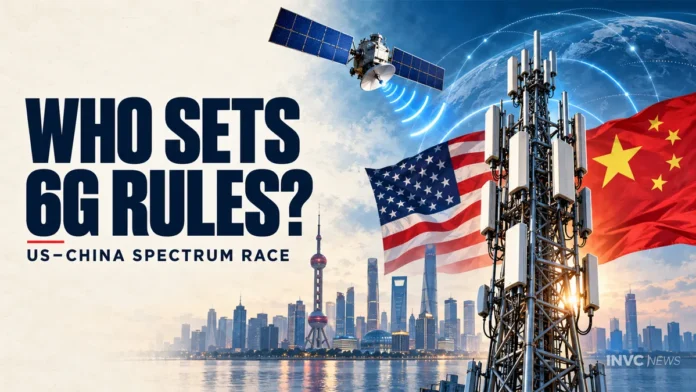
WASHINGTON, United States | October 9, 2026 — The US–China 6G race is moving beyond laboratories and into diplomatic negotiating rooms. Two American senators warn that Washington could surrender valuable ground before a major global telecommunications conference even begins unless the Trump administration appoints its delegation leader soon.
Democratic Senator Ruben Gallego of Arizona and Republican Senator Jim Banks of Indiana have urged Secretary of State Marco Rubio to name that leader before November 30. Regional negotiations begin that day in Bogotá, Colombia, where countries across the Americas will start aligning positions ahead of the 2027 World Radiocommunication Conference.
Their warning centers on a consequential question: who will influence the international rules governing the airwaves that future mobile networks and satellite systems need?
Shanghai raises the stakes for Washington
The International Telecommunication Union will hold WRC-27 in Shanghai from October 18 through November 12, 2027.
The conference reviews and revises the Radio Regulations, the international treaty governing radio-frequency spectrum and associated satellite orbits. Its decisions shape how countries use shared resources for mobile communications, satellite services and other wireless applications.
In their September 29 letter, released publicly this week, Gallego and Banks argued that China’s position as host could give Beijing an advantage in advancing proposals favorable to Chinese technology companies, including Huawei.
That remains the senators’ assessment of a negotiating risk. Hosting the conference does not give China unilateral authority to write its outcomes.
Nevertheless, the lawmakers say Washington needs a coordinated diplomatic response well before delegates arrive in Shanghai.
Why a November appointment matters for a 2027 conference
The immediate deadline concerns preparation rather than the conference itself.
According to the letter, the National Telecommunications and Information Administration and Federal Communications Commission have already developed and submitted US proposals to the Inter-American Telecommunication Commission, known as CITEL.
Washington plans to present its remaining positions at the next meeting of CITEL’s Permanent Consultative Committee II, beginning November 30 in Bogotá.
The senators want the delegation chief to help shape those positions before representing them internationally. Otherwise, a late appointment could leave the official defending a strategy they had little opportunity to develop.
Their request also reflects how telecommunications diplomacy works: technical studies, regional coordination and coalition building precede the final negotiations.
6G leadership involves more than faster phones
Radio spectrum provides the frequencies through which wireless systems communicate. International coordination helps different services share those frequencies while limiting harmful interference.
For next-generation networks, spectrum decisions therefore influence which bands operators and equipment manufacturers can plan around.
However, WRC-27 will not finalize every aspect of 6G.
The ITU calls the next generation of mobile technology IMT-2030. Its broader development process includes performance requirements, evaluation methods and assessments of proposed radio technologies.
The ITU has invited candidate technology submissions between February 2027 and February 2029. That timetable illustrates why spectrum negotiations and technical standardization must move together, even though they follow distinct processes.
For consumers, the eventual stakes extend to coverage and connectivity. For businesses, they include infrastructure planning and the equipment ecosystems that future networks will use.
Huawei sits at the center of the senators’ warning
Gallego and Banks fear that Huawei-aligned proposals could gain influence before the United States and its partners establish coordinated alternatives.
Their concern extends beyond American networks. They also asked the administration to explain how it would work with industry and international partners to build trusted telecommunications supply chains.
In particular, they want countries in the Global South to have viable alternatives to Huawei and other Chinese suppliers.
That makes the dispute broader than a competition over one conference. The senators connect diplomatic influence with the practical choices available to countries buying telecommunications infrastructure.
Their letter does not establish that Huawei has already secured favorable WRC-27 decisions. Instead, it urges Washington to act before the negotiating positions harden.
Satellite networks add another pressure point
The lawmakers also highlighted the rapid expansion of non-geostationary satellite constellations.
These networks place additional importance on international coordination because satellite systems must share spectrum and operate alongside other communications services.
Meanwhile, the ITU says WRC-27 will address spectrum and orbital resources for services on Earth and in space. Its remit includes mobile connectivity, satellite communications and space research.
Consequently, the negotiations matter to both terrestrial network operators and companies building satellite infrastructure.
The 2023 lesson Washington faces
The senators cited a leadership change during preparations for WRC-23 as a warning.
According to their letter, former American delegation members reported that replacing the delegation head at short notice cost valuable time for developing relationships and regional coalitions.
Gallego and Banks want the administration to avoid that disruption. They also acknowledged progress by US agencies, making clear that their demand concerns stronger leadership and coordination rather than a claim that preparations have stopped.
They requested a written response or briefing by October 23, 2026, and a closed briefing on the administration’s China strategy by spring 2027.
The deadlines to watch
| Date | Why it matters |
| October 23, 2026 | Senators’ requested deadline for a response or briefing. |
| Before November 30, 2026 | Requested appointment of the US delegation chief. |
| November 30, 2026 | Scheduled start of the Bogotá regional meeting. |
| Spring 2027 | Requested closed briefing on countering Chinese influence. |
| October 18–November 12, 2027 | WRC-27 negotiations in Shanghai. |
The dispute places an early diplomatic decision at the center of a much larger technology contest. Washington’s next test is whether it can organize its leadership and partners before the rules for future connectivity move closer to agreement.