By Team INVC | INVC NEWS
MUMBAI, India | October 4, 2026 — Dalal Street enters the new week carrying an uncomfortable record: Indian equities have now fallen for eight consecutive weeks, their longest weekly losing streak in roughly 25 years. The selloff has pushed the Sensex below 72,000 and the Nifty 50 close to the 22,400 mark, leaving investors with one central question before trading resumes Monday — has the market fallen enough to stage a meaningful rebound, or is a ninth straight weekly loss now in sight?
The answer could arrive quickly. The week of October 5–9 will bring the Reserve Bank of India’s monetary policy decision, the beginning of the September-quarter earnings season, fresh signals from crude oil and West Asia, and continued scrutiny of foreign investor flows and U.S. bond yields. Any one of those factors could move the market sharply. Taken together, they make this one of the most important trading weeks of the current correction.
The RBI Monetary Policy Committee will meet from October 5 to October 7, with the policy decision due Wednesday. A Reuters poll of economists shows a majority expect the central bank to raise the repo rate by 25 basis points to 5.50%, which would mark the first increase since February 2023. Markets will watch not only the rate decision but also the RBI’s language on inflation, economic growth, crude oil, the rupee and the possibility of further tightening later in the year.
Eight Weeks of Selling Have Changed the Market Mood
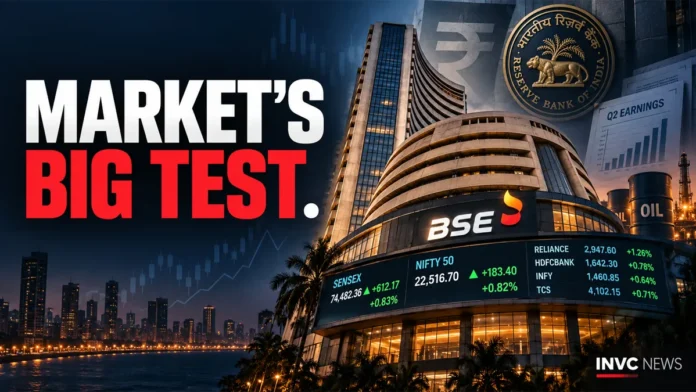
The latest holiday-shortened week offered little relief to investors. The Nifty 50 declined 718.55 points, or 3.11%, to close at 22,421.95, while the Sensex fell 1,986.04 points, or 2.69%, to 71,909.70. Both benchmarks recorded their eighth consecutive weekly decline, the longest such losing streak in about a quarter-century. Over those eight weeks, the Nifty has lost roughly 8.7%, while the Sensex is down about 8.4%.
The decline was not driven by one isolated problem. Heavy foreign selling, elevated crude oil prices, rising U.S. Treasury yields, weakness in the rupee and persistent geopolitical uncertainty combined to keep investors defensive. Fifteen of the 16 major sectoral indexes ended the latest week lower, with auto and consumer-oriented stocks among the hardest hit, while information technology provided some relative support.
That broad weakness matters because it suggests investors have not simply been rotating money from one sector into another. Instead, risk appetite itself has been under pressure. Domestic institutional buying has helped absorb part of the foreign selling, but it has not yet been enough to reverse the broader trend.
RBI Could Decide Whether the Market Gets Relief or Another Shock
The RBI decision on October 7 is likely to be the biggest domestic macro event of the week. The current repo rate stands at 5.25%, and economists have increasingly moved toward expecting a 25-basis-point increase as inflation broadens, crude prices remain elevated and global interest rates stay high.
A rate hike would not necessarily surprise the market because expectations have already shifted substantially. The more important question may be what the RBI says next. If policymakers raise rates but signal that future action will depend heavily on incoming inflation and energy data, investors may view the move as measured. If the central bank sounds significantly more worried about inflation and indicates that additional hikes are likely, rate-sensitive sectors could remain under pressure.
Banks, non-banking financial companies, real estate stocks, automobiles and other consumer-sensitive sectors could react sharply because higher rates influence borrowing costs, loan demand and corporate valuations. Bond yields and the rupee will also respond to the central bank’s guidance.
For investors, therefore, Wednesday is not simply about whether the repo rate becomes 5.50%. It is about whether the RBI tells markets that this is a small adjustment or the beginning of a longer tightening cycle.
TCS Will Put Corporate Earnings Back in the Spotlight
Just one day after the RBI decision, Tata Consultancy Services is scheduled to report its Q2 FY27 results on October 8, effectively bringing the large-cap IT earnings season into focus. HCLTech will follow later in October, while Infosys is scheduled to report on October 23.
TCS results will matter beyond the stock itself because the technology sector has been one of the few areas showing relative resilience during the latest market weakness. Investors will closely examine revenue growth, margins, deal wins, client spending and management commentary on artificial intelligence.
That final issue may prove particularly important. Major Indian IT companies are dealing with a complicated transition in which AI is creating new opportunities but is also putting pressure on traditional pricing models. Analysts expect the September quarter to be challenging for the sector, with cautious client spending and AI-led pricing pressure likely to restrain growth.
A stronger-than-expected TCS result or encouraging guidance could provide support to the IT index and improve broader sentiment. Weak numbers, however, could remove one of the few cushions that helped the market during the previous week.
Crude Oil May Be the Market’s Biggest Wild Card
For India, crude oil remains one of the most important external variables because the country imports most of its oil requirements. High prices can increase the import bill, pressure the rupee, hurt corporate margins and complicate the RBI’s inflation calculations.
There has been some encouraging news. Crude shipments from the Gulf have recovered substantially toward pre-war levels, with flows improving as producers use alternative pipelines, rerouting arrangements and ship-to-ship transfers. That recovery has reduced some of the most extreme supply fears surrounding the Strait of Hormuz.
However, investors should not confuse improved oil flows with the disappearance of geopolitical risk. Security threats to shipping remain, refined-product flows are still significantly disrupted, and fresh escalation in West Asia could quickly restore a larger risk premium to crude prices.
This creates a potentially powerful market trigger. If diplomatic signals improve and crude prices fall decisively, Indian equities could receive one of the strongest sources of relief available to them. Lower oil would help inflation expectations, the rupee, corporate margins and the broader macro outlook simultaneously.
On the other hand, another escalation that sends Brent sharply higher could reinforce the market’s current defensive mood.
Nifty Is Oversold — but That Does Not Automatically Mean the Bottom Is In
Technical indicators increasingly show the extent of the damage. After eight consecutive weekly declines, momentum indicators have moved toward oversold territory, raising the possibility of sharp short-covering rallies even if the broader trend remains weak.
The Nifty closed at 22,421.95 after touching a weekly low near 22,217. That makes the 22,200–22,350 region an important immediate support area. A sustained break below that zone could expose the psychological 22,000 level, followed by a deeper support area near 21,800.
On the upside, the first test will come around the 22,600–22,700 region. If the Nifty can reclaim that area and sustain the move, attention could shift toward 22,800 and then the psychologically important 23,000 level.
The critical distinction for traders will be between a technical bounce and an actual trend reversal. After such a long decline, a powerful one- or two-session recovery would not be unusual. For the market structure to improve more convincingly, the Nifty would need to reclaim resistance levels and hold them while foreign selling and crude-related pressure ease.
Foreign Investors Remain a Major Problem
Foreign portfolio investor activity remains one of the biggest obstacles facing Indian equities. Persistent foreign selling has intensified as global bond yields rise and investors reassess the relative attractiveness of emerging-market assets.
Higher U.S. Treasury yields matter because they increase the return available from dollar-denominated fixed-income assets. When investors can earn attractive yields in the United States without taking emerging-market currency and equity risk, countries such as India may see capital outflows.
Foreign selling in Indian equities has already reached exceptionally high levels this year. The rupee has also weakened, while domestic bond yields have climbed. Those pressures reinforce one another: foreign outflows can hurt the currency, a weaker currency can increase imported inflation, and higher inflation risk can put more pressure on interest rates.
A meaningful reversal in foreign flows would therefore be one of the clearest signs that the market environment is beginning to stabilize.
The Domestic Economy Is Sending a Very Different Signal
One reason investors have not completely abandoned Indian equities is that the underlying domestic economy continues to produce relatively strong data.
India’s Index of Industrial Production increased 8% year over year in August 2026, supported by a 9% rise in manufacturing and 12.3% growth in electricity and gas supply. Eighteen of 23 manufacturing industry groups recorded positive growth during the month.
That creates an unusual market setup. Equity prices are being pressured by external risk, foreign selling, oil and interest rates at a time when domestic industrial activity remains relatively robust.
This divergence is important. If global conditions stabilize, strong domestic fundamentals could give investors a reason to return quickly. But if external pressures continue escalating, even good domestic economic data may struggle to overcome the drag from higher energy costs and tighter financial conditions.
Do Not Wait for U.S. Payrolls Next Week — They Are Already Out
Investors should also adjust their U.S. economic calendar. The September nonfarm payrolls report was released on October 2, showing only 29,000 jobs added versus expectations for roughly 90,000, while unemployment rose to 4.2%. The softer employment report reduced expectations of another immediate Federal Reserve rate increase.
The September ISM Manufacturing PMI was also released before the new trading week, coming in at 54.5. Manufacturing remained in expansion territory, although input-price pressures increased.
For the October 5–9 week, global markets will instead focus on indicators including U.S. services-sector data, trade figures, weekly jobless claims and, critically, the minutes of the Federal Reserve’s September meeting. Those minutes could offer clues about how policymakers are balancing persistent inflation against softer employment conditions.
What Could Trigger a Sharp Relief Rally?
After eight weeks of losses, the market does not necessarily need perfect news to rally. It may simply need bad news to stop getting worse.
A combination of lower crude oil prices, easing West Asia tensions, a measured RBI policy message, encouraging TCS results and a reduction in foreign selling could trigger aggressive short covering.
The reason is positioning. When markets decline for several consecutive weeks, traders accumulate bearish positions and investors become cautious. A sudden improvement in the news flow can force some of those positions to unwind quickly, creating a rally that is faster than the preceding decline might suggest.
However, investors should distinguish between relief and recovery. A sustainable recovery would require evidence that inflation risks are stabilizing, foreign selling is easing and corporate earnings remain strong enough to justify current valuations.
What Could Push the Market Into a Ninth Losing Week?
The downside scenario is equally clear. A hawkish RBI, another spike in crude oil, fresh escalation in West Asia, disappointing earnings or another surge in global bond yields could push the Nifty below its recent lows.
A break below 22,200 would likely attract additional technical selling. If that occurs alongside continued FPI outflows, the market could begin testing the 22,000 psychological level and potentially the 21,800 region.
That would make the current correction more painful, particularly for mid-cap and small-cap investors who have already seen volatility increase sharply.
INVC NEWS Bottom Line
Dalal Street is entering the new week after one of its most persistent losing stretches in decades, but the next five trading sessions could provide a clearer answer on whether the correction is approaching exhaustion or entering another phase.
The RBI policy decision on October 7 will be the first major test. TCS earnings on October 8 will then offer an early read on corporate India’s September-quarter performance. Meanwhile, crude oil and developments in West Asia will continue to influence inflation expectations, the rupee and foreign investor sentiment.
The key Nifty battlefield is also becoming clearer. The 22,200–22,350 zone is emerging as an important area of support, while a recovery toward 22,800–23,000 would begin to challenge the bearish structure.
After eight straight losing weeks, investors are understandably looking for a bottom. But the market does not need another prediction right now; it needs evidence.
If oil cools, the RBI avoids a major hawkish surprise, earnings hold up and foreign selling slows, the rebound could be sharp. If those conditions fail to materialize, Dalal Street may find that the ninth week is just as difficult as the eight that came before it.