By Team INVC | INVC NEWS
NEW DELHI, India | October 4, 2026 — The United States wants influence. China wants influence. Every major power wants partners.
India wants something else.
Options.
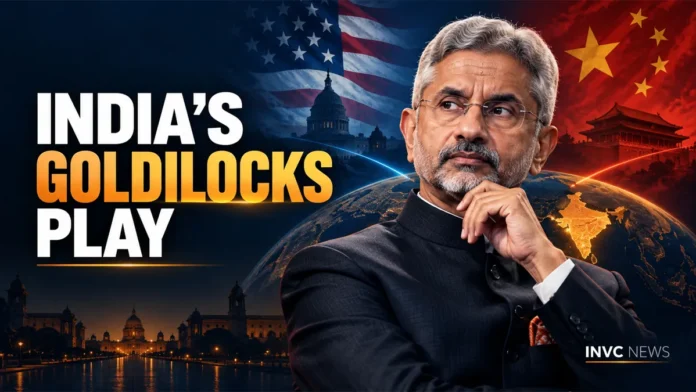
External Affairs Minister S. Jaishankar used an unusually vivid phrase in New Delhi to describe the global power contest now shaping diplomacy, economics and security.
He called it a “Goldilocks scenario.”
Not too hot.
Not too cold.
Just competitive enough to create room for countries like India to maneuver.
And hidden inside that simple metaphor was a much bigger message:
India does not want to be forced into choosing between Washington and Beijing. It wants enough power, enough partnerships and enough alternatives to choose issue by issue.
That is the real story.
Because the new global order is no longer about one alliance, one camp or one permanent friend.
It is about who can keep the most doors open without losing control of their own interests.
And India clearly intends to be one of those countries.
THE 60-SECOND BRIEF
Jaishankar’s message can be reduced to five sharp points:
- India does not want U.S.-China competition to spiral into confrontation
- Emerging powers are increasing options and reducing dependence
- Supply chains are now part of national security
- Countries can cooperate without agreeing on everything
- Quad, BRICS, IMEC, INSTC and new technology coalitions all fit the same playbook
In short:
Work with America where interests match.
Work with China where interests match.
Work with others where interests match.
But do not become dependent on anyone.
That is the strategy.
‘Not Too Hot, Not Too Cold’ — Why That Phrase Matters
Jaishankar’s “Goldilocks” reference may sound playful.
It is not.
If U.S.-China rivalry becomes too intense, countries could be pushed into hard camps.
That would force difficult choices.
Trade could suffer.
Supply chains could split.
Technology ecosystems could fragment.
Security pressures could rise.
But if the rivalry becomes too soft, smaller and middle powers could lose leverage.
Competition between big powers gives other countries room to negotiate better deals, attract investment, diversify alliances and strengthen their strategic importance.
So India’s ideal scenario is not peace without competition.
It is competition without breakdown.
That is a very different thing.
India’s Real Message: Don’t Ask Us to Pick a Side
For years, global diplomacy has repeatedly asked India one question:
Are you with the West, or are you with the rest?
India’s answer increasingly appears to be:
That is the wrong question.
India works with the United States, Japan and Australia in the Quad.
India sits with China and other major emerging economies in BRICS.
India wants deeper connectivity with Europe and the Middle East.
India also supports corridors running through Eurasia.
India works with Western countries on technology.
It works with developing countries on climate and infrastructure.
To outsiders, that may sometimes look contradictory.
To New Delhi, it looks like strategy.
Quad With America, BRICS With China — Contradiction or Confidence?
This is where things get interesting.
The Quad places India alongside the United States, Japan and Australia in the Indo-Pacific.
The grouping deals with maritime security, technology, supply chains and regional stability.
BRICS places India in a completely different room.
China is there.
Other major emerging economies are there.
The agenda is different.
Global governance, economic influence and the collective voice of the Global South matter more.
So what is India doing in both?
Simple.
Because both platforms serve different Indian interests.
That is not diplomatic confusion.
That is diplomatic flexibility.
And flexibility is valuable when the world is unstable.
The Old Alliance System Is Losing Its Grip
Jaishankar’s broader argument is that countries no longer need perfect ideological alignment before working together.
That is a huge shift.
Under older alliance models, countries often joined long-term blocs.
Membership came with expectations.
Positions became predictable.
Today’s emerging powers are much more transactional.
They ask:
What is the issue?
What is the benefit?
What is the risk?
Who is useful on this specific problem?
Then they cooperate.
Tomorrow, on another issue, the partners may change.
That is not disloyalty.
That is the architecture of a multipolar world.
America and China Are Competing — Everyone Else Is Hedging
The U.S.-China rivalry is not just military or diplomatic.
It now stretches into:
Technology.
Semiconductors.
Artificial intelligence.
Critical minerals.
Manufacturing.
Energy.
Telecommunications.
Ports.
Shipping routes.
Digital networks.
Supply chains.
Investment.
That means countries cannot simply ask who has the stronger army.
They must ask:
Who controls what we need?
That is where de-risking comes in.
Supply Chains Are the New Battlefields
One of Jaishankar’s most important points concerned supply chains.
The pandemic, wars, sanctions and geopolitical tensions have taught governments one brutal lesson:
If one country controls something essential, dependence can become vulnerability overnight.
That is why countries now want alternative suppliers.
Alternative routes.
Alternative manufacturing hubs.
Alternative technology partners.
Alternative sources of energy.
In other words:
Never allow one crisis to shut down your entire system.
That thinking is now at the center of India’s external strategy.
One Trade Route Is No Longer Enough
Jaishankar also pointed to multiple connectivity projects.
The India-Middle East-Europe Economic Corridor is one.
The International North-South Transport Corridor is another.
The Northern Sea Route adds yet another possibility.
Why support multiple corridors?
Because one route can be blocked.
One region can become unstable.
One shipping lane can become risky.
One geopolitical conflict can change trade economics overnight.
More routes mean more resilience.
And resilience means strategic freedom.
This Is Where India Wants to Be Clever
India’s calculation is straightforward.
If you have only one major partner, that partner has leverage over you.
If you have five serious partners, you have leverage over all five.
That is the heart of strategic autonomy.
Not isolation.
Not neutrality.
Not sitting on the fence.
It means entering relationships without surrendering freedom of action.
That is a much harder strategy to execute.
But if done well, it can be extremely powerful.
Quad Is Not BRICS — and That Is Exactly the Point
Quad does not need to behave like BRICS.
BRICS does not need to behave like the Quad.
IMEC does not need to replace INSTC.
Technology coalitions do not need to become military alliances.
Different structures can serve different purposes.
That is precisely the system Jaishankar appears to be describing.
Think of it less like one giant alliance.
Think of it like a toolbox.
India picks the tool depending on the problem.
That is the new game.
Middle Powers Are No Longer Background Players
One of the biggest changes in the global system is that emerging and middle powers are becoming more assertive.
They do not simply wait for Washington, Beijing, Moscow or Brussels to decide everything.
They form their own groups.
They build issue-based coalitions.
They coordinate on trade.
They coordinate on energy.
They coordinate on climate.
They coordinate on connectivity.
They coordinate on technology.
And when enough of them work together, they can influence the agenda.
That is where BRICS becomes important.
Not because every member agrees on everything.
They clearly do not.
But because collectively, they can amplify their voice.
BRICS: The ‘We Are Stronger Together’ Club
Jaishankar’s point on BRICS is especially revealing.
Countries join such platforms because they believe their collective voice carries more weight than their individual voices.
That matters in institutions dominated for decades by older Western powers.
The message from emerging economies is becoming louder:
The global system cannot keep pretending the balance of power has not changed.
India wants reform.
Brazil wants more influence.
Others want greater representation.
China wants a larger role too.
Their motivations differ.
But their frustration with older power structures creates common ground.
That is enough for cooperation.
Technology Is Creating New Alliances Too
The world’s next strategic fault line may not run through borders.
It may run through chips, networks and AI.
That is why technology partnerships are becoming strategic assets.
Jaishankar referenced newer cooperation models in technology and resources.
This matters because countries increasingly understand that digital dependence can be just as dangerous as energy dependence.
Control of semiconductors matters.
Control of critical minerals matters.
Control of cloud infrastructure matters.
Control of communications systems matters.
The next generation of alliances may therefore look less like NATO and more like technology ecosystems stitched together by trust and supply chains.
India’s Advantage: It Can Sit in More Than One Room
India’s biggest advantage may be exactly this:
It is important to almost everyone.
The United States sees India as a strategic partner in the Indo-Pacific.
Europe sees India as a market and geopolitical partner.
The Gulf sees India as a major economic partner.
Russia sees India as a long-standing strategic relationship.
BRICS sees India as a central emerging power.
The Global South sees India as an influential voice.
China sees India as both competitor and unavoidable regional heavyweight.
That gives New Delhi something extremely valuable:
negotiating space.
The challenge is to preserve it.
The Risk: Playing Everyone Is Easy to Say, Hard to Do
There is, however, one big danger.
Strategic autonomy works only if a country has enough economic, military and technological strength to support it.
Otherwise, “keeping options open” can quickly turn into “having no leverage.”
India therefore has to keep growing.
Faster manufacturing.
Stronger defense capability.
More technology depth.
More reliable supply chains.
Greater energy security.
Better infrastructure.
Because diplomacy becomes much easier when economic power sits behind it.
What Jaishankar Is Really Saying
Strip away the diplomatic language and the message becomes remarkably clear:
India does not want a world where China dominates.
India does not want a world where America dictates every choice either.
India wants a world where multiple centers of power exist — because that creates room for India itself to rise.
That is the real significance of the “Goldilocks” idea.
Not too much American dominance.
Not too much Chinese dominance.
Not too much confrontation.
Not too much comfort.
Enough competition to create opportunity.
Enough stability to exploit it.
THE BIGGER PICTURE
The old world wanted countries to answer:
Whose camp are you in?
The new world increasingly asks:
What do you want, and who can help you get it?
That may sound transactional.
It is.
But geopolitics has always been transactional.
The difference today is that more countries have more choices.
India wants to be one of the countries with the most.
INVC NEWS Bottom Line
Jaishankar’s “Goldilocks scenario” sounds like a clever diplomatic phrase.
It is actually a blueprint.
India’s emerging playbook looks something like this:
Quad with America.
BRICS with China.
Connectivity with Europe and the Gulf.
Energy partnerships where needed.
Technology alliances where useful.
Multiple trade routes.
Multiple supply chains.
Maximum room to maneuver.
That is not fence-sitting.
That is calculated flexibility.
And if New Delhi succeeds, the biggest prize will not simply be better relations with one superpower or another.
It will be something much more valuable:
the ability to say no when necessary, yes when useful — and never be forced to choose before India itself is ready.