
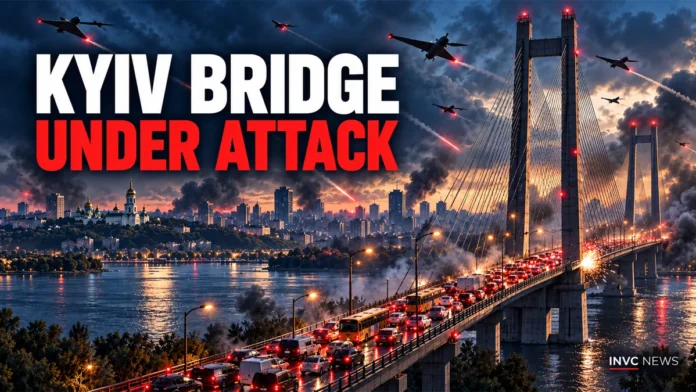
Repeated strikes shut a vital Dnipro crossing and disrupt neighboring routes, forcing commuters into gridlock as officials assess damage and reorganize traffic.
By Team INVC | INVC NEWS
KYIV, Ukraine — Getting across the Dnipro River became a major obstacle for Kyiv residents Friday as repeated Russian drone strikes shut the Southern Bridge and restrictions on other crossings pushed commuters into long traffic jams.
The attacks brought the war directly into the capital’s daily transportation network. Cars and buses backed up as residents searched for alternative ways between the eastern and western banks.
But the scale of the disruption requires a precise distinction: reporting confirms repeated strikes on the Southern Bridge and traffic restrictions affecting other crossings. It does not establish that Russian aircraft directly struck three separate bridges or that all traffic across Kyiv stopped.
One Bridge Under Repeated Attack
The Southern Bridge, also known as the Pivdennyi Bridge, came under Russian drone attack on October 1 and again on October 2, according to Kyiv officials.
Mayor Vitali Klitschko reported damage involving a bridge support, sections of the roadway and protective structures around the metro crossing. Further strikes followed while the bridge was already closed.
A closure establishes that authorities have suspended movement. It does not, by itself, establish that a bridge has collapsed or become irreparable. The extent of the damage and the conditions for reopening require an engineering assessment.
How the Restrictions Spread Across the River
Kyiv’s city administration published the following arrangements at 5:07 p.m. local time on October 2:
| Crossing | Officially reported arrangement |
| Southern Bridge | Closed to road traffic in both directions |
| Metro Bridge | Left-bank-to-right-bank traffic partially restricted during air alerts |
| Paton Bridge | Open, with right-bank-to-left-bank restrictions during air alerts |
| Northern Bridge | Operating, with right-bank-to-left-bank restrictions during air alerts |
| Podilskyi crossing | Operating in reversible mode, with right-bank-to-left-bank restrictions during air alerts |
| Darnytskyi Bridge | Right-bank-to-left-bank traffic operating in one lane |
These are the arrangements recorded in that bulletin, rather than a live guarantee of conditions on October 3.
The picture is one of severely constrained movement across several routes. It is more complex than a claim that three bridges were destroyed and the entire city stopped.
For Commuters, the Cost Is Measured in Hours
The disruption quickly became a household problem.
Tetiana Osypenko, a 49-year-old seamstress interviewed by AFP, said she had spent three hours trying to reach work while her bus remained caught in traffic. She also described lost earnings and earlier transport interruptions that had forced her to spend a night in a metro station.
Klitschko delivered a blunt assessment: “The enemy is tearing Kyiv apart.”
The bridge crisis shows how damage at one crossing can affect people far beyond the immediate strike site. Drivers diverted elsewhere compete for limited road space, while restrictions during air alerts make journey times harder to predict.
A Disruption Tactic—With Intent Still Under Scrutiny
The attacks have renewed attention to Russia’s ability to interrupt urban life by targeting transportation infrastructure.
Aviation expert and former Antonov test engineer Kostiantyn Kryvolap told the Kyiv Independent that the strikes could be intended to halt traffic, disrupt logistics and exert psychological pressure rather than demolish the bridge.
That is an expert interpretation of the attacks’ possible purpose, rather than a confirmed Russian operational plan.
Russia’s Defense Ministry said its drones had struck a Kyiv bridge and asserted that its targets served military purposes. That assertion remains Russia’s account; it does not independently establish the bridge’s military use or erase the documented civilian disruption.
The Next Test: Restoring Safe Crossings
City authorities said they were awaiting specialist assessments before deciding on further use of the Southern Bridge and the restoration of metro movement across it.
Reopening therefore involves two linked questions: whether the structure can safely carry traffic, and how officials can preserve cross-river travel under continuing attack.
For Kyiv residents, the immediate stakes are concrete: reaching work, returning home and knowing whether the route available before an air alert will still be available afterward.