By Team INVC | INVC NEWS
AHMEDABAD, India | October 2, 2026 —
India’s next big gas story may begin not in an oil field, but with agricultural waste, cattle dung and municipal garbage.
Adani Total Gas Limited is accelerating its compressed biogas strategy as India moves through a mandatory blending program designed to raise the share of CBG in specified CNG and domestic PNG consumption to 5% by FY2028-29.
For consumers, the change may happen quietly inside the gas network. For the energy industry, however, it represents something much bigger: an attempt to replace part of fossil natural gas with domestically produced renewable gas while converting waste into commercial fuel.
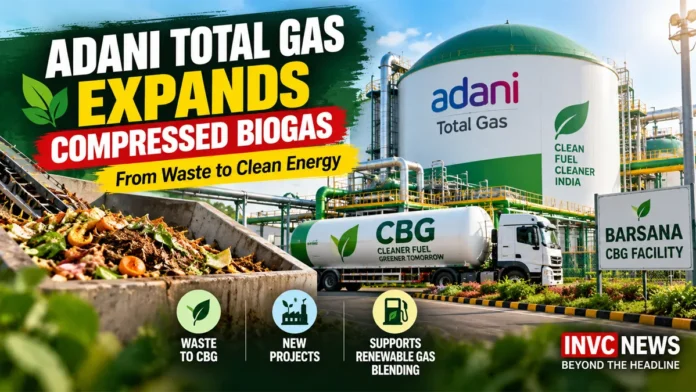
ATGL is building that opportunity through its wholly owned subsidiary, Adani TotalEnergies Biomass Limited, with projects spanning agricultural waste and municipal solid waste.
The company’s Barsana facility in Uttar Pradesh is already producing CBG, while projects in Ahmedabad and Rajkot are designed to expand its waste-to-gas pipeline.
The real question is no longer whether India wants more biogas.
It is whether companies such as ATGL can build enough reliable production capacity to meet a blending mandate that becomes progressively tougher.
THE 60-SECOND BRIEF
What is happening?
Adani Total Gas is expanding its compressed biogas business as India progressively raises mandatory CBG blending requirements.
What is the 5% target?
India’s Compressed Biogas Obligation scales toward 5% blending in specified CNG for transport and PNG for domestic use from FY2028-29.
Where does ATGL stand now?
ATGL reported CBG equivalent to 1% of relevant CNG and domestic PNG consumption in FY2025-26 and has indicated a 2% share for FY2026-27.
Where will the gas come from?
ATGL’s biomass subsidiary is developing CBG from agricultural residues and municipal solid waste.
What is its flagship project?
The Barsana biogas plant in Uttar Pradesh is ATGL’s major operational CBG project.
What comes next?
Municipal solid-waste-to-CBG projects in Ahmedabad and Rajkot form part of the company’s expansion pipeline.
Why should consumers care?
More domestic CBG could reduce reliance on conventional natural gas, turn waste into fuel and support cleaner city-gas supplies.
Why 5% Changes the Business Case
For years, compressed biogas was largely discussed as an emerging alternative fuel.
The blending mandate changes that equation.
City gas distribution companies now have a defined path for incorporating CBG into gas supplied to transport and domestic consumers.
The obligation began at 1% and progressively increases toward 5%.
That creates something every new energy industry needs:
predictable demand.
Instead of CBG producers first building plants and then searching for buyers, mandatory blending gives the sector a clearer future market.
For ATGL, which already operates a large city gas distribution business, that creates a strategic advantage.
It can participate in producing renewable gas while also operating infrastructure capable of distributing gas to consumers.
ATGL Has Already Entered the Blending Curve
ATGL’s latest annual reporting shows that its CBG business is moving beyond the planning stage.
The company reported more than 1,654 metric tons of CBG sold during FY2025-26.
Its Barsana operation achieved peak production of 7.5 tons per day during the year, with the company expecting production to ramp up further in FY2026-27.
ATGL also reported CBG equivalent to 1% of total relevant CNG transport and domestic PNG consumption during FY2025-26.
For FY2026-27, that figure is expected to rise to 2%.
Those numbers matter because the final 5% requirement cannot be met simply by announcing more plants.
The fuel has to be produced consistently, transported or injected into the appropriate network and supplied at commercial scale.
Barsana Shows How the Model Works
The Barsana project near Mathura, Uttar Pradesh, is central to ATGL’s strategy.
Unlike conventional natural gas, which originates underground, compressed biogas can be produced from organic material.
The Barsana project is designed around agricultural and organic feedstock, including materials such as cattle dung, paddy straw and press mud.
The process converts biodegradable waste into biogas. After purification and compression, the resulting CBG can perform many of the functions associated with conventional CNG.
That turns an environmental problem into an energy resource.
Crop residue and other organic waste that might otherwise require disposal can become feedstock.
The plant can produce renewable gas.
And the remaining material can support production of organic fertilizer.
That circular model is one reason CBG has become strategically attractive.
Ahmedabad and Rajkot Add the Urban-Waste Opportunity
ATGL is also pursuing a different feedstock source: city waste.
Its biomass subsidiary has secured municipal solid waste projects in Ahmedabad and Rajkot, Gujarat.
The Ahmedabad project has a planned feedstock capacity of about 500 tons per day, while Rajkot is designed around approximately 250 tons per day.
These projects are important because India’s CBG opportunity is not limited to farms.
Cities generate enormous quantities of organic municipal waste every day.
If part of that waste can be converted into usable gas, municipalities potentially gain another waste-management route while the energy system gains domestic renewable fuel.
That creates a compelling proposition:
less waste going unused, more energy produced locally.
Why Adani Total Gas Wants Its Own CBG Supply
The 5% obligation creates a practical challenge for every affected city gas distributor.
Where will enough CBG come from?
Relying entirely on third-party suppliers could expose distributors to availability, pricing and transportation risks.
ATGL’s decision to develop its own biomass platform gives it another option.
By producing CBG through Adani TotalEnergies Biomass, the company can build greater control over part of its renewable-gas supply.
That does not eliminate the need for outside producers.
But it can provide greater visibility over supply as mandatory blending percentages rise.
This Is Bigger Than an Adani Expansion Story
The significance extends beyond one company.
India imports substantial quantities of energy.
CBG offers a fundamentally different supply chain because its feedstock can originate inside the country.
Agricultural residues, cattle waste, press mud and municipal organic waste are domestic resources.
Converting those materials into gas can therefore contribute to several goals at once:
reducing waste, producing renewable fuel, supporting rural economic activity and limiting part of the demand for conventional fossil gas.
That is why CBG sits at the intersection of energy security and the circular economy.
But Scaling Biogas Is Not Easy
The opportunity is large.
So are the execution challenges.
A biogas plant needs a dependable stream of feedstock.
Agricultural waste can be seasonal.
Collection costs matter.
Transportation matters.
Moisture and feedstock quality matter.
A plant designed for hundreds of tons of daily input cannot operate efficiently if the required biomass does not arrive consistently.
Municipal waste brings another challenge: segregation.
If organic material arrives mixed with unsuitable waste, processing becomes more complicated and expensive.
Therefore, the real test for ATGL will not simply be how many projects it announces.
It will be how efficiently those projects operate at scale.
From 1% to 5%: The Hard Part Comes Later
Early blending percentages are easier to meet because the amount of renewable gas required is relatively limited.
As the mandate rises, the supply requirement increases sharply.
That means the transition from 1% to 2% is not the end of the story.
The challenge grows as the industry moves toward 5%.
More plants must operate.
Existing plants must improve utilization.
Feedstock supply chains must mature.
And the economics must remain viable for producers as well as gas distributors.
The next few years will therefore reveal whether India’s CBG industry can move from a promising clean-energy segment into a genuinely large-scale fuel market.
What This Could Mean for CNG and PNG Users
Consumers should not expect their CNG vehicles or household PNG connections to suddenly work differently because renewable gas is being blended into the system.
CBG, once appropriately purified, has characteristics that allow it to substitute for conventional natural gas in relevant applications.
The bigger change happens upstream.
A portion of the gas reaching the network can increasingly originate from renewable biological waste rather than fossil sources.
That makes the transition potentially significant even when the consumer experience remains almost unchanged.
The Investment Story Investors Should Watch
For investors, the key question is not simply whether CBG is environmentally attractive.
It is whether it can become commercially scalable.
Mandatory blending improves demand visibility.
ATGL already has city gas infrastructure and a customer base.
Its biomass subsidiary provides exposure to production.
Its CBG dispensing expansion creates another route to market.
Those pieces create an integrated strategy.
However, capital expenditure, plant utilization, feedstock costs and regulatory economics will determine whether the business ultimately generates attractive returns.
That makes production volumes and capacity utilization more meaningful than headline announcements alone.
NUMBERS THAT MATTER
5%
India’s eventual mandatory CBG blending level under the phased framework.
2%
ATGL’s reported target share of relevant CNG and domestic PNG consumption for FY2026-27.
1,654 MT
CBG sold by ATGL’s biomass business during FY2025-26.
7.5 TPD
Peak CBG production achieved at the Barsana operation during FY2025-26.
500 TPD
Planned municipal solid waste feedstock capacity for the Ahmedabad project.
250 TPD
Planned feedstock capacity for the Rajkot municipal waste project.
THE BIGGER PICTURE
India’s energy transition will not be powered by a single technology.
Solar and wind can decarbonize electricity.
Electric vehicles can reduce petroleum demand in transport.
Green hydrogen could eventually help hard-to-abate industries.
CBG addresses a different challenge.
It offers a route to make part of the gas economy renewable while simultaneously dealing with organic waste.
That is what makes ATGL’s expansion strategically interesting.
It is not simply building another source of gas.
It is betting that waste itself will become part of India’s future energy infrastructure.
WHAT HAPPENS NEXT
The numbers to watch are straightforward.
First, whether Barsana reaches its planned higher production rate.
Second, how quickly Ahmedabad and Rajkot move toward commercial operation.
Third, whether ATGL can keep increasing CBG availability as the national blending requirement rises.
And finally, whether greater scale makes renewable gas commercially competitive enough to attract substantially more investment across India.
Plant announcements will generate headlines.
Actual CBG output will determine whether the strategy works.
INVC NEWS BOTTOM LINE
Adani Total Gas is positioning itself for a regulatory change that could reshape part of India’s city gas industry.
The 5% CBG requirement is not simply an environmental target. It creates a guaranteed direction of travel for renewable gas demand.
ATGL is responding by building a supply chain that stretches from agricultural residues and municipal waste to compressed biogas and ultimately the city gas network.
If the strategy scales, its impact could extend beyond one company.
India could turn more farm and urban waste into domestic fuel, reduce part of its dependence on fossil gas and make renewable energy available through infrastructure consumers already use.
The decisive question is now execution:
Can ATGL produce enough CBG, reliably and economically, as India moves from 1% and 2% blending toward 5%?
That is the number that could turn today’s biogas expansion into a much larger energy story.