MOUNTAIN VIEW, United States | October 1, 2026 —
Google has made its biggest move yet in the latest frontier AI battle.
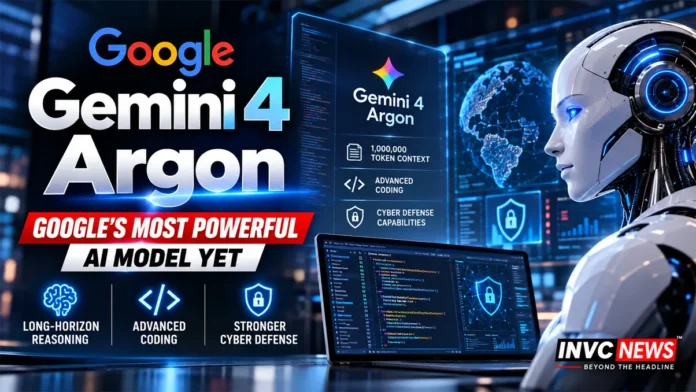
The company has unveiled Gemini 4 Argon, a new flagship artificial intelligence model designed to handle long-running software engineering jobs, complex professional work, and advanced cybersecurity tasks. But the headline number is hard to ignore: Argon can generate up to 1 million output tokens in a single run, dramatically expanding the amount of work an AI model can potentially complete before stopping.
For businesses, developers, and AI power users, however, an even bigger question matters: Does Gemini 4 Argon actually outperform OpenAI’s GPT-6 Astra and Anthropic’s leading Claude models—or does it simply look stronger on Google’s chosen benchmarks?
The early numbers make the contest much more interesting. But there is a catch: most people cannot use Argon yet.
THE 60-SECOND BRIEF
Google announced Gemini 4 Argon on September 30, 2026, positioning it as a frontier model for real-world software engineering, legal and financial knowledge work, long-horizon agentic tasks, and cyber defense.
Its standout specification is a 1 million-token maximum output, up sharply from the 64,000-token output ceiling associated with earlier Gemini models.
Google is initially providing access to selected trusted cybersecurity defenders through its Fairwind Program rather than immediately opening the model to everyone.
Google says Argon delivers frontier-level results across coding, business automation, knowledge work, and cybersecurity evaluations. Independent reporting on Google’s published results shows Argon beating major competing models on several benchmarks, although it does not lead every test.
And that distinction matters.
Gemini 4 Argon looks extremely competitive. It is too early, however, to declare one universal winner in the frontier AI race based on benchmark scores alone.
What Is Gemini 4 Argon?
Gemini 4 Argon is the first major model in Google’s new Gemini 4 generation.
Rather than focusing primarily on conversational AI, Google is pitching Argon as a model capable of sustaining reasoning across complex, long-duration workflows.
That includes writing and debugging software, completing multistep engineering assignments, analyzing professional information in areas such as law and finance, and finding security weaknesses in software.
This is an important shift.
The next stage of the AI competition is increasingly about whether a model can finish a difficult job, not simply answer a difficult question.
That puts Argon directly into the same high-end market being contested by OpenAI and Anthropic.
1 Million Output Tokens: Why This Number Matters
Argon’s most striking technical feature is its 1 million-token output limit.
Output tokens represent what the model can generate, rather than simply how much information it can read as input.
That distinction is crucial.
A very large output allowance could allow an AI system to sustain longer reasoning trajectories, generate extensive code, work through complicated engineering problems, produce large structured documents, and continue multistage agentic tasks without hitting a conventional output ceiling.
Google says the increase takes Argon from the 64,000-token output level of earlier Gemini models to 1 million tokens.
That is roughly a 15.6-fold increase.
But readers should not interpret a larger token limit as proof that every response will automatically become smarter or more accurate. Model intelligence, reasoning reliability, latency, cost, tool use, and error rates remain separate considerations.
Coding: Argon Posts a Major Benchmark Result
Software engineering is one of the most important battlegrounds for frontier AI, and Google’s published numbers put Argon among the strongest models in the field.
On DeepSWE v1.1, a software engineering benchmark, Gemini 4 Argon reportedly scored 77.9%.
Published comparisons place that result ahead of several competing frontier systems included in Google’s benchmark presentation.
That matters because coding benchmarks are moving beyond simple code generation toward longer workflows in which models must understand repositories, diagnose problems, modify code, and complete engineering tasks.
Still, benchmark results require context.
Different companies may use different model configurations, reasoning budgets, tools, test harnesses, or evaluation conditions. A lead on one benchmark therefore does not establish that a model is universally superior for every coding workload.
Cybersecurity May Be Argon’s Most Important Capability
The biggest story may not be coding at all.
It may be cyber defense.
Google says Gemini 4 Argon can work through difficult vulnerability-related tasks, including identifying critical software weaknesses and helping validate and patch them.
This capability is powerful enough that Google is taking an unusually controlled approach to deployment.
Instead of immediately releasing Argon broadly to consumers, Google is first giving access to selected trusted cyber defenders through its Fairwind Program.
The company is also participating in a U.S. government voluntary process for pre-release access as it evaluates safety and misuse risks.
The logic is straightforward: an AI system that becomes substantially better at discovering vulnerabilities could help defenders secure systems faster—but similar capabilities could create risks if misused.
That is why Argon’s restricted rollout is almost as significant as its benchmark scores.
Gemini 4 Argon vs GPT-6 Astra: The Battle Is More Complicated Than One Score
Google’s new model arrives directly into competition with OpenAI’s GPT-6 Astra, another frontier system with advanced software engineering and cybersecurity capabilities.
OpenAI describes Astra as its most capable model for demanding professional work. According to OpenAI’s published specifications, GPT-6 Astra supports a 1.05 million-token context window and a maximum output of 128,000 tokens.
Argon’s headline output ceiling is therefore dramatically larger.
But output capacity and overall model performance are not the same thing.
OpenAI reports extremely strong results for Astra in areas including computer use, science, software engineering, professional workflows, and cybersecurity.
Google’s own benchmark set, meanwhile, shows Argon ahead of major competitors on several tests, while other results remain competitive or favor rival systems.
The meaningful conclusion is therefore not that one model has already defeated the other.
It is that Google has returned to the top tier of the frontier-model competition with a system that appears capable of challenging OpenAI and Anthropic across several commercially important workloads.
And What About Anthropic’s Claude?
Anthropic remains another major player in this contest, particularly in coding and professional knowledge work.
Google’s benchmark comparisons include leading Anthropic models, and Argon performs strongly against them across several of the tests Google highlighted.
However, the same caution applies.
Benchmarks measure specific capabilities under specific conditions. Businesses choosing between Gemini, GPT, and Claude will ultimately care about factors that benchmark charts do not fully capture: reliability on their own data, tool integration, latency, security controls, context handling, API stability, and total cost.
In other words, the AI race is increasingly becoming a workload-by-workload contest, rather than a single leaderboard.
Price Could Become Google’s Second Big Weapon
Google has also revealed aggressive introductory API pricing for Argon.
The company says the model will launch at an introductory rate of:
$2 per 1 million input tokens
$10 per 1 million output tokens
Google also says cached input tokens will receive a 95% discount from the input-token price.
After the introductory period, Google says standard pricing will rise to $4 per million input tokens and $20 per million output tokens.
Google has not specified when the introductory pricing period will end.
That pricing deserves attention because frontier AI economics are becoming nearly as important as raw benchmark performance.
A model that performs exceptionally well but costs significantly more to operate may be less attractive for businesses running millions or billions of tokens through production systems.
Google Is Already Using Argon Internally
Argon is not being presented solely as a research demonstration.
Google says it is already using the model internally for engineering work, including coding, debugging, and infrastructure optimization.
That internal deployment is strategically important.
Google operates one of the world’s largest technology infrastructures. Improvements in software engineering productivity or data center efficiency can therefore translate into substantial operational benefits even before the model becomes a mass-market product.
It also gives Google a large real-world environment in which to test increasingly autonomous AI workflows.
Why Can’t Everyone Use Gemini 4 Argon Yet?
This is the most important limitation for readers excited about the announcement.
Gemini 4 Argon is not yet broadly available to ordinary Gemini users or all developers.
Google is beginning with a limited group of trusted cybersecurity defenders through Fairwind.
The company says it plans to expand access gradually as it collects feedback, strengthens guardrails, and evaluates the model through additional safety processes.
Developers, enterprises, and consumers are expected to receive broader access later, but Google has not announced a firm general-release date.
So anyone seeing claims that Gemini 4 Argon is already universally available should distinguish between announcement, limited rollout, and full public availability.
Why This Launch Matters Beyond Google
Gemini 4 Argon signals a broader change in the AI industry.
The first generation of generative AI competition centered on chatbots that could answer questions, summarize documents, and generate text.
The next phase is about AI systems capable of completing long, complicated jobs.
That includes navigating software projects, operating tools, investigating security vulnerabilities, processing huge information sets, and maintaining reasoning across workflows that may take far longer than a conventional chatbot interaction.
A 1 million-token output allowance makes Google’s direction especially clear.
The goal is no longer simply a chatbot that can say more.
It is an AI system that can potentially work longer.
What Happens Next
Three things will determine whether Gemini 4 Argon becomes a genuine turning point for Google.
First, independent developers and researchers need broad enough access to reproduce and challenge Google’s benchmark claims.
Second, real-world users need to determine whether the enormous output allowance translates into better long-horizon reliability rather than simply longer responses.
Third, Google must show that it can make advanced cyber capabilities widely useful without creating unacceptable security risks.
Until then, the benchmark numbers are important—but real-world deployment will be the tougher test.
INVC NEWS Bottom Line
Gemini 4 Argon is not simply another Gemini upgrade. It represents Google’s push toward AI models that can stay on complex tasks longer, perform serious software engineering work, and operate in cybersecurity environments where mistakes carry real consequences.
Its 1 million-token output limit, strong published coding and cyber results, and aggressive introductory pricing make it one of the most consequential frontier-model announcements of 2026.
But the biggest test is still ahead.
Google has shown what Argon can do on its published evaluations. Now it must prove those advantages when developers, businesses, and eventually consumers can test the model at scale.
The battle with GPT-6 Astra and Claude will not be settled by a launch-day benchmark chart. It will be settled by which model can reliably complete the hardest real-world work at the best combination of accuracy, safety, speed, and cost.